
Last letters from the living dead man
David Patterson (Spirit) Hatch
THE CLASSIC COLLECTION · 1778
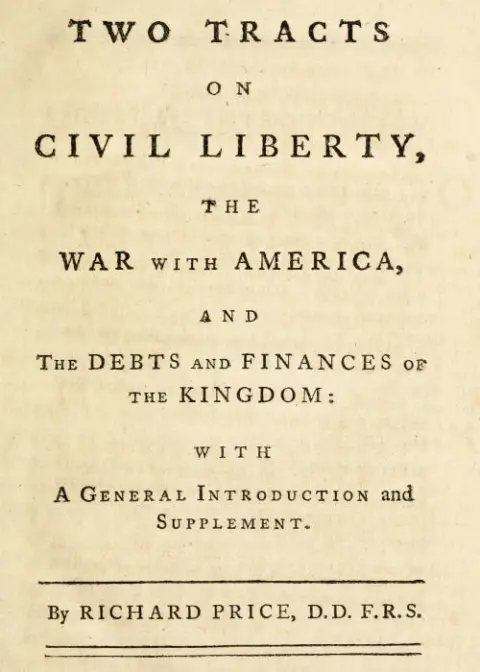
"Two Tracts on Civil Liberty, the War with America, and the Debts and Finances of the Kingdom" by Richard Price is a historical treatise written in the late 18th century. The work comprises two tracts that explore the concepts of civil liberty and the implications of the American War for Independence, as well as the financial implications of these issues for Britain. Price delves into the philosophical underpinnings of government and the nature of liberty, emphasizing the importance of representation and consent within a just society. The opening of this treatise presents an introduction to the fundamental arguments for civil liberty that Price aims to make. He contrasts two competing views of government: one that establishes authority through the people's consent and another that derives authority from divine right. Price articulates his belief that legitimate government must be founded on the principles of freedom and equality, where laws are a reflection of the collective will. Furthermore, he addresses the growing tensions between Britain and America, arguing that the rights and liberties of the American colonies must be acknowledged, warning that attempts to subjugate them could lead to a broader conflict that undermines the values of civil liberty he cherishes. The matters discussed set the stage for his detailed exploration of political philosophy and practical governance as the historical context unfolds.
Introduction adapted from the source catalogue; source summaries may be automatically generated.
Free to read · English · 84,822 words · No account needed
MAKE TIME FOR A GOOD BOOK
On by default. Untick to stop anonymous reading totals. Each page counts after 10 seconds in view. How this works.
Anonymous counting is on unless you have switched it off.
NOTE (6)—CONSOLIDATED 3 per cent. BANK ANNUITIES. See page 121.—The capital of these annuities is made a distinct stock from that of the annuities called Reduced, because it never bore a higher interest than 3 per cent.—It consisted originally of the following loans—37,821l. remaining in 1727, of 3 per cent. annuities, granted in lieu of St. Christopher’s and Nevis debentures—800,000l. borrowed in 1731—600,000l. borrowed in 1736—300,000l. in 1738—6.400,000l. in 1742, 1743, 1744 and 1745, and charged on additional duties on spirituous liquors, wines, vinegar, &c.—1.000,000l. borrowed in 1750—24.490,000l. borrowed in the course of the last war, and funded on the additional duties on beer, houses, stamps, &c.—4.900,000l. borrowed in 1766, 1767 and 1768—And 1.253,700l. of the 4 per cent. annuities, subscribed into the 3 per cent. annuities in 1770.
All these loans were by 25 Geo. II. 1751, and several subsequent Acts of Parliament, consolidated into one joint stock; and carried, with the duties for paying the interest, to the Sinking Fund. And in 1770, they formed a capital of 39.781,521l. which has been since reduced, by the payments mentioned in the Postscript at the end of this tract, to the sum specified in the account to which this note refers.—See a more full account in Mr. Ashmore’s Analysis, &c. from page 5 to page 11.
NOTE (7)—REDUCED 3 per cent. BANK ANNUITIES. See page 121.—The capital of these annuities consisted, in 1749, of loans in 1746, 1747, and 1748, and navy, ordnance and transport debts funded in 1749, amounting to 18.402,472l. and all bearing 4 per cent. interest.—By the 23d of Geo. II. 1749, these loans were reduced to an interest of 3 per cent. and by the great consolidating Act in 1751, they were converted into one stock, and carried into the Sinking Fund with the duties on carriages, and the additional duties on glass, spirituous liquors, houses, windows, stamps, merchandize imported, &c. which had been granted for paying the interest.—In 1751, certain exchequer tallies and orders, amounting to 129,750l. were subscribed into this stock; and in 1765, navy bills to the amount of 1,482,000l. were subscribed into it, which made its whole original amount 20.014.222l.—In 1751, there was paid off 830,898l. being stock which had not been subscribed agreeably to the Act in 1749 for reducing interest; and in 1772, 1774, and 1775, so much more of this stock was paid off as reduced it to its present amount.—See Mr. Ashmore’s Analysis, p. 12-16.
NOTE (8)—CIVIL LIST MILLION. See page 121.—The income settled upon King George I. for his civil list, was 700,000l.—In 1720, there had been granted him besides, from the Royal Exchange and London Assurance companies, 300,000l. And in 1726, this million was farther granted towards paying off his debts.
Your reading position is saved on this browser. Take it to another device with a library code. Reading pages adapt to text, rather than matching a printed edition.
BEHIND THE BOOK
This eBook is for the use of anyone anywhere in the United States and most other parts of the world at no cost and with almost no restrictions whatsoever. You may copy it, give it away or re-use it under the terms of the Project Gutenberg License included with this eBook or online at www.gutenberg.org. If you are not located in the United States, you will have to check the laws of the country where you are located before using this eBook. Read the source licence.
The original source file, including credits and licence, is retained by this library. Request an original-format copy at no charge. Please include the book title and Project Gutenberg identifier #57970.
KEEP YOUR CURIOSITY GOING
David Patterson (Spirit) Hatch
Cécile Tormay

Moritz Busch
Coulson Kernahan
John L. Ransom

Ralph Waldo Emerson