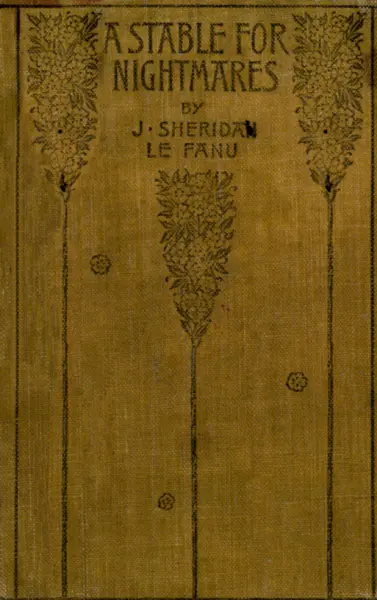
A Stable for Nightmares; or, Weird Tales
Joseph Sheridan Le Fanu & Charles L. (Charles Lawrence), Sir Young
THE CLASSIC COLLECTION · 1836
"Two Ghostly Mysteries" by Joseph Sheridan Le Fanu is a collection of two supernatural stories written during the mid-19th century. The first tale, "A Chapter in the History of a Tyrone Family", revolves around a tragic narrative centered on family and loss, featuring the protagonist's emotional turmoil following the death of her sister. The second story, "The Murdered Cousin", focuses on themes of suspicion and intrigue within a family, likely revealing dark secrets connected to a gruesome murder. At the start of the collection, the story "A Chapter in the History" introduces the narrator, Fanny Richardson, who recounts her childhood in a wealthy yet emotionally cold family. Following her sister's marriage and subsequent death, Fanny grapples with feelings of neglect from her parents and the overwhelming loneliness that ensues. As the story unfolds, the tension builds around the mystery of her sister's death and the haunting events that accompany it. The opening sections set the stage for a tale steeped in themes of loss, familial duty, and the eerie presence of the supernatural, leading readers to anticipate a rich exploration of the impact of such dark occurrences on the human psyche.
Introduction adapted from the source catalogue; source summaries may be automatically generated.
Free to read · English · 27,919 words · No account needed
MAKE TIME FOR A GOOD BOOK
On by default. Untick to stop anonymous reading totals. Each page counts after 10 seconds in view. How this works.
Anonymous counting is on unless you have switched it off.
"You had no interruption from the next room?" said my uncle.
"No," was the brief reply.
"Secure the jewels, Ned; the French harpy must not lay her claws upon them. You're a steady hand, by G--d; not much blood--eh?"
"Not twenty drops," replied his son, "and those on the quilt."
"I'm glad it's over," whispered my uncle again; "we must lift the--the thing through the window, and lay the rubbish over it."
They then turned to the bedside, and, winding the bed-clothes round the body, carried it between them slowly to the window, and exchanging a few brief words with some one below, they shoved it over the window-sill, and I heard it fall heavily on the ground underneath.
"I'll take the jewels," said my uncle; "there are two caskets in the
lower drawer."
He proceeded, with an accuracy which, had I been more at ease, would have furnished me with matter of astonishment, to lay his hand upon the very spot where my jewels lay; and having possessed himself of them, he called to his son:--
"Is the rope made fast above?"
"I'm no fool; to be sure it is," replied he.
They then lowered themselves from the window; and I rose lightly and cautiously, scarcely daring to breathe, from my place of concealment, and was creeping towards the door, when I heard my uncle's voice, in a sharp whisper, exclaim, "Get up again; G--d d--n you, you've forgot to lock the room door"; and I perceived, by the straining of the rope which hung from above, that the mandate was instantly obeyed. Not a second was to be lost. I passed through the door, which was only closed, and moved as rapidly as I could, consistently with stillness, along the lobby. Before I had gone many yards, I heard the door through which I had just passed roughly locked on the inside. I glided down the stairs in terror, lest, at every corner, I should meet the murderer or one of his accomplices. I reached the hall, and listened, for a moment, to ascertain whether all was silent around. No sound was audible; the parlour windows opened on the park, and through one of them I might, I thought, easily effect my escape. Accordingly, I hastily entered; but, to my consternation, a candle was burning in the room, and by its light I saw a figure seated at the dinner-table, upon which lay glasses, bottles, and the other accompaniments of a drinking party. Two or three chairs were placed about the table, irregularly, as if hastily abandoned by their occupants. A single glance satisfied me that the figure was that of my French attendant. She was fast asleep, having, probably, drank deeply. There was something malignant and ghastly in the calmness of this bad woman's features, dimly illuminated as they were by the flickering blaze of the candle. A knife lay upon the table, and the terrible thought struck me--"Should I kill this sleeping accomplice in the guilt of the murderer, and thus secure my retreat?" Nothing could be easier; it was but to draw the blade across her throat, the work of a second.
Your reading position is saved on this browser. Take it to another device with a library code. Reading pages adapt to text, rather than matching a printed edition.
Joseph Sheridan Le Fanu & Charles L. (Charles Lawrence), Sir Young
Joseph Sheridan Le Fanu
Joseph Sheridan Le Fanu
Joseph Sheridan Le Fanu
BEHIND THE BOOK
This eBook is for the use of anyone anywhere in the United States and most other parts of the world at no cost and with almost no restrictions whatsoever. You may copy it, give it away or re-use it under the terms of the Project Gutenberg License included with this eBook or online at www.gutenberg.org. If you are not located in the United States, you will have to check the laws of the country where you are located before using this eBook. Read the source licence.
The original source file, including credits and licence, is retained by this library. Request an original-format copy at no charge. Please include the book title and Project Gutenberg identifier #12828.
KEEP YOUR CURIOSITY GOING
Coulson Kernahan

Maurice Baring
Frances Wright
Cécile Tormay
Francis Greenleaf Allinson & Anne C. E. (Anne Crosby Emery) Allinson

Frederic Jesup Stimson