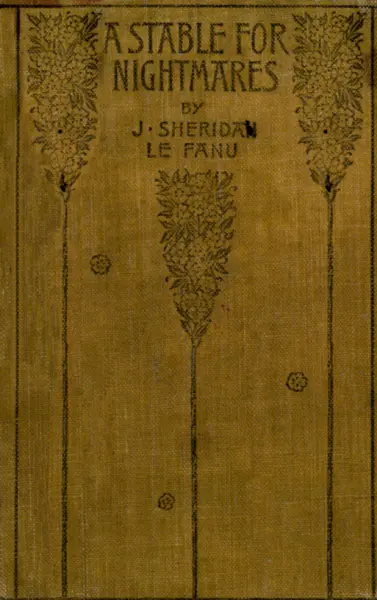
A Stable for Nightmares; or, Weird Tales
Joseph Sheridan Le Fanu & Charles L. (Charles Lawrence), Sir Young
THE CLASSIC COLLECTION · 1836
"Two Ghostly Mysteries" by Joseph Sheridan Le Fanu is a collection of two supernatural stories written during the mid-19th century. The first tale, "A Chapter in the History of a Tyrone Family", revolves around a tragic narrative centered on family and loss, featuring the protagonist's emotional turmoil following the death of her sister. The second story, "The Murdered Cousin", focuses on themes of suspicion and intrigue within a family, likely revealing dark secrets connected to a gruesome murder. At the start of the collection, the story "A Chapter in the History" introduces the narrator, Fanny Richardson, who recounts her childhood in a wealthy yet emotionally cold family. Following her sister's marriage and subsequent death, Fanny grapples with feelings of neglect from her parents and the overwhelming loneliness that ensues. As the story unfolds, the tension builds around the mystery of her sister's death and the haunting events that accompany it. The opening sections set the stage for a tale steeped in themes of loss, familial duty, and the eerie presence of the supernatural, leading readers to anticipate a rich exploration of the impact of such dark occurrences on the human psyche.
Introduction adapted from the source catalogue; source summaries may be automatically generated.
Free to read · English · 27,919 words · No account needed
MAKE TIME FOR A GOOD BOOK
On by default. Untick to stop anonymous reading totals. Each page counts after 10 seconds in view. How this works.
Anonymous counting is on unless you have switched it off.
The paroxysm passed away. I prayed once more with the bitter, agonised fervour of one who feels that the hour of death is present and inevitable. When I arose, I went once more to the window and looked out, just in time to see a shadowy figure glide stealthily along the wall. The task was finished. The catastrophe of the tragedy must soon be accomplished. I determined now to defend my life to the last; and that I might be able to do so with some effect, I searched the room for something which might serve as a weapon; but either through accident, or else in anticipation of such a possibility, every thing which might have been made available for such a purpose had been removed.
I must then die tamely and without an effort to defend myself. A thought suddenly struck me; might it not be possible to escape through the door, which the assassin must open in order to enter the room? I resolved to make the attempt. I felt assured that the door through which ingress to the room would be effected was that which opened upon the lobby. It was the more direct way, besides being, for obvious reasons, less liable to interruption than the other. I resolved, then, to place myself behind a projection of the wall, the shadow would serve fully to conceal me, and when the door should be opened, and before they should have discovered the identity of the occupant of the bed, to creep noiselessly from the room, and then to trust to Providence for escape. In order to facilitate this scheme, I removed all the lumber which I had heaped against the door; and I had nearly completed my arrangements, when I perceived the room suddenly darkened, by the close approach of some shadowy object to the window. On turning my eyes in that direction, I observed at the top of the casement, as if suspended from above, first the feet, then the legs, then the body, and at length the whole figure of a man present itself. It was Edward Tyrrell. He appeared to be guiding his descent so as to bring his feet upon the centre of the stone block which occupied the lower part of the window; and having secured his footing upon this, he kneeled down and began to gaze into the room. As the moon was gleaming into the chamber, and the bed-curtains were drawn, he was able to distinguish the bed itself and its contents. He appeared satisfied with his scrutiny, for he looked up and made a sign with his hand. He then applied his hands to the window-frame, which must have been ingeniously contrived for the purpose, for with apparently no resistance the whole frame, containing casement and all, slipped from its position in the wall, and was by him lowered into the room. The cold night wind waved the bed-curtains, and he paused for a moment; all was still again, and he stepped in upon the floor of the room. He held in his hand what appeared to be a steel instrument, shaped something like a long hammer. This he held rather behind him, while, with three long, tip-toe strides, he brought himself to the bedside. I felt that the discovery must now be made, and held my breath in momentary expectation of the execration in which he would vent his surprise and disappointment. I closed my eyes; there was a pause, but it was a short one. I heard two dull blows, given in rapid succession; a quivering sigh, and the long-drawn, heavy breathing of the sleeper was for ever suspended. I unclosed my eyes, and saw the murderer fling the quilt across the head of his victim; he then, with the instrument of death still in his hand, proceeded to the lobby-door, upon which he tapped sharply twice or thrice. A quick step was then heard approaching, and a voice whispered something from without. Edward answered, with a kind of shuddering chuckle, "Her ladyship is past complaining; unlock the door, in the devil's name, unless you're afraid to come in, and help me to lift her out of the window." The key was turned in the lock, the door opened, and my uncle entered the room. I have told you already that I had placed myself under the shade of a projection of the wall, close to the door. I had instinctively shrunk down cowering towards the ground on the entrance of Edward through the window. When my uncle entered the room, he and his son both stood so very close to me that his hand was every moment upon the point of touching my face. I held my breath, and remained motionless as death.
Your reading position is saved on this browser. Take it to another device with a library code. Reading pages adapt to text, rather than matching a printed edition.
Joseph Sheridan Le Fanu & Charles L. (Charles Lawrence), Sir Young
Joseph Sheridan Le Fanu
Joseph Sheridan Le Fanu
Joseph Sheridan Le Fanu
BEHIND THE BOOK
This eBook is for the use of anyone anywhere in the United States and most other parts of the world at no cost and with almost no restrictions whatsoever. You may copy it, give it away or re-use it under the terms of the Project Gutenberg License included with this eBook or online at www.gutenberg.org. If you are not located in the United States, you will have to check the laws of the country where you are located before using this eBook. Read the source licence.
The original source file, including credits and licence, is retained by this library. Request an original-format copy at no charge. Please include the book title and Project Gutenberg identifier #12828.
KEEP YOUR CURIOSITY GOING
Coulson Kernahan

Maurice Baring
Frances Wright
Cécile Tormay
Francis Greenleaf Allinson & Anne C. E. (Anne Crosby Emery) Allinson

Frederic Jesup Stimson