Walled In: A True Story of Randall’s Island
William O. Stoddard
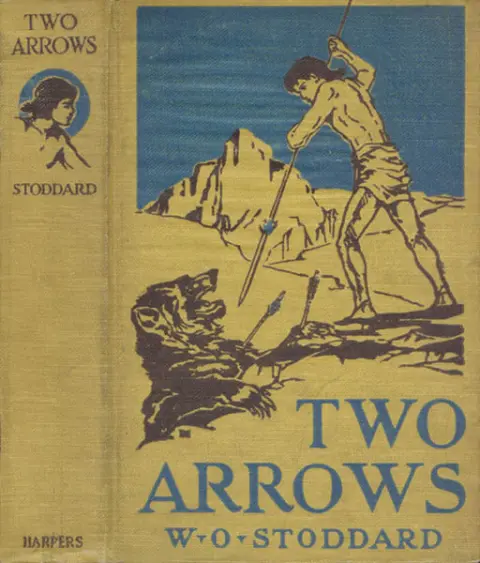
THE CLASSIC COLLECTION · 1886
"Two Arrows: A Story of Red and White" by William O. Stoddard is a historical novel written in the late 19th century. The narrative centers on the challenges and adventures of a young Nez Percé boy named Two Arrows, who embarks on a journey of survival and self-discovery against the backdrop of the American frontier. As desperate circumstances unfold, readers are introduced to the dramatic world of Native American life during a time of strife and conflict. The opening of the story sets the stage with a vivid description of a Nez Percé camp experiencing dire starvation after failed hunts and a locust invasion. The stark imagery portrays the desolate conditions faced by the tribe, emphasizing their struggle for survival. Among them is Two Arrows, a young boy with unyielding determination and spirit. As he embarks on a solo quest for food, he showcases both bravery and skill, witnessing wildlife and honing his abilities while ultimately discovering a level of autonomy and strength. Throughout this beginning, themes of resilience, belonging, and the harsh realities of life on the plains are introduced, promising a gripping adventure ahead as the young hero seeks to prove himself amidst adversity.
Introduction adapted from the source catalogue; source summaries may be automatically generated.
Free to read · English · 56,059 words · No account needed
MAKE TIME FOR A GOOD BOOK
On by default. Untick to stop anonymous reading totals. Each page counts after 10 seconds in view. How this works.
Anonymous counting is on unless you have switched it off.
Leaning over the upper log of the barrier, rifle in hand, and peering out upon the starlit slope beyond him, stood the form of Jonas, the miner. Not a sound came to him from the mists and shadows of the valley, and he was just remarking, aloud,
"It's as quiet as a cornfield," when a voice at his elbow explained,
"Hist! Ha-ha-pah-no--sh-sh!" and Na-tee-kah dropped upon the ground, and pressed her little round ear against it. So, almost instantly, did Ha-ha-pah-no, and he heard Sile saying,
"Their ears are better than yours or mine if they can hear anything."
"Didn't know there was one of ye nigh me," said Jonas. "That's the way for a feller to lose his hair--looking too hard in one direction while somebody comes up behind him. No, Sile, I haven't heerd a thing."
Na-tee-kah sprang to her feet.
"Horse come. Ugh!" and she held up her hand for silence, while Ha-ha-pah-no also arose, listening intently.
"Indian ears for it," said Jonas. "'Pears to me I can hear something now
myself."
"I can't, then," said another voice. It was that of a sleepy miner, who had waked up to follow Sile, just as he had been awakened by even the noiseless movements of the squaws.
"Hark!" exclaimed Jonas.
It was the sound of galloping, and then a shrill whoop.
"Two Arrows!" screamed Na-tee-kah. "'Pache get him!"
Jonas had already thrown down the logs of wood in the opening, and now
he shouted,
"Rifles, boys! Ready!"
There was a great shout from the bivouac behind them, but it seemed almost no time before a pony and his rider dashed into dim view before them, followed by a larger shadow, from which came whoop after whoop.
"Take the hind one. Give it to him," shouted Jonas, as a streak of fire sprang from his own rifle-muzzle. Two other shots followed, as if there were any chance of hitting a galloping horseman in such a half darkness as that. Hit or no hit, one Apache warrior was so utterly astounded that he drew rein, all but throwing his horse upon his haunches, and the pony-rider he was pursuing wheeled sharply to the right. Half a minute later and all would have been over with Two Arrows, in all probability, but, as matters had now turned, it was his enemy who had made a blunder. He sat for several precious seconds almost motionless, although not a shot had touched him, and by so doing he put himself up for a target at very short arrow range. The next instant he was dashing wildly away into the darkness, for the horse had an arrow in his flank to spur him, and the brave himself had a similar token of the skill of Two Arrows projecting from his right thigh.
Your reading position is saved on this browser. Take it to another device with a library code. Reading pages adapt to text, rather than matching a printed edition.
William O. Stoddard
William O. Stoddard
William O. Stoddard
William O. Stoddard
BEHIND THE BOOK
This eBook is for the use of anyone anywhere in the United States and most other parts of the world at no cost and with almost no restrictions whatsoever. You may copy it, give it away or re-use it under the terms of the Project Gutenberg License included with this eBook or online at www.gutenberg.org. If you are not located in the United States, you will have to check the laws of the country where you are located before using this eBook. Read the source licence.
The original source file, including credits and licence, is retained by this library. Request an original-format copy at no charge. Please include the book title and Project Gutenberg identifier #29616.
KEEP YOUR CURIOSITY GOING
Cécile Tormay

Moritz Busch
Coulson Kernahan
John L. Ransom

Maurice Baring
Frances Wright