THE CLASSIC COLLECTION✦An outlaw’s diary: the CommuneCLASSIC FREE BOOKS
An outlaw’s diary: the Commune
Cécile Tormay
THE CLASSIC COLLECTION · 1878
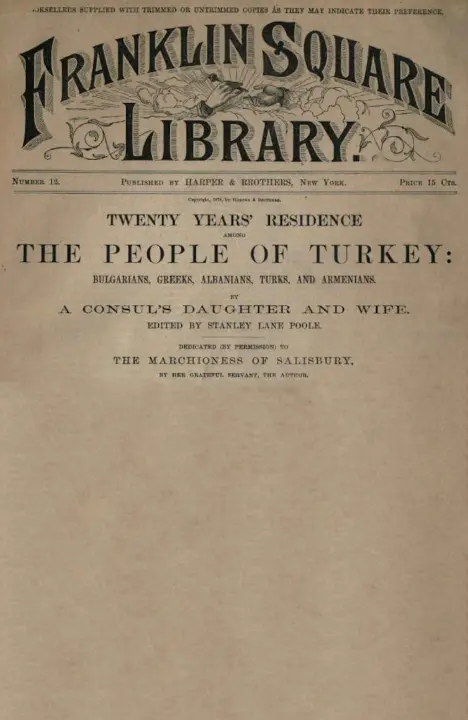
"Twenty Years' Residence among the People of Turkey: Bulgarians, Greeks, Albanians, Turks, and Armenians" is a historical account published in the late 19th century, edited by Stanley Lane Poole. The book provides a detailed examination of various ethnic groups in Turkey, particularly focusing on their social conditions, customs, and national characteristics. It is written from the perspective of an Englishwoman who has spent two decades observing and interacting with these communities, highlighting the nuances of their lives and the complex relationships between them. At the start of the work, the author discusses the lack of authoritative and comprehensive information regarding the Eastern Question, emphasizing the need for a reliable source that captures the diverse conditions of the people living under Ottoman rule. The preface elaborates on her extensive experiences in various provinces of Turkey, setting the tone for a nuanced exploration of the ethnic identities of Bulgarians, Greeks, and Turks, among others. The opening portion introduces us to the complicated historical context of the Bulgarians, detailing their struggles under Ottoman oppression, societal dynamics, and the development of their national identity while contrasting their experiences with those of other groups in the region.
Introduction adapted from the source catalogue; source summaries may be automatically generated.
Free to read · English · 151,574 words · No account needed
MAKE TIME FOR A GOOD BOOK
On by default. Untick to stop anonymous reading totals. Each page counts after 10 seconds in view. How this works.
Anonymous counting is on unless you have switched it off.
[1] Leromenos signifies soiled, which among the Greeks is the highest title of a brigand bravo, evinced in the filth of his long-worn and unwashed fustanella.
[2] “Brigand Albanian!” “Bath-boy!”
[3] “Very well, we shall see, it may be done.”
[4] Turkish ethnology divides the human race into seventy-seven and a half nations, the Jews representing the half, and the gypsies being entirely excluded. This is clearly an improvement upon Mohammed’s estimate of the number of different sects in Islam, etc.
[5] In August, 1875, the law of inheritance on vakouf lands was modified
and improved.
[6] Boghcha, bundle.
[7] Leyen, basin.
[8] Ibrik, jug.
[9] Pastes for soup and pilaf.
[10] Molasses made from grapes.
[11] Preserves made with molasses from fresh or dried fruits.
[12] Starch made from wheat, much used for making sweets.
[13] “How do you do?”
[14] “Valley-lord,” or feudal chief.
[15] Generally a European, who often attains to high rank and fortune.
[16] In polite language, “child of unknown paternity.”
[17] A few years ago the mother of Sultan Abdul-Aziz, desirous of further reducing this number, brought forward an old palace regulation, that every seraglio woman found enceinte should be subjected to the operation of artificial abortion, with the exception of the first four wives.
[18] Under-superintendent of the harem.
[19] Should the father be unacquainted with the form of prayer, an Imam is called in, who reads the prayer over the infant, outside the door.
[20] Old women, whose mission it is to be the bearer of invitations to
all ceremonies.
[21] Wonderful! Let it be long-lived and happy!
[22] The Italian expression “Multi Saluti” is the nearest approach to a correct interpretation of this word.
[23] “Baron” signifies Mr.
[24] Wonderful!
[25] Giving rise to the Greek saying of “καμαρώνει σά νύμφἤ.”
[26] The best man and head bridesmaid, whose duty it is subsequently to be the godfather and godmother of the children: see p. 40.
[27] The following is a translation of this distich:—
“O Maldever! O Stardever! why do you wait outside? Dismount thy steed and enter thy husband’s house, O bride!”
[28] These crosses are of three classes, and range in value from 100 to 500 piastres—14s. to 3l. 10s.
[29] Blind or lame, is he or she acceptable?
[30] Sourah lvii. v. 19.
[31] Sourah xxxv. v. 44.
[32] Sourah ii. v. 275.
[33] The evil being is supposed to be of immense size, his upper lip touching heaven, and his lower earth; and he holds in his hand a huge iron cudgel.
[34] In some inland towns the relations continue to chant the Myriologia all the way to the church, and afterwards to the burial-ground.
Your reading position is saved on this browser. Take it to another device with a library code. Reading pages adapt to text, rather than matching a printed edition.
BEHIND THE BOOK
This eBook is for the use of anyone anywhere in the United States and most other parts of the world at no cost and with almost no restrictions whatsoever. You may copy it, give it away or re-use it under the terms of the Project Gutenberg License included with this eBook or online at www.gutenberg.org. If you are not located in the United States, you will have to check the laws of the country where you are located before using this eBook. Read the source licence.
The original source file, including credits and licence, is retained by this library. Request an original-format copy at no charge. Please include the book title and Project Gutenberg identifier #67626.
KEEP YOUR CURIOSITY GOING
Cécile Tormay

Moritz Busch
John L. Ransom
Frances Wright
Cécile Tormay

Mabel Potter Daggett