THE CLASSIC COLLECTION✦An outlaw’s diary: the CommuneCLASSIC FREE BOOKS
An outlaw’s diary: the Commune
Cécile Tormay
THE CLASSIC COLLECTION · 1878
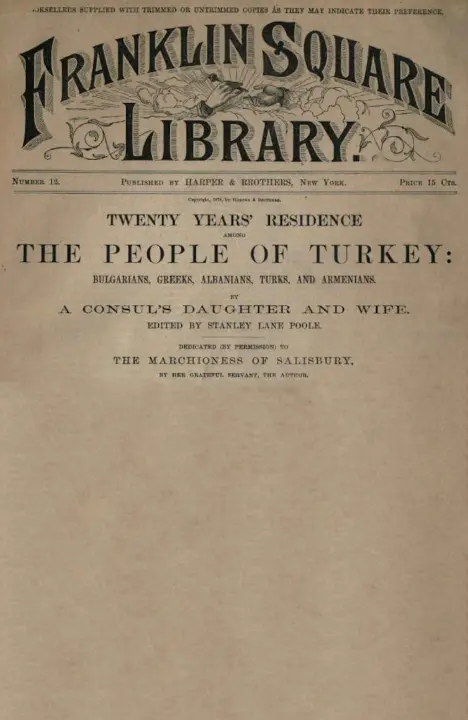
"Twenty Years' Residence among the People of Turkey: Bulgarians, Greeks, Albanians, Turks, and Armenians" is a historical account published in the late 19th century, edited by Stanley Lane Poole. The book provides a detailed examination of various ethnic groups in Turkey, particularly focusing on their social conditions, customs, and national characteristics. It is written from the perspective of an Englishwoman who has spent two decades observing and interacting with these communities, highlighting the nuances of their lives and the complex relationships between them. At the start of the work, the author discusses the lack of authoritative and comprehensive information regarding the Eastern Question, emphasizing the need for a reliable source that captures the diverse conditions of the people living under Ottoman rule. The preface elaborates on her extensive experiences in various provinces of Turkey, setting the tone for a nuanced exploration of the ethnic identities of Bulgarians, Greeks, and Turks, among others. The opening portion introduces us to the complicated historical context of the Bulgarians, detailing their struggles under Ottoman oppression, societal dynamics, and the development of their national identity while contrasting their experiences with those of other groups in the region.
Introduction adapted from the source catalogue; source summaries may be automatically generated.
Free to read · English · 151,574 words · No account needed
MAKE TIME FOR A GOOD BOOK
On by default. Untick to stop anonymous reading totals. Each page counts after 10 seconds in view. How this works.
Anonymous counting is on unless you have switched it off.
The Turkish Conquest and Greek Schools—Monasteries almost the sole Preservers of Letters—Movement of the last Half-Century—Athenian Teaching and Its Influence on Turkey—Education of the Greeks at Constantinople—Μνημόσυνα—Salonika Girls’ Schools—Boys’ Schools—A Greek School based upon Mr. Herbert Spencer—The Past and the Present of the Greeks—Bulgarian Ignorance—Birth of a Desire for Knowledge—A Report from a Bulgarian Young Lady—The First Bulgarian Book—Bulgarian Authors—Schools—Church Supervision—Loyalty to the Sultan—Bulgarian Language—Schoolmasters and their Reforming Influence—Bulgarian Intelligence—American Missionaries.
It was not to be expected that the immense progress made by Greece during the past half century in education would exercise no influence upon the Greeks in Turkey. The people of the kingdom of Greece, secure of their own freedom, released from that servile condition to which centuries of oppressive misrule had reduced them, and become citizens of a liberty-loving country, have for the past twenty years been using every effort to promote the cause of liberty by the spread of education among their brethren still in subjection to the Porte. When the Turks conquered the Greek provinces, they did their best to extinguish education among their Christian subjects: the Greek schools were suppressed, new ones prohibited, and the Greek children had to be taught during the night.[36] But the monasteries, nests of ignorance and vice as they were, were the principal refuges of letters. Scattered all over the empire, they enjoyed the privileges drawn from the special liberty and favor granted by the wise Sultan to the Greek clergy. This was done by the Sultan with the view of acquiring unlimited control over the Greek rayahs, by giving a just sufficient amount of power to a small but influential body of men, to induce them to support his designs. Mount Athos, one of these privileged asylums, became a famous resort of the retired clergy. A college of some merit was also established on this monastic spot for affording secular instruction to Greek youths. At Phanar, the secluded refuge of the Greek noblesse, in right of their privileges, education among the higher classes was promoted. For a long time this was the only place Constantinople could boast as supplying men of letters, some of whom, being conversant with foreign languages, were employed in European embassies as interpreters. Within the last fifty years the educational movement among the Greeks of Turkey has altered its course. Some schools established in the country afforded elementary instruction to the children, but, for the most part, they were now sent to Athens and Syra to complete their studies, where numerous schools and colleges afforded them the means of acquiring a perfect knowledge of their own language and a tolerably good general education. This migration, perseveringly continued for nearly thirty years, increased the number of these Athenian and Syraote establishments, and the pecuniary benefit they derived from it enabled them to perfect their organization. Politics and learning were two essential elements of education, which the modern Greeks uphold with a tenacity worthy of final success. The young Greek rayah, sent to Athens, returns to his home a scholar and a staunch Philhellene, burning with an all-absorbing desire to instil his ideas and feelings into the minds of his fellow rayahs. Such currents flow slowly but surely among a population that, debased as it may be by a foreign yoke, has a history and literature of its own to look back to. The first students returning from Greece were the pioneers of the immense progress that education has lately made among the Greeks in Turkey. None can realize and testify to this better than those who have watched its introduction and development in the interior. As I stated in another part of this work, even the élite of the Greek society of Broussa thirty years ago had lost the use of their mother-tongue, replacing it by broken Turkish. Since then, the introduction of schools has been the means of restoring the use of their own language to the great majority of the people, though one portion of the town is still ignorant of it, in consequence of the profitable occupation the silk factories afford to girls, who are sent there from a very early age, instead of going to school. The inhabitants of the surrounding villages, in all of which Greek schools have now been established, have learnt their national language—a proof that although the general attention of the Greeks has naturally first been directed to promoting education in Thessaly, Macedonia, and Epirus, the scattered colonies left on the Asiatic side have not been altogether forgotten or neglected; they have now good colleges in Smyrna, and schools in less important towns and villages.
Your reading position is saved on this browser. Take it to another device with a library code. Reading pages adapt to text, rather than matching a printed edition.
BEHIND THE BOOK
This eBook is for the use of anyone anywhere in the United States and most other parts of the world at no cost and with almost no restrictions whatsoever. You may copy it, give it away or re-use it under the terms of the Project Gutenberg License included with this eBook or online at www.gutenberg.org. If you are not located in the United States, you will have to check the laws of the country where you are located before using this eBook. Read the source licence.
The original source file, including credits and licence, is retained by this library. Request an original-format copy at no charge. Please include the book title and Project Gutenberg identifier #67626.
KEEP YOUR CURIOSITY GOING
Cécile Tormay

Moritz Busch
John L. Ransom
Frances Wright
Cécile Tormay

Mabel Potter Daggett