THE CLASSIC COLLECTION✦An outlaw’s diary: the CommuneCLASSIC FREE BOOKS
An outlaw’s diary: the Commune
Cécile Tormay
THE CLASSIC COLLECTION · 1878
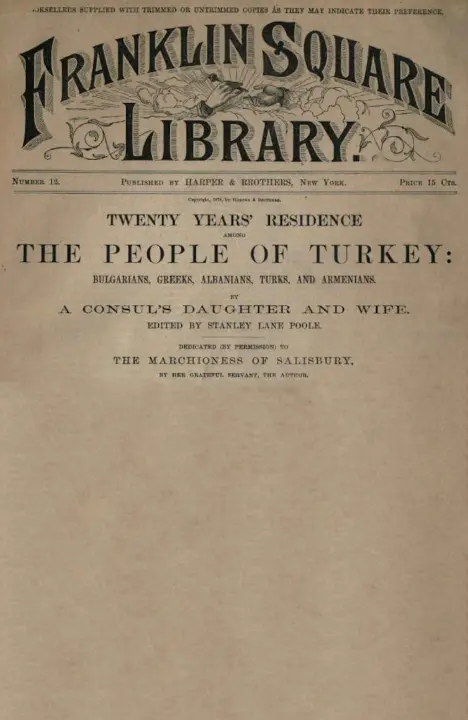
"Twenty Years' Residence among the People of Turkey: Bulgarians, Greeks, Albanians, Turks, and Armenians" is a historical account published in the late 19th century, edited by Stanley Lane Poole. The book provides a detailed examination of various ethnic groups in Turkey, particularly focusing on their social conditions, customs, and national characteristics. It is written from the perspective of an Englishwoman who has spent two decades observing and interacting with these communities, highlighting the nuances of their lives and the complex relationships between them. At the start of the work, the author discusses the lack of authoritative and comprehensive information regarding the Eastern Question, emphasizing the need for a reliable source that captures the diverse conditions of the people living under Ottoman rule. The preface elaborates on her extensive experiences in various provinces of Turkey, setting the tone for a nuanced exploration of the ethnic identities of Bulgarians, Greeks, and Turks, among others. The opening portion introduces us to the complicated historical context of the Bulgarians, detailing their struggles under Ottoman oppression, societal dynamics, and the development of their national identity while contrasting their experiences with those of other groups in the region.
Introduction adapted from the source catalogue; source summaries may be automatically generated.
Free to read · English · 151,574 words · No account needed
MAKE TIME FOR A GOOD BOOK
On by default. Untick to stop anonymous reading totals. Each page counts after 10 seconds in view. How this works.
Anonymous counting is on unless you have switched it off.
Thus began and ended an affair which was nothing but a joke to those who were on the spot and behind the scenes; while the Catholic world, judging from all the wild tales of the press on the subject, seemed to lose their reason over it to the extent of exciting the curiosity of some governments and greatly alarming others, until the thing died out, to make room for more important matters.
However successful the work of conversion may be in the East when it is carried on (as with the Romish Church) with the object of entirely denationalizing a community and absorbing it into the proselytizing church, it will prove a failure in the long run. In the case of the United or Catholic Armenians, one sees another instance of the tendency of all the subject races of the Porte whenever a question of religion or political liberty is raised; it is to the West that one and all look for the settlement of these questions, for support, and for protection. European interference has been systematically imposed upon the Porte, and has obtained ascendancy over it in proportion as the Turk has become weak and incapable of resistance.
The Armenian nation seems to have remained united and at peace with the Church of its adoption until the year 1587, when Pope Sixtus sent the Bishop of Sidon as ambassador to the Armenian Melkhites, Jacobites, and Chaldean communities, to recover them from their heresy and establish papal authority over them; but the utmost the legate obtained at the time was the consent of the Armenian Patriarch of Cilicia to sign a confession of the Catholic faith according to the statutes of the Council of Florence. In the meanwhile numerous missionaries belonging to the order of the Jesuits and others had settled in the country with the object of carrying on the work of conversion. It was one of these, a Jesuit, who, a century later, converted Mechitar, the illustrious founder of the United Armenian community, which now numbers over 40,000 souls. Mechitar united in his person the qualities of the theologian, the scholar, and the patriot. Yielding to persuasion, he adopted the Catholic creed and directed all his energies to propagating it among his countrymen. His ideas were, however, those of an enlightened man who wished to combine conversion with mental development and liberal ideas based upon the sound foundation of separating the civil from the religious rights, founding a Church, Catholic in faith, but Armenian in nationality, with a constitution free from the direct control and interference of the See of Rome. It is impossible to say how far the project of the intrepid convert was feasible; his enterprise met with very decided opposition from the head of the propaganda, whose efforts were directed with fanatical tenacity and ardor towards denationalizing and Latinizing the new converts. Thus the community in its very origin found itself divided into two branches—the liberal, professing the views of Mechitar, proud of the name of Armenian, and desirous of promoting the interests of their fatherland; and the Ultramontanes, bigoted and holding Rome as the sole pivot on which their social, moral, and religious existence turned. These divisions soon caused dissensions, and Mechitar, finding the opposition of the Fathers too strong for him in his native land, left it and went to Constantinople, where he hoped to find more liberty and a more extended field for action. Here, also, bitter disappointment awaited him, for he found the pressure of the European Fathers put upon the new Church; mild persuasion and exhortation were set aside and an earnest policy of intolerance and exclusiveness was preached to the new community, forbidding its members to enter the churches of their fathers, which were represented as “sanctuaries of the devil,” holding its liturgy up to execration, and refusing absolution to those unwilling to submit to these severe doctrines. This system of intolerance succeeded so well with the retrograde party as to widen the breach already separating it from the liberal, and sowed at the same time the seeds of that mortal hatred between the United and the Gregorian Armenians that has more than once well-nigh caused their common destruction. At this stage, while party dissensions rendered union among the Armenian Catholics impossible, the work of proselytism marched on, until the Gregorians, alarmed at its rapid progress, rose in a body, and by means of hypocrisy and intrigue, headed by their uncompromising patriarch Ephraim, obtained a firman from the Porte ordering the banishment of all the Armenian Catholics from Constantinople. Thus the sparks of persecution kindled by this patriarch soon spread into a general conflagration under his successor Avidic, who, gaining the ear and support of the Grand Mufti Feizallah, obtained decree after decree for the persecution, confiscation, and expatriation of all their opponents in the empire, including the Fathers. The blow was too strong, and the sensation it created too great, for it to be passed over by the Western powers belonging to the same Church. A French ambassador consequently raised his voice so loudly and effectively at the Porte as to have the obnoxious patriarch expelled and exiled to Chios; the ill-fated dignitary, however, was not allowed to expiate his evil-doing in peace and solitude, but, waylaid, it is believed, by some equally unchristian Jesuit Fathers, he was kidnapped and taken to the Isle of St. Margaret, where he died the death of a martyr.
Your reading position is saved on this browser. Take it to another device with a library code. Reading pages adapt to text, rather than matching a printed edition.
BEHIND THE BOOK
This eBook is for the use of anyone anywhere in the United States and most other parts of the world at no cost and with almost no restrictions whatsoever. You may copy it, give it away or re-use it under the terms of the Project Gutenberg License included with this eBook or online at www.gutenberg.org. If you are not located in the United States, you will have to check the laws of the country where you are located before using this eBook. Read the source licence.
The original source file, including credits and licence, is retained by this library. Request an original-format copy at no charge. Please include the book title and Project Gutenberg identifier #67626.
KEEP YOUR CURIOSITY GOING
Cécile Tormay

Moritz Busch
John L. Ransom
Frances Wright
Cécile Tormay

Mabel Potter Daggett