THE CLASSIC COLLECTION✦An outlaw’s diary: the CommuneCLASSIC FREE BOOKS
An outlaw’s diary: the Commune
Cécile Tormay
THE CLASSIC COLLECTION · 1878
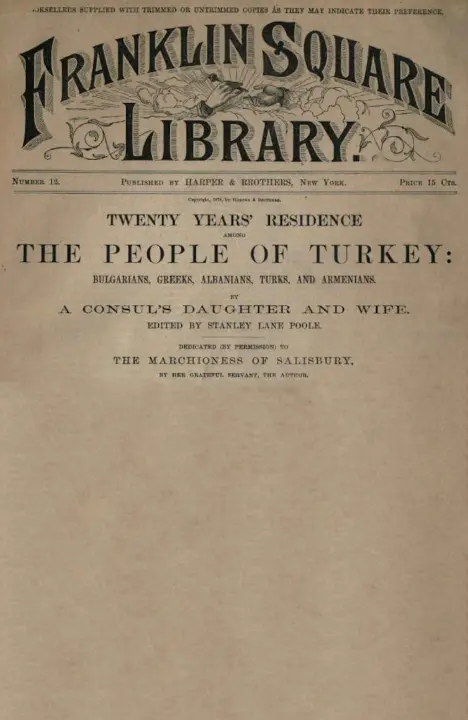
"Twenty Years' Residence among the People of Turkey: Bulgarians, Greeks, Albanians, Turks, and Armenians" is a historical account published in the late 19th century, edited by Stanley Lane Poole. The book provides a detailed examination of various ethnic groups in Turkey, particularly focusing on their social conditions, customs, and national characteristics. It is written from the perspective of an Englishwoman who has spent two decades observing and interacting with these communities, highlighting the nuances of their lives and the complex relationships between them. At the start of the work, the author discusses the lack of authoritative and comprehensive information regarding the Eastern Question, emphasizing the need for a reliable source that captures the diverse conditions of the people living under Ottoman rule. The preface elaborates on her extensive experiences in various provinces of Turkey, setting the tone for a nuanced exploration of the ethnic identities of Bulgarians, Greeks, and Turks, among others. The opening portion introduces us to the complicated historical context of the Bulgarians, detailing their struggles under Ottoman oppression, societal dynamics, and the development of their national identity while contrasting their experiences with those of other groups in the region.
Introduction adapted from the source catalogue; source summaries may be automatically generated.
Free to read · English · 151,574 words · No account needed
MAKE TIME FOR A GOOD BOOK
On by default. Untick to stop anonymous reading totals. Each page counts after 10 seconds in view. How this works.
Anonymous counting is on unless you have switched it off.
“Le quartier est la demeure de ce qu’on appelle la noblesse grecque, qui vivent tous aux dépenses des princes de Moldavie et de Valachie. C’est une université de toutes les scélératesses, et il n’existe pas encore de langue assez riche pour donner des noms à toutes celles qui s’y commettent. Le fils y apprend de bonne heure à assassiner adroitement son père pour quelque argent qu’il ne saurait être poursuivi. Les intrigues, les cabales, l’hypocrisie, la trahison, la perfidie, surtout l’art d’extorquer de l’argent de toutes mains, y sont enseignés méthodiquement!”
An English author of more recent date, but neither more enlightened nor animated with a greater sense of justice or impartiality, denies their right to a national history or their possession of an ancestry, furnishing them instead with one out of his fertile imagination. According to him several millions of Greeks are nameless, homeless upstarts, who have invariably made their fortunes by following the trade of bakals, or chandlers, and, with the enormous and illegal profits of their business, send their sons to Athens to be educated and receive a European varnish, then to return to Turkey full of pretension and bad morals, to sow discord and create mischief among their less enlightened brethren. Such absurd statements carry their own refutation; but they mislead people who are already prejudiced and ready to believe anything bad of the Greeks. The general currency such erroneous assertions receive, even in England, the country of Byron and the seamen of Navarino, struck me in a remark lately made by an intelligent English boy of twelve, who, happening to hear the Greeks mentioned at the luncheon-table, asked his mother if all the Greeks were not cut-throats?
These fallacies are gradually being cleared away. As a nation the Greeks possess undeniable virtues and talents, which, properly encouraged and guided, have in them the making of a strong progressive people—such as one day the Greeks will assuredly be. Their faults are as distinct and prominent as their virtues. In the careful and impartial examination a long residence has enabled me to make of the character of this people, I discovered a good deal of vanity, bravado, and overweening conceit. They are vain of their ability, and still more vain of the merits and capacity of free Hellas, of which they are so enamoured as to consider this little kingdom, in its way, on a level with the Great Powers. The spirit of bravado is often shown in animated disputes and controversies, for which they have a great partiality. They are subtle, extremely sensitive, fond of gain, but never miserly. Their enthusiastic nature, given free scope, will lead them into the doing of golden deeds; and, in the same way, bad influence will make of some the most finished rogues in creation. No Greek thief of Constantinople will be beaten in daring or in the art of carrying out a coup de main. No assassin will more recklessly plunge his knife into the heart of an enemy, no seducer be more enticing, no brigand more dashing and bold. And yet in the worst of these there is some redeeming quality; a noble action polluted by many bad ones; crimes often followed by remorse and a return to a steady and honest life. Gratitude for a good service is always met with among the Greeks, as among the Albanians. An example of this may be seen in an adventure that more than twenty years ago happened to an Englishman in the Government employ, who was travelling in a province infested by brigands. Armed and accompanied by a good escort, Mr. F. had set out during the night for the town of L⸺, and following the impulse of an adventurous spirit, he strayed away from his companions in a dense forest. The light of a full moon made the path quite distinct, and he had proceeded some distance, when his bridle was suddenly seized by some fierce-looking fellows, who appeared by his side as if by magic. Mr. F.’s surprise was as great as the action was menacing; but he instantly seized his revolver, and thought on the prudence of using it, when the “capitan,” a regular leromenos,[1] sprang forward, and a struggle ensued for its possession, in which the weapon was broken. The moment was critical, the danger imminent, for self-defence was out of the question with a broken revolver. In this emergency, with the presence of mind which characterizes him, Mr. F. thought of another means of protection, and removing the white cover of his official cap, pointed out the crown on it, and declared himself a servant of the British Government. This had the desired effect, for the chief released his hold of the bridle, and retired a short distance with his companions to hold a consultation, the result of which was his again stepping forward, and inquiring if the gentleman was the son of the consul of the town of T⸺, and being answered in the affirmative the “capitan,” with much feeling, declared he was free to pursue his way, for his father had rendered many good and noble services to the Greek families of Thessaly and Epirus, and had saved the lives and property of many others. “Besides,” added he, “we love and respect the English. But a few miles hence you will fall in with the camp of old A. Pasha, who, with 800 troops and two guns, intends to surround yonder mountain, where he expects to entrap and chase us like wild beasts. The price of your freedom is your word of honor not to reveal to him your meeting with us until to-morrow; when that is given, your escort will be allowed to pass unmolested.” Mr. F. then continued his journey, and a couple of hours brought him to the camp of his friend the brigand-chasing Pasha, who gave him an excellent supper, and entertained him with the plan of his next day’s assault on the brigand band, to which he had patiently to listen, bound as he was by his word not to reveal what he knew of their whereabouts until the next day. As the game the Pasha expected to entrap escaped him on the morrow, the revelation naturally annoyed him; but he was too well aware of the value an Englishman placed upon his pledged word, even to a brigand, to find fault with the reticence of his friend on that occasion.
Your reading position is saved on this browser. Take it to another device with a library code. Reading pages adapt to text, rather than matching a printed edition.
BEHIND THE BOOK
This eBook is for the use of anyone anywhere in the United States and most other parts of the world at no cost and with almost no restrictions whatsoever. You may copy it, give it away or re-use it under the terms of the Project Gutenberg License included with this eBook or online at www.gutenberg.org. If you are not located in the United States, you will have to check the laws of the country where you are located before using this eBook. Read the source licence.
The original source file, including credits and licence, is retained by this library. Request an original-format copy at no charge. Please include the book title and Project Gutenberg identifier #67626.
KEEP YOUR CURIOSITY GOING
Cécile Tormay

Moritz Busch
John L. Ransom
Frances Wright
Cécile Tormay

Mabel Potter Daggett