THE CLASSIC COLLECTION✦An outlaw’s diary: the CommuneCLASSIC FREE BOOKS
An outlaw’s diary: the Commune
Cécile Tormay
THE CLASSIC COLLECTION · 1878
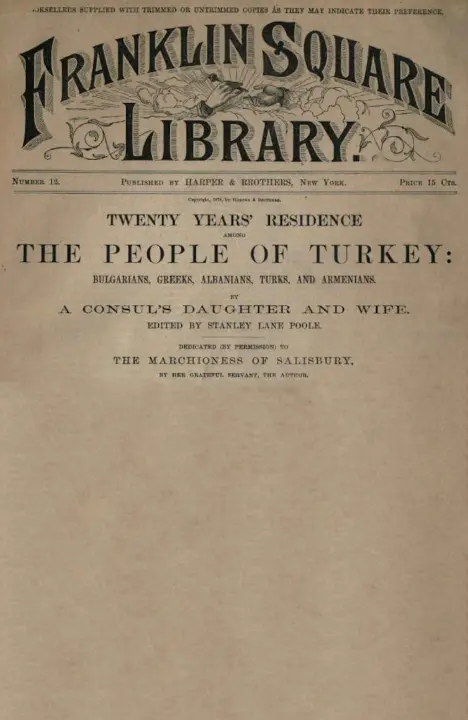
"Twenty Years' Residence among the People of Turkey: Bulgarians, Greeks, Albanians, Turks, and Armenians" is a historical account published in the late 19th century, edited by Stanley Lane Poole. The book provides a detailed examination of various ethnic groups in Turkey, particularly focusing on their social conditions, customs, and national characteristics. It is written from the perspective of an Englishwoman who has spent two decades observing and interacting with these communities, highlighting the nuances of their lives and the complex relationships between them. At the start of the work, the author discusses the lack of authoritative and comprehensive information regarding the Eastern Question, emphasizing the need for a reliable source that captures the diverse conditions of the people living under Ottoman rule. The preface elaborates on her extensive experiences in various provinces of Turkey, setting the tone for a nuanced exploration of the ethnic identities of Bulgarians, Greeks, and Turks, among others. The opening portion introduces us to the complicated historical context of the Bulgarians, detailing their struggles under Ottoman oppression, societal dynamics, and the development of their national identity while contrasting their experiences with those of other groups in the region.
Introduction adapted from the source catalogue; source summaries may be automatically generated.
Free to read · English · 151,574 words · No account needed
MAKE TIME FOR A GOOD BOOK
On by default. Untick to stop anonymous reading totals. Each page counts after 10 seconds in view. How this works.
Anonymous counting is on unless you have switched it off.
It is needless to say anything here about the doctrines of the Greek Church: every one knows the insignificant differences which separate it from the Church of Rome. The rites are less generally known; but unfortunately they are too numerous and various to be described here. The general impression produced by a Greek service is gorgeousness. The rites are essentially Oriental, and have been little changed since the early days of the Eastern Empire. The ceremonies are endless; fast and feast days, with their distinctive rites, are always occurring, and though generally disregarded by the upper classes are scrupulously observed by the peasantry, to whom the fasts (on which they work as usual) cause actual physical injury, and the feasts sometimes produce almost equally disastrous effects. Some parts of the service are very beautiful and impressive; but the prayers are generally intoned in a hurried and irreverent manner, which renders them hard to be understood. These things, however, are mending: the lower clergy pay more attention to the ordinary rules of decorum in the conduct of the services, and bishops are now not consecrated unless they are somewhat educated. Formerly the lives of the saints were the topics of sermons, now they are becoming more practical and exhortatory; but political subjects are strictly excluded.
Since the conquest the Greek Church and its clergy in the Ottoman Empire have never been supported by the Government, nor have its ministers ever received any grant either for themselves or the churches and schools under their care. An imperial order confirms the nomination of patriarchs, metropolitans, archbishops, and bishops. The last received from each family in their diocese a portion of the produce of its fields: from a peasant, for example, from half a kilo of corn and hay to a whole kilo, according to his means. This was considered a loyal donation from each household to its spiritual guide. Besides this the archbishops enjoyed special benefits from the celebration of marriages, funerals, and other religious ceremonies to which they were invited. But unfortunately these emoluments eventually became subject to some abuses, which excited murmurs from the community. Another custom was that a bishop should receive from his diocese, at his consecration, a sum sufficient to defray his immediate expenses during the first year. This sum, as well as the offerings in kind, was fixed by the elders of the town in which the metropolitan resided; the local authorities never interfered in these arrangements, except when the bishops demanded their assistance for the recovery of their dues. These usages continued in force until 1860; Feizi Pasha and his two supporters, Ali Pasha and Fouad Pasha, had previously tried every means to induce the Patriarch of Constantinople and his Synod, together with the higher classes of the Greek nation, to accept the funds of their church from the Ottoman Government. The Porte, in order to obtain the end it had in view, showed itself liberal by promising large fees to the higher clergy. But for religious, political, and social reasons, the patriarch and the nation in general rejected the proposal. After the Crimean War a Constitutional Assembly, composed of bishops and lay deputies from all the provinces, was convened by order of the Porte, to deliberate upon the settlement of some administrative affairs connected with the œcumenical throne of Constantinople, the cathedrals, and the bishops. This assembly also regulated, among other things, the revenues of the patriarch and all the archbishops. Each province, proportionately to its extent, its political importance, and its Christian population, was ordered to pay a fixed sum. The annual minimum is 30,000 piastres, and the maximum 90,000 piastres. The patriarch receives thirty per cent on this. The fees fixed by the elders of each province are paid annually by each family: the maximum of this contribution does not exceed twenty piastres each, which, in the aggregate, constitutes the revenues of the bishops and the pay of their subordinates. The extra revenues are regulated in the same manner, the ancient customs concerning their receipt having been abolished. The fees and extra emoluments of the lower clergy of cities, towns, and villages are received after the same fashion. An annual sum is paid by each family to the priest, which in many villages rarely exceeds three or four piastres. The archbishops also receive their stipend from their diocese, and are very seldom obliged to request the assistance of the authorities, who show great repugnance to interfering in the matter.
Your reading position is saved on this browser. Take it to another device with a library code. Reading pages adapt to text, rather than matching a printed edition.
BEHIND THE BOOK
This eBook is for the use of anyone anywhere in the United States and most other parts of the world at no cost and with almost no restrictions whatsoever. You may copy it, give it away or re-use it under the terms of the Project Gutenberg License included with this eBook or online at www.gutenberg.org. If you are not located in the United States, you will have to check the laws of the country where you are located before using this eBook. Read the source licence.
The original source file, including credits and licence, is retained by this library. Request an original-format copy at no charge. Please include the book title and Project Gutenberg identifier #67626.
KEEP YOUR CURIOSITY GOING
Cécile Tormay

Moritz Busch
John L. Ransom
Frances Wright
Cécile Tormay

Mabel Potter Daggett