THE CLASSIC COLLECTION✦An outlaw’s diary: the CommuneCLASSIC FREE BOOKS
An outlaw’s diary: the Commune
Cécile Tormay
THE CLASSIC COLLECTION · 1878
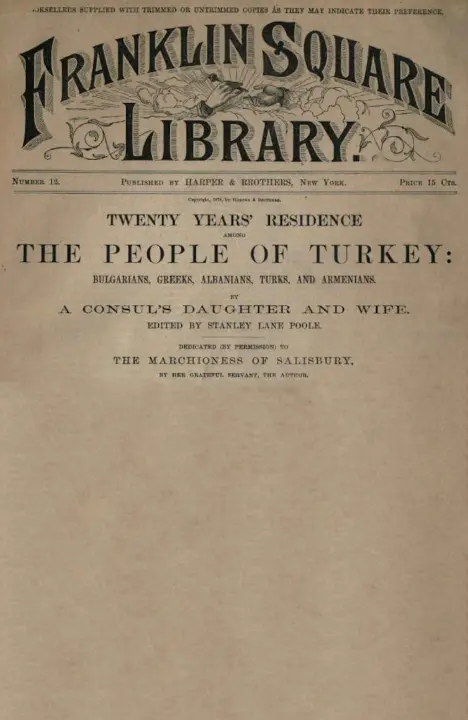
"Twenty Years' Residence among the People of Turkey: Bulgarians, Greeks, Albanians, Turks, and Armenians" is a historical account published in the late 19th century, edited by Stanley Lane Poole. The book provides a detailed examination of various ethnic groups in Turkey, particularly focusing on their social conditions, customs, and national characteristics. It is written from the perspective of an Englishwoman who has spent two decades observing and interacting with these communities, highlighting the nuances of their lives and the complex relationships between them. At the start of the work, the author discusses the lack of authoritative and comprehensive information regarding the Eastern Question, emphasizing the need for a reliable source that captures the diverse conditions of the people living under Ottoman rule. The preface elaborates on her extensive experiences in various provinces of Turkey, setting the tone for a nuanced exploration of the ethnic identities of Bulgarians, Greeks, and Turks, among others. The opening portion introduces us to the complicated historical context of the Bulgarians, detailing their struggles under Ottoman oppression, societal dynamics, and the development of their national identity while contrasting their experiences with those of other groups in the region.
Introduction adapted from the source catalogue; source summaries may be automatically generated.
Free to read · English · 151,574 words · No account needed
MAKE TIME FOR A GOOD BOOK
On by default. Untick to stop anonymous reading totals. Each page counts after 10 seconds in view. How this works.
Anonymous counting is on unless you have switched it off.
Sultan Mahmoud, the grandfather of the present Sultan, was in his bath when the news of the birth of his son Abdul-Aziz was announced to him. The tidings are said to have made him look sad and thoughtful; he heaved a deep sigh, and expressed his regret at having been informed of the event when divested of his clothing, saying it was a bad omen, and his son was likely to leave his people as naked as the news of his birth had found his father. Unfortunately for the nation, this prediction was but too exactly realized.
Predictions have great influence over the Mohammedan mind. On the eve of great battles, or on the occasion of any great political change, prophecies are consulted and astrologers appealed to, to prognosticate the issue of the coming event. Many of these individuals have paid with their heads for the non-fulfilment of their prophecies.
The last prediction in circulation at Stamboul, uttered since the death of Sultan Abdul-Aziz, says that seven sultans must succeed each other, most of them dying violent deaths, before the Empire will be secure.
While living at a farm near Broussa, situated a few miles from the town, not far from the ruins of a fine old hostelry called the “Bloody Khan,” my mother was one moonlight night accosted by an old Turk while we were out walking. He was a stranger in the place, tall and handsome, with a snowy beard falling upon his slightly bent chest. A peculiar, restless look about the eyes, and the numerous scars that covered his bare breast and face were evident indications that whatever his present calling might be, his past life must have been a stormy and adventurous one. He walked quietly towards us, and stopping before my mother, with a certain amount of respect mingled with paternal familiarity, said to her, “Kuzim, gel! (Daughter, come!) I have a secret to reveal to you.” My mother followed him, and half amused and wholly incredulous listened to the following recital. Pointing to the “Bloody Khan,” which, being situated upon the principal road leading into the interior, had once been occupied by a band of forty robbers, he said, “I was the chief of the band of brigands that occupied that Khan. You must know its story. Forty years have passed during which my faithful followers have been caught, killed, or dispersed, leaving me the sole representative of the band. A timely repentance of my evil ways led me to make a Tubé vow and renounce the old trade. I have since lived in peace with Allah and with men. I have sworn to lay violent hands on no man’s property more; but my conscience does not rebel against attempting to recover what I had buried beneath yonder wall. I want your powerful concurrence to dig out this buried treasure, the greater part of which will be yours.” My mother naturally refused to have anything to do with the affair. Seeing her unwillingness, the old man tried all his powers of persuasion to induce her to take part in his plan, saying, “On me, my daughter, be the sin. I will rest content with a small portion of what will be recovered, all the rest I abandon to you!” Finding this last inducement had no more effect than his previous promises, he turned away, saying, “Since you refuse I must seek somebody else.” Among the few Mohammedan inhabitants of the small village his choice fell upon the Imam, whose enterprising face promised the old man better success. The cunning Imam, on hearing the brigand’s tale, being persuaded of its veracity, at once promised his assistance, mentally deciding, however, that he would be the only one to profit by the hidden treasure. He at once began to make use of the usual stratagem of superstition, which could alone secure the success of his plan. Telling the old man that according to his books ill-gained wealth must be in the possession of evil spirits, and that in order to guard themselves against their influences during their digging enterprise, and to prevent the treasure from turning into charcoal, a peculiar process of appeasing and soothing incantations would be needed; but that he would at once proceed to perform these, and at the first crowing of the cock all would be ready, and they would proceed together to the spot and unearth the treasure. The credulous old chief stroked his beard, and said that with Allah’s help and the good-will of the Peris by the next day they would be rich men. In the course of the night, as arranged, the two, spade in hand, leading the Imam’s horse bearing saddle bags, proceeded to the spot. The Imam commenced operations by surrounding himself and his companion with as many magical observances as he could invent. Telling him to remove the first spadeful of earth, they went on digging alternately until a hollow sound told the sharp ear of the Imam that the distance between them and the coveted wealth was not great. He threw down his spade, and again resorting to magical mummeries declared that the danger was imminent, as the spell foretold resistance on the part of the spirits, and a refusal to yield possession unless a goat were at once sacrificed to them. “Go,” said he, earnestly, “back to the mosque, and in the small chamber you will find three goats; take the milk-white one and bring it here. Do not hurry it much, but lead it gently, as becomes the virtue of the offering.” The old man, nothing doubting, with Turkish nonchalance went quietly back to the village, which lay about three miles distant. The Imam once rid of him, and when in no danger of being seen or heard, set actively to work, got out the treasure, placed it in his saddle-bags, mounted, and rode off, and was never seen or heard of in the village again. The old man returned in due time, accompanied by the goat, to find nothing but his spades, the pile of earth, and the gaping hole. Disgusted, disappointed, and enraged, he came back to the village, and early next morning made his appearance at the farm. Inquiring for my mother, he acquainted her with the pitiable results of his attempt. This time the curiosity of the whole family was roused, and we all proceeded in a body to the spot. The old man’s assertions proved to be perfectly correct, and my brother, upsetting part of the upturned earth, discovered a handsome silver dish and cup, which we took home with us as trophies of the strange adventure.
Your reading position is saved on this browser. Take it to another device with a library code. Reading pages adapt to text, rather than matching a printed edition.
BEHIND THE BOOK
This eBook is for the use of anyone anywhere in the United States and most other parts of the world at no cost and with almost no restrictions whatsoever. You may copy it, give it away or re-use it under the terms of the Project Gutenberg License included with this eBook or online at www.gutenberg.org. If you are not located in the United States, you will have to check the laws of the country where you are located before using this eBook. Read the source licence.
The original source file, including credits and licence, is retained by this library. Request an original-format copy at no charge. Please include the book title and Project Gutenberg identifier #67626.
KEEP YOUR CURIOSITY GOING
Cécile Tormay

Moritz Busch
John L. Ransom
Frances Wright
Cécile Tormay

Mabel Potter Daggett