THE CLASSIC COLLECTION✦An outlaw’s diary: the CommuneCLASSIC FREE BOOKS
An outlaw’s diary: the Commune
Cécile Tormay
THE CLASSIC COLLECTION · 1878
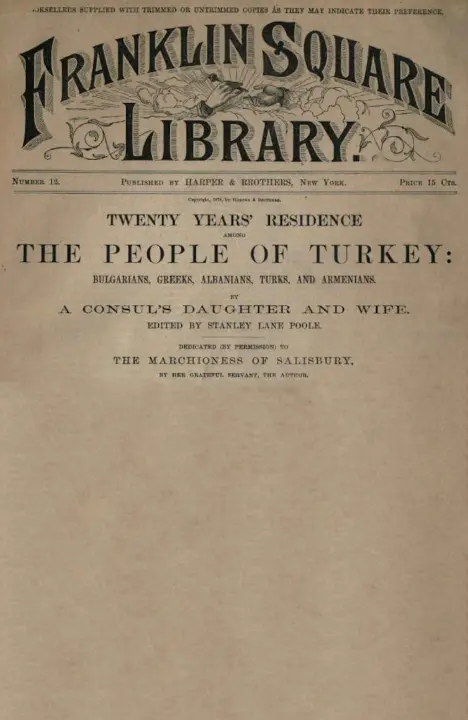
"Twenty Years' Residence among the People of Turkey: Bulgarians, Greeks, Albanians, Turks, and Armenians" is a historical account published in the late 19th century, edited by Stanley Lane Poole. The book provides a detailed examination of various ethnic groups in Turkey, particularly focusing on their social conditions, customs, and national characteristics. It is written from the perspective of an Englishwoman who has spent two decades observing and interacting with these communities, highlighting the nuances of their lives and the complex relationships between them. At the start of the work, the author discusses the lack of authoritative and comprehensive information regarding the Eastern Question, emphasizing the need for a reliable source that captures the diverse conditions of the people living under Ottoman rule. The preface elaborates on her extensive experiences in various provinces of Turkey, setting the tone for a nuanced exploration of the ethnic identities of Bulgarians, Greeks, and Turks, among others. The opening portion introduces us to the complicated historical context of the Bulgarians, detailing their struggles under Ottoman oppression, societal dynamics, and the development of their national identity while contrasting their experiences with those of other groups in the region.
Introduction adapted from the source catalogue; source summaries may be automatically generated.
Free to read · English · 151,574 words · No account needed
MAKE TIME FOR A GOOD BOOK
On by default. Untick to stop anonymous reading totals. Each page counts after 10 seconds in view. How this works.
Anonymous counting is on unless you have switched it off.
The blow aimed at the Bulgarian Church a little more than a century ago fell with equal weight upon the schools, which, though neither numerous nor effective, were nevertheless most valuable to the people, as the last depositories of their national tongue. These establishments, though the use of the Bulgarian language was formally abolished in them by the Greek Patriarch, still remained scattered all over Bulgaria, and, directed by the priests, enabled the Bulgarians, during the revival of the Church question, to make use of them as foundations for the more important and solid erections that have subsequently risen over them. The sudden manifestation of a desire for instruction and national improvement in Bulgaria is one of the most extraordinary phenomena I have had occasion to notice in the East.
Education at the time of the commencement of this movement was a privilege possessed by the very small section of the nation who were able to seek it in foreign countries. The townspeople studied but little, and the teaching in their schools comprised the Greek language, together with a few general notions: while the bulk of the population in the rural districts were left in entire ignorance. Those who wished for a more complete education, without leaving their country, had recourse to the higher Greek schools, in spite of the antipathy that existed between the two races.
I had written to a Bulgarian gentleman requesting some information upon the state of education in his country, but, unfortunately, the time at which I made this request did not allow him to meet my demand, and his daughter, a clever and accomplished young lady, undertook the task instead. The following is part of her first letter on the subject:
“CHÈRE MADAME: Mon père m’a dit que vous désiriez avoir quelques renseignements relativement à l’instruction en Bulgarie: une statistique des écoles, je crois. Comme il est très-occupé dans ce moment, il m’a chargé de vous fournir le peu de renseignements que nous possédons à ce sujet. J’ai donc recueilli tout ce qui a été publié jusqu’à présent par rapport aux écoles; mais malheureusement tout cela n’est que fort incomplet. Je me suis donc adressée aux evêques, espérant obtenir d’eux des informations plus exactes, et surtout plus complètes, et quelques uns d’eux m’ont promis de m’envoyer des statistiques des écoles dans leurs éparchies. Quant à l’origine de ce mouvement de la nation Bulgare vers la lumière, on n’en sait pas grand’chose. Tout ce que je pourrais vous dire à ce sujet n’est que les premières manifestations, faisant présager le reveil de cette nation à la vie, datent du commencement de ce siècle. Déjà en 1806 apparait le premier livre publié en langue Bulgare; l’année 1819 on voit paraître deux autres, et depuis ce temps chaque année apporte son contingent, quoique bien maigre encore, à ce petit trésor, qui s’amasse goutte à goutte. Quel rêve avait fait tressaillir ce peuple dans cette torpeur où il était plongé et qui avait toutes les apparences d’une léthargie devant durer éternellement? Etait-ce un souvenir instantané du passé? Une espérance subite d’un avenir moins sombre? Car, l’époque est assez loin encore où cette agglomeration de peuples, dont il fait partie, va venir en contact avec l’Europe civilisée et en subir l’influence. Quelque intéressante que serait l’explication de ce phénomène, on est obligé néanmoins de se contenter de conjectures. La tâche de l’historien qui essayerait d’élaircir ce point est tout aussi difficile que celle du philosophe qui cherche à de décrire le travail operé dans l’âme de l’enfant avançant progressivement à la lumière des nouvelles notions. Dans tous les deux cas, l’individu, dans lequel s’opére ce travail et qui pourtant est le plus à même d’en observer la marche, est, par sa faiblesse même, incapable d’en juger; il subit passivement, et c’est tout. Cependant cette période si obscure de notre vie nationale nous a légué trois noms bien brillants. Je veux parler du père Paisiy, qui, vers la fin du dernier siècle écrivait une histoire de la Bulgarie et quelques autres ouvrages; de Stoiko Vladislavoff (1739-1815), plus tard connu sous le nom de Sofraniy, qui écrivit près d’une vingtaine d’ouvrages dont quelques uns n’existent plus; et enfin de Néophite Bogvely, dont un des ouvrages, intitulé ‘Mati Bolgaria’ (Mère Bulgarie), est d’une actualité si frappante qu’on le croirait écrit hier. C’est un dialogue entre une mère et son fils dans lequel ils déplorent l’état de la patrie et recherchent les causes de ses malheurs. La mère se demande comment, malgré les immunités accordées aux Chrétiens et la promulgation de tant de bonnes lois, le sort de ces derniers ne se trouve pas amélioré; alors le fils la fait attention à la manière dont les lois sont appliquées. On ne parlerait pas autrement aujourd’hui! Observons en outre que tous les trois parlent du joug phanariote comme d’une des principales causes des malheurs de la Bulgarie. Ceci montre que reveil de l’esprit national chez les Bulgares n’est point, comme quelques uns aiment à le faire croire, un mouvèment factice dû à quelques individus. C’est dans l’histoire de ces trois hommes, qui, dans des circonstances plus favorables auraient infailliblement été de veritables flambeaux pour leur nation et peut-être pour l’humanité—c’est dans leur histoire, dis-je, qu’il faudrait chercher une partie des causes de la régénération de la nation Bulgare.
Your reading position is saved on this browser. Take it to another device with a library code. Reading pages adapt to text, rather than matching a printed edition.
BEHIND THE BOOK
This eBook is for the use of anyone anywhere in the United States and most other parts of the world at no cost and with almost no restrictions whatsoever. You may copy it, give it away or re-use it under the terms of the Project Gutenberg License included with this eBook or online at www.gutenberg.org. If you are not located in the United States, you will have to check the laws of the country where you are located before using this eBook. Read the source licence.
The original source file, including credits and licence, is retained by this library. Request an original-format copy at no charge. Please include the book title and Project Gutenberg identifier #67626.
KEEP YOUR CURIOSITY GOING
Cécile Tormay

Moritz Busch
John L. Ransom
Frances Wright
Cécile Tormay

Mabel Potter Daggett