THE CLASSIC COLLECTION✦An outlaw’s diary: the CommuneCLASSIC FREE BOOKS
An outlaw’s diary: the Commune
Cécile Tormay
THE CLASSIC COLLECTION · 1878
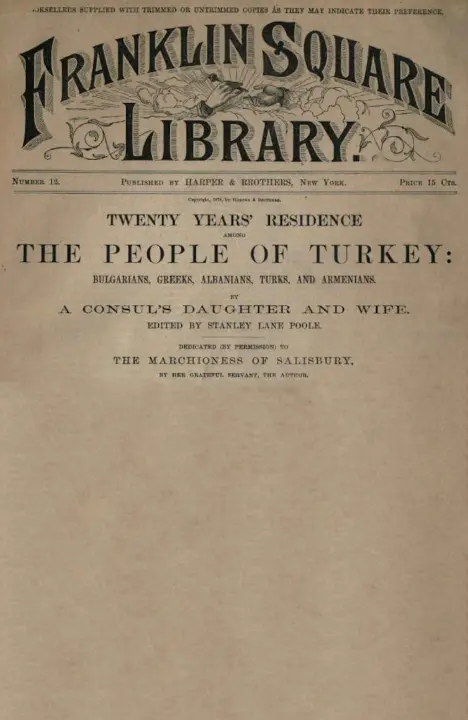
"Twenty Years' Residence among the People of Turkey: Bulgarians, Greeks, Albanians, Turks, and Armenians" is a historical account published in the late 19th century, edited by Stanley Lane Poole. The book provides a detailed examination of various ethnic groups in Turkey, particularly focusing on their social conditions, customs, and national characteristics. It is written from the perspective of an Englishwoman who has spent two decades observing and interacting with these communities, highlighting the nuances of their lives and the complex relationships between them. At the start of the work, the author discusses the lack of authoritative and comprehensive information regarding the Eastern Question, emphasizing the need for a reliable source that captures the diverse conditions of the people living under Ottoman rule. The preface elaborates on her extensive experiences in various provinces of Turkey, setting the tone for a nuanced exploration of the ethnic identities of Bulgarians, Greeks, and Turks, among others. The opening portion introduces us to the complicated historical context of the Bulgarians, detailing their struggles under Ottoman oppression, societal dynamics, and the development of their national identity while contrasting their experiences with those of other groups in the region.
Introduction adapted from the source catalogue; source summaries may be automatically generated.
Free to read · English · 151,574 words · No account needed
MAKE TIME FOR A GOOD BOOK
On by default. Untick to stop anonymous reading totals. Each page counts after 10 seconds in view. How this works.
Anonymous counting is on unless you have switched it off.
While Greeks and Bulgarians in the heat of controversy were snatching churches and monasteries from each other, the priests and monks who were attached to these sacred foundations found themselves unpleasantly jostled between the two hostile elements. To be a Greek priest or monk and be forced to acknowledge the supremacy of an anathematized and illegal church was a profanation not to be endured; and, on the other hand, to be a Bulgarian and be forced to pray day by day for a detested spiritual head rejected by his nation was an insupportable anomaly. In the midst of the difficulty and confusion at first caused by this state of affairs, some of the good fathers and monks had to remove their quarters and betake themselves to a wandering life, visiting their respective communities and encouraging the people by their exhortations to hold fast to their church and oppose with all their might the claims and usurping tendencies of the others. Among these a Bulgarian monk, more venturous and evidently endowed with a greater amount of imaginative eloquence than the rest, and rejoicing in the title of Spheti Panteleemon, regarded himself as the prophet of the Bulgarian people. This Saint Panteleemon was a man of middle age and middle height, with a jovial face, a cunning look, and an intelligent but restless eye, by no means indicative of an ascetic view of life.
Contrary to the saying that no man is a prophet in his own country, Spheti Panteleemon was acknowledged as such by a considerable class of his people, consisting entirely of the gentle sex, and his success among them was as great as ritualism appears to be in England.
The preaching of this prophet, intended solely for the Bulgarian women, became so pronounced in its tenets, so eloquent in its delivery, and was rendered so impressive by the different means he employed to instil his precepts into the hearts and minds of his hearers, that their number soon increased into a vast congregation, which flocked from all parts of the country to hear the words of their favorite saint. On such occasions, this false prophet, who had managed to usurp possession of a small monastery, would stand forth amid thousands of women, who at his approach would cross themselves and fall down almost to worship him. Spheti Panteleemon, in acknowledgment of this mark of devotion, would raise his voice and rehearse his doctrines to the devotees. These doctrines included strange principles, asserted by their author to be the best and surest way to Paradise; but they scarcely conduced to the satisfaction of the husbands. Women, according to this man, were to be free and independent, and their principal affections were to be bestowed upon their spiritual guide; their earnestness was to be proved by depositing their earthly wealth (consisting chiefly of their silver ornaments) at his feet. The practical Bulgarian husbands, however, were by no means admirers of this new spiritual director, whose sole object appeared to be to rob them of the affections of their wives along with their wealth, and they soon raised their voices against his proceedings. After holding counsel on the subject, they decided to give notice of his doings to the local authorities, and by their influence to have him sent out of the country. The prophet was arrested one fine morning, while addressing a congregation of 500 women, by a body of police, and brought to the prison of the town of S⸺, whilst all the women devoutly followed, weeping, beating their breasts, and clamoring for the release of their saint. The husbands, on the other hand, pleaded their grievances against this disorganizer of society, and proved his dishonesty by displaying to the authorities a quantity of silver trinkets of all descriptions taken from his dwelling, to the great indignation of his devotees. The imagination of some of these ignorant and superstitious peasant women had been so worked upon that they solemnly declared to me that the feet of their prophet never touched the ground, but remained always a distance of two feet above it, and that his sole sustenance was grass. While his fate was still undecided, amidst the wailings of the women, the protests of the husbands, and the embarrassment of the authorities, the fellow got out of the difficulty by declaring himself a “Uniate” and a member of the Church of Rome. This avowal could not fail to excite the interest of the agents of that body: they claimed the stray sheep as redeemed, took him under their immediate protection, but (it is to be hoped) deprived him of his pretended attribute of sanctity and the power of making himself any longer a central object of attraction to the beau sexe.
Your reading position is saved on this browser. Take it to another device with a library code. Reading pages adapt to text, rather than matching a printed edition.
BEHIND THE BOOK
This eBook is for the use of anyone anywhere in the United States and most other parts of the world at no cost and with almost no restrictions whatsoever. You may copy it, give it away or re-use it under the terms of the Project Gutenberg License included with this eBook or online at www.gutenberg.org. If you are not located in the United States, you will have to check the laws of the country where you are located before using this eBook. Read the source licence.
The original source file, including credits and licence, is retained by this library. Request an original-format copy at no charge. Please include the book title and Project Gutenberg identifier #67626.
KEEP YOUR CURIOSITY GOING
Cécile Tormay

Moritz Busch
John L. Ransom
Frances Wright
Cécile Tormay

Mabel Potter Daggett