THE CLASSIC COLLECTION✦An outlaw’s diary: the CommuneCLASSIC FREE BOOKS
An outlaw’s diary: the Commune
Cécile Tormay
THE CLASSIC COLLECTION · 1878
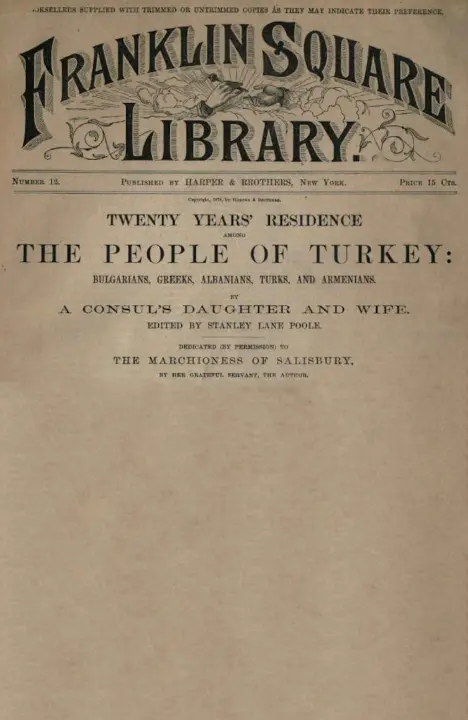
"Twenty Years' Residence among the People of Turkey: Bulgarians, Greeks, Albanians, Turks, and Armenians" is a historical account published in the late 19th century, edited by Stanley Lane Poole. The book provides a detailed examination of various ethnic groups in Turkey, particularly focusing on their social conditions, customs, and national characteristics. It is written from the perspective of an Englishwoman who has spent two decades observing and interacting with these communities, highlighting the nuances of their lives and the complex relationships between them. At the start of the work, the author discusses the lack of authoritative and comprehensive information regarding the Eastern Question, emphasizing the need for a reliable source that captures the diverse conditions of the people living under Ottoman rule. The preface elaborates on her extensive experiences in various provinces of Turkey, setting the tone for a nuanced exploration of the ethnic identities of Bulgarians, Greeks, and Turks, among others. The opening portion introduces us to the complicated historical context of the Bulgarians, detailing their struggles under Ottoman oppression, societal dynamics, and the development of their national identity while contrasting their experiences with those of other groups in the region.
Introduction adapted from the source catalogue; source summaries may be automatically generated.
Free to read · English · 151,574 words · No account needed
MAKE TIME FOR A GOOD BOOK
On by default. Untick to stop anonymous reading totals. Each page counts after 10 seconds in view. How this works.
Anonymous counting is on unless you have switched it off.
Altogether, the total number of the employés of the Palace is about 5500. But this is not all; these servants employ also other persons beneath them, so that every day 7000 persons are fed at the expense of the Palace. So great is the disorder in the organization that the contractors claim five francs per diem for the food of each of these 7000 persons, which amounts to £511,000 per annum for the employés only.
The various items comprise £1120 for wood, £1040 for rice, and £16,000
for sugar.
The wages of employés included in the civil list amounted to a total of £200,000, exclusive of the salaries of aides-de-camp, doctors, musicians, etc., which were paid by the minister of war.
The stables of the Palace contained 600 horses, whose provender, according to the estimates of the most reasonable contractors, cost three Turkish liras per month, making a total of about £20,000.
More than 200 carriages of every description were kept in the palace. These were for the most part presents from the Viceroy of Egypt, but the expenses of the 150 coachmen and footmen with their rich liveries are paid by a civil list, also the harness-maker’s accounts, and other items of this department.
The annual expenditure for pictures, porcelain, etc., was never less than £140,000, and in one year Sultan Abdul-Aziz spent £120,000 for pictures only. As for jewels, the purchases attained the annual sum of £100,000, and the expenses of the harem for presents, dresses, etc., absorbed £160,000 per annum.
Besides these items, the allowances to the mother and sisters of the Sultan, to his nephews and nieces, and to the heir-apparent, amounted to £181,760. This gives a total of at least £1,300,000 annually. To this must be added £80,000 for keeping in repair the existing Imperial kiosks and palaces, and £580,000 for the construction of new ones. The Imperial revenue in the civil list was £1,280,000. The expenditure was really over £2,000,000.
I am unable to give an estimate of the expenses of the seraglio of the present Sultan, but I have been informed on good authority that his Majesty personally superintends the management of the palace, and regulates its expenditure with great wisdom and economy; it will take some time, however, to put an end to the disorder, corruption, and irregularity that have become so rooted in the whole system, and caused the extravagance and waste that prevailed in the households of former sultans. A Turkish proverb says, “Baluk bashtan kokar,” “The fish begins to decompose at the head;” accordingly, if the head be sound there is every hope that the body will also keep fresh.
The haremlik of the Seraglio contains from 1000 to 1500 women, divided among the Sultan’s household; that of his mother, the Validé Sultana; and those of the princes.
Your reading position is saved on this browser. Take it to another device with a library code. Reading pages adapt to text, rather than matching a printed edition.
BEHIND THE BOOK
This eBook is for the use of anyone anywhere in the United States and most other parts of the world at no cost and with almost no restrictions whatsoever. You may copy it, give it away or re-use it under the terms of the Project Gutenberg License included with this eBook or online at www.gutenberg.org. If you are not located in the United States, you will have to check the laws of the country where you are located before using this eBook. Read the source licence.
The original source file, including credits and licence, is retained by this library. Request an original-format copy at no charge. Please include the book title and Project Gutenberg identifier #67626.
KEEP YOUR CURIOSITY GOING
Cécile Tormay

Moritz Busch
John L. Ransom
Frances Wright
Cécile Tormay

Mabel Potter Daggett