THE CLASSIC COLLECTION✦An outlaw’s diary: the CommuneCLASSIC FREE BOOKS
An outlaw’s diary: the Commune
Cécile Tormay
THE CLASSIC COLLECTION · 1923
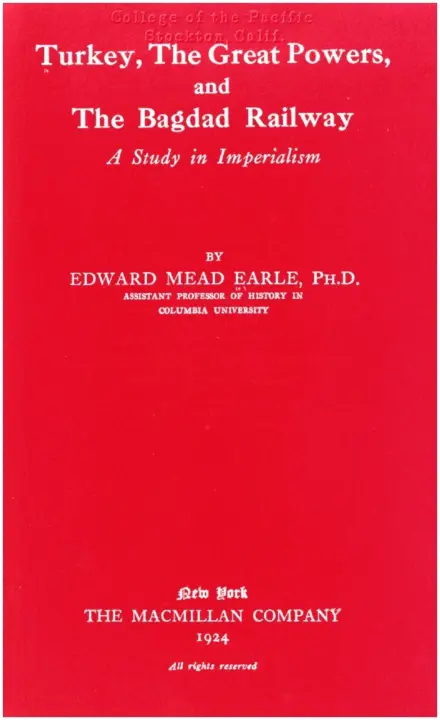
"Turkey, the Great Powers, and the Bagdad Railway: A Study in Imperialism" by Edward Mead Earle is a historical account written in the early 20th century. The book explores the intricate dynamics of imperialism as they relate to the rise of the Bagdad Railway project and its implications on Turkey and its global significance. Through meticulous analysis, it examines how various great powers engaged with the Ottoman Empire’s resources and strategic position. The opening of the book details the historical context leading to the significance of the Bagdad Railway, introducing it as an essential link reviving ancient trade routes during the 19th century. Earle outlines the broader implications of rail development on the economic and political stability of Turkey, emphasizing both the hopes tied to modernization and the inherent dangers posed by international rivalries. The narrative sets the stage for a deeper discussion on how this railway project emerged in a landscape fraught with imperial aspirations and the challenges the Ottoman Empire faced in asserting its sovereignty amidst foreign interests. Overall, the initial chapters lay a foundation for understanding the complexities that surrounded the construction of the Bagdad Railway as a symbol of both progress and contention in modern imperialism.
Introduction adapted from the source catalogue; source summaries may be automatically generated.
Free to read · English · 109,189 words · No account needed
MAKE TIME FOR A GOOD BOOK
On by default. Untick to stop anonymous reading totals. Each page counts after 10 seconds in view. How this works.
Anonymous counting is on unless you have switched it off.
[19] Parliamentary Debates, House of Commons, fifth series, Volume 59 (1914), pp. 2179–2189. Sir Mark Sykes (1879–1919) had traveled extensively in the Near and Far East and was the author of many books on the political and economic problems of those regions. During the Great War he was commissioned by the British Government to negotiate with France regarding the delimitation of the Allies’ interests in Mesopotamia and Syria. He was one of the authors of the Sykes-Picot Treaty of 1916.
[20] Supra, pp. 111–112, 228–229.
[21] Memorandum of Djavid Bey, cited in Chapter IX, supra.
[22] Haldane, op. cit., passim; W. von Hohenzollern, My Memoirs, 1878–1918, pp. 142–156; supra, pp. 198–199; The Annual Register, 1912, pp. 16, 332; Count de Lalaing, Belgian Minister in London, to M. Davignon, Belgian Minister of Foreign Affairs, February 9 and 16, 1912, despatches Nos. 88 and 90, translated in Morel, op. cit., pp. 228–230.
[23] Supra, pp. 205–207.
[24] Baron Marschall died in September, 1912, after only a few weeks of service at his new post. He was succeeded by Prince Lichnowsky, who took up his duties in London in November. Regarding the lecture tour of Sir Harry Johnston see the authentic account by Bernadotte Schmitt, England and Germany, 1740–1914, pp. 355–356. Herr von Jagow’s opinion of the importance of an Anglo-German understanding on the Near East is to be found in his reply to Prince Lichnowsky, in the Norddeutsche Allgemeine Zeitung of March 23, 1918, translated by Munroe Smith, The Disclosures from Germany, pp. 130–131.
[25] Regarding the Anglo-Turkish negotiations cf. Parliamentary Debates, House of Commons, Volume 53 (1913), pp. 392–395; Stenographische Berichte, XIII Legislaturperiode, 1 Session, Volume 291 (1913), pp. 6274c-6294d; Karl Helfferich, Die Vorgeschichte des Weltkrieges, pp. 143 et seq.; Mesopotamia, pp. 97–98; The Times (London), May 17 and May 31, 1913; The Quarterly Review, Volume 228 (1917), pp. 517–521; de Siebert, op. cit., Chapter XX.
[26] Parliamentary Debates, House of Commons, Volume 53 (1913), p.
393.
[27] Stenographische Berichte, XIII Legislaturperiode, 1 Session, Volume 289 (1913), p. 4744d. Cf., also, ibid., pp. 4744c-4746c; Volume 290 (1913), p. 5326a-c.
[28] For copies of this and other agreements the author is indebted to Dr. von Gwinner, of the Deutsche Bank.
[29] For the text of the agreement cf. E.M. Earle, “The Secret Anglo-German Convention of 1914 regarding Asiatic Turkey,” in the Political Science Quarterly (New York), Volume XXXVIII (1923), pp. 41–44.
[30] “Correspondence between His Majesty’s Government and the United States Ambassador respecting Economic Rights in Mandated Territories,” Parliamentary Papers, No. Cmd. 675 (1921); The Daily News (London), June 26, 1920; G. Slocombe, “The Oil Behind the War Scare,” in The Daily Herald (London), October 12 and 13, 1922; The Disclosures from Germany, p. 238.
[31] Parliamentary Debates, House of Commons, Volume 64 (1914), pp.
116–117.
[32] For the complete text of the convention, cf. E. M. Earle, “The Secret Anglo-German Convention of 1914 regarding Asiatic Turkey,” loc. cit., pp. 24–44.
[33] Fullerton, op. cit., p. 307.
[34] Prince Lichnowsky, quoted from The Disclosures from Germany, pp.
71–72.
[35] Saint-Yves, loc. cit., pp. 526–531; Anatolia, pp. 49 et seq. Regarding the earlier development of Italian economic interests in Turkey cf. supra, pp. 105–107.
Your reading position is saved on this browser. Take it to another device with a library code. Reading pages adapt to text, rather than matching a printed edition.
BEHIND THE BOOK
This eBook is for the use of anyone anywhere in the United States and most other parts of the world at no cost and with almost no restrictions whatsoever. You may copy it, give it away or re-use it under the terms of the Project Gutenberg License included with this eBook or online at www.gutenberg.org. If you are not located in the United States, you will have to check the laws of the country where you are located before using this eBook. Read the source licence.
The original source file, including credits and licence, is retained by this library. Request an original-format copy at no charge. Please include the book title and Project Gutenberg identifier #66221.
KEEP YOUR CURIOSITY GOING
Cécile Tormay

Moritz Busch
John L. Ransom
Frances Wright
Cécile Tormay

Mabel Potter Daggett