THE CLASSIC COLLECTION✦An outlaw’s diary: the CommuneCLASSIC FREE BOOKS
An outlaw’s diary: the Commune
Cécile Tormay
THE CLASSIC COLLECTION · 1923
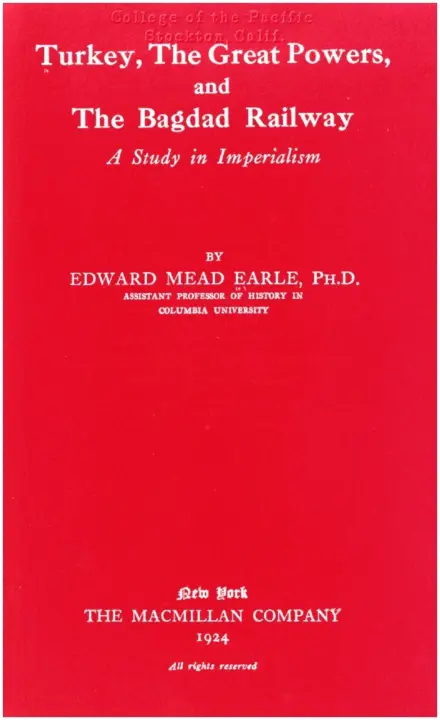
"Turkey, the Great Powers, and the Bagdad Railway: A Study in Imperialism" by Edward Mead Earle is a historical account written in the early 20th century. The book explores the intricate dynamics of imperialism as they relate to the rise of the Bagdad Railway project and its implications on Turkey and its global significance. Through meticulous analysis, it examines how various great powers engaged with the Ottoman Empire’s resources and strategic position. The opening of the book details the historical context leading to the significance of the Bagdad Railway, introducing it as an essential link reviving ancient trade routes during the 19th century. Earle outlines the broader implications of rail development on the economic and political stability of Turkey, emphasizing both the hopes tied to modernization and the inherent dangers posed by international rivalries. The narrative sets the stage for a deeper discussion on how this railway project emerged in a landscape fraught with imperial aspirations and the challenges the Ottoman Empire faced in asserting its sovereignty amidst foreign interests. Overall, the initial chapters lay a foundation for understanding the complexities that surrounded the construction of the Bagdad Railway as a symbol of both progress and contention in modern imperialism.
Introduction adapted from the source catalogue; source summaries may be automatically generated.
Free to read · English · 109,189 words · No account needed
MAKE TIME FOR A GOOD BOOK
On by default. Untick to stop anonymous reading totals. Each page counts after 10 seconds in view. How this works.
Anonymous counting is on unless you have switched it off.
[6] Parliamentary Debates, House of Commons, fifth series, Volume 21
(1911), pp. 241–244.
[7] Journal Officiel, Débats parlementaires, Chambre des Députés, January 13, 1911, pp. 33–34. M. Jaurès was one of the Frenchmen who felt that their Government never should have opposed the Bagdad Railway in the first instance.
[8] Ibid., January 16, pp. 64 et seq.; Parliamentary Debates, House of Commons, Volume 21 (1911), pp. 82 et seq., 243–244; The Times, January 17 and 19, 1911.
[9] Parliamentary Debates, House of Commons, Volume 21 (1911), p. 82.
[10] Cf. supra, pp. 224–225.
[11] Cf. G. Saint-Yves, “Les chemins de fer français dans la Turquie d’Asie,” in Questions diplomatiques et coloniales, Volume 37 (1914), pp. 526–531; Anatolia, pp. 51–52.
[12] It was proposed that the Anatolian Railways should construct three branches: one from a point east of Bulgurlu north and north-east to Kaisarieh and Sivas; a second from Angora east to the aforementioned branch, joining it near Kaisarieh; a third from Adabazar to Boli. The branch of the Bagdad Railway from Nisibin to Diarbekr and Arghana was authorized by the concession of 1903.
[13] Much of the present account of the negotiations of the years 1910–1914 is based upon documentary material furnished by Dr. von Gwinner and upon additional information supplied by Sir Henry Babington Smith and Djavid Bey. Almost everything heretofore published has been very general in character, but one may find some illuminating details in the following: R. de Caix, “La France et les chemins de fer de l’Asie turque,” in Questions diplomatiques et coloniales, Volume 36 (1913), pp. 386–387; Armenia and Kurdistan, p. 36; Commerce Reports, No. 18a (1915), pp. 2–3; Stenographische Berichte, XIII Legislaturperiode, 1 Session, Volume 291 (1913), pp. 6274c et seq.; American Journal of International Law, April, 1918; Commandant de Thomasson, “Les négotiations franco-allemandes,” in Questions diplomatiques et coloniales, Volume 37 (1914), pp. 257 et seq.
[14] For certified copies of the minutes of the meetings of August 19–20 and September 24–26, 1913, and for the text of the convention of February 15, 1914, the author is indebted to Dr. von Gwinner.
[15] Stenographische Berichte, XIII Legislaturperiode, 1 Session, Volume 291 (1913), p. 6274c. No. 111 of a series of despatches published by the German Foreign Office (Berlin, 1915), an English translation of which is to be found in E.D. Morel’s Diplomacy Revealed (London, 1921), pp. 282–283.
[16] Parliamentary Papers, No. Cmd. 964 (1920).
[17] Cf. de Caix, op. cit., pp. 386–387.
[18] It should be made clear that not all the terms of the Franco-German agreement were carried out before the beginning of the Great War. Because of the delay in the negotiations with Great Britain (cf. infra) the exchange of Bagdad Railway securities for Imperial Ottoman Bonds was not completed, with the result that, when the War came, French bankers still held an interest in the Bagdad Railway Company.
Your reading position is saved on this browser. Take it to another device with a library code. Reading pages adapt to text, rather than matching a printed edition.
BEHIND THE BOOK
This eBook is for the use of anyone anywhere in the United States and most other parts of the world at no cost and with almost no restrictions whatsoever. You may copy it, give it away or re-use it under the terms of the Project Gutenberg License included with this eBook or online at www.gutenberg.org. If you are not located in the United States, you will have to check the laws of the country where you are located before using this eBook. Read the source licence.
The original source file, including credits and licence, is retained by this library. Request an original-format copy at no charge. Please include the book title and Project Gutenberg identifier #66221.
KEEP YOUR CURIOSITY GOING
Cécile Tormay

Moritz Busch
John L. Ransom
Frances Wright
Cécile Tormay

Mabel Potter Daggett