THE CLASSIC COLLECTION✦An outlaw’s diary: the CommuneCLASSIC FREE BOOKS
An outlaw’s diary: the Commune
Cécile Tormay
THE CLASSIC COLLECTION · 1923
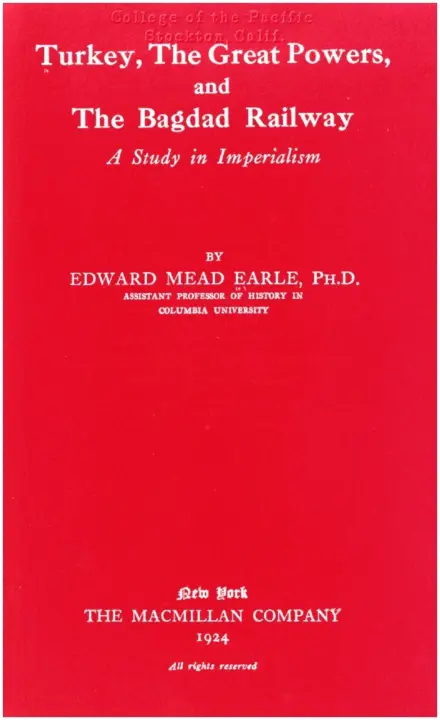
"Turkey, the Great Powers, and the Bagdad Railway: A Study in Imperialism" by Edward Mead Earle is a historical account written in the early 20th century. The book explores the intricate dynamics of imperialism as they relate to the rise of the Bagdad Railway project and its implications on Turkey and its global significance. Through meticulous analysis, it examines how various great powers engaged with the Ottoman Empire’s resources and strategic position. The opening of the book details the historical context leading to the significance of the Bagdad Railway, introducing it as an essential link reviving ancient trade routes during the 19th century. Earle outlines the broader implications of rail development on the economic and political stability of Turkey, emphasizing both the hopes tied to modernization and the inherent dangers posed by international rivalries. The narrative sets the stage for a deeper discussion on how this railway project emerged in a landscape fraught with imperial aspirations and the challenges the Ottoman Empire faced in asserting its sovereignty amidst foreign interests. Overall, the initial chapters lay a foundation for understanding the complexities that surrounded the construction of the Bagdad Railway as a symbol of both progress and contention in modern imperialism.
Introduction adapted from the source catalogue; source summaries may be automatically generated.
Free to read · English · 109,189 words · No account needed
MAKE TIME FOR A GOOD BOOK
On by default. Untick to stop anonymous reading totals. Each page counts after 10 seconds in view. How this works.
Anonymous counting is on unless you have switched it off.
[3] The texts of the various treaties of capitulation may be found in G. E. Noradounghian (ed.), Recueil d’actes internationaux de l’Empire ottoman, 1300–1902 (4 volumes, Paris, 1897–1903), Volume I, documents numbers 153, 170, 196, 201, etc., ad lib., Volume II, numbers 499, 593, etc., ad lib.; also Recueil des traités de la Porte ottomane avec les puissances étrangères, 1536–1901 (10 volumes, Paris, 1864–1901), passim; E. A. Van Dyck, Report on the Capitulations of the Ottoman Empire, Forty-seventh Congress, Special Session, Senate Executive Document No. 3, First Session, Senate Executive Document No. 87 (Washington, 1881–1882); G. Pelissie du Rausas, Le régime des capitulations dans l’Empire ottoman (2 volumes, Paris, 1902–1905); A. R. von Overbeck, Die Kapitulationen des osmanischen Reiches (Breslau, 1917); W. Lehman, Die Kapitulationen (Weimar, 1917); P. M. Brown, Foreigners in Turkey, Their Juridical Status (Princeton, 1914).
[4] For an account of the establishment, functions, and operation of the Ottoman Public Debt Administration, cf. George Young (ed.), Corps de droit ottoman—Recueil des codes, lois, réglements, ordonnances, et actes les plus importants du droit intérieur, et d’études sur le droit coutumier de l’Empire ottoman (7 volumes, Oxford, 1905–1906), Volume V, Chapter LXXXV; A. Heidborn, Manuel de droit public et administratif de l’Empire ottoman (2 volumes, Vienna, 1912), Volume II; C. Morawitz, Les finances de Turquie (Paris, 1902); A. du Velay, Essai sur l’histoire financière de la Turquie (Paris, 1903), Parts V and VI; L. Delaygue, Essai sur les finances ottomanes (Paris, 1911).
[5] There were a few factories erected in Turkey by foreign capitalists, notably those of the Oriental Carpet Manufacturers, Ltd., the American Tobacco Company, and the Deutsche-Levantischen Baumwollgesellschaft. In general, however, the factory and the factory town were not common phenomena in Asiatic Turkey. An interesting account of the effects of the Industrial Revolution upon economic conditions in Turkey is that of Talcott Williams, Turkey a World Problem of Today (Garden City, 1921), pp. 268 et seq.; W. S. Monroe, Turkey and the Turks: an Account of the Lands, Peoples and Institutions of the Ottoman Empire (London, 1909), Chapter X; M. J. Garnett, Turkish Life in Town and Country (London, 1904).
[6] J. E. Spurr (ed.), Political and Commercial Geology (New York, 1921), pp. 109, 115–116, 172–173, 184–185; Anatolia, No. 17 in a series of handbooks published by the Historical Section of the Foreign Office (London, 1920), pp. 88–90.
[7] Spurr, op. cit., pp. 358–359; Armenia and Kurdistan, No. 62 of the Foreign Office Handbooks, p. 60; L. Dominian, “The Mineral Wealth of Asia Minor,” in The Near East, May 26, 1916, p. 91; E. Banse, Auf den Spuren der Bagdadbahn (Weimar, 1913), pp. 140–145; L. de Launay, La Géologie et les richesses minerales de l’Asie (Paris, 1911); R. Fitzner, Anatolien, Wirtschaftsgeographie (Berlin, 1902); P. Rohrbach, Die wirtschaftliche Bedeutung Westasiens (Halle, 1902); G. Carles, La Turquie économique (Paris, 1906); E. Mygind, “Anatolien und seine wirtschaftliche Bedeutung,” in Die Balkan Revue, Volume 4 (1917), pp. 1–6.
Your reading position is saved on this browser. Take it to another device with a library code. Reading pages adapt to text, rather than matching a printed edition.
BEHIND THE BOOK
This eBook is for the use of anyone anywhere in the United States and most other parts of the world at no cost and with almost no restrictions whatsoever. You may copy it, give it away or re-use it under the terms of the Project Gutenberg License included with this eBook or online at www.gutenberg.org. If you are not located in the United States, you will have to check the laws of the country where you are located before using this eBook. Read the source licence.
The original source file, including credits and licence, is retained by this library. Request an original-format copy at no charge. Please include the book title and Project Gutenberg identifier #66221.
KEEP YOUR CURIOSITY GOING
Cécile Tormay

Moritz Busch
John L. Ransom
Frances Wright
Cécile Tormay

Mabel Potter Daggett