THE CLASSIC COLLECTION✦An outlaw’s diary: the CommuneCLASSIC FREE BOOKS
An outlaw’s diary: the Commune
Cécile Tormay
THE CLASSIC COLLECTION · 1923
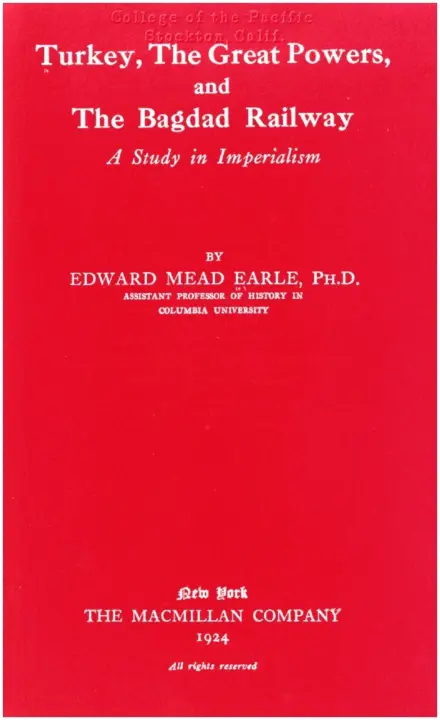
"Turkey, the Great Powers, and the Bagdad Railway: A Study in Imperialism" by Edward Mead Earle is a historical account written in the early 20th century. The book explores the intricate dynamics of imperialism as they relate to the rise of the Bagdad Railway project and its implications on Turkey and its global significance. Through meticulous analysis, it examines how various great powers engaged with the Ottoman Empire’s resources and strategic position. The opening of the book details the historical context leading to the significance of the Bagdad Railway, introducing it as an essential link reviving ancient trade routes during the 19th century. Earle outlines the broader implications of rail development on the economic and political stability of Turkey, emphasizing both the hopes tied to modernization and the inherent dangers posed by international rivalries. The narrative sets the stage for a deeper discussion on how this railway project emerged in a landscape fraught with imperial aspirations and the challenges the Ottoman Empire faced in asserting its sovereignty amidst foreign interests. Overall, the initial chapters lay a foundation for understanding the complexities that surrounded the construction of the Bagdad Railway as a symbol of both progress and contention in modern imperialism.
Introduction adapted from the source catalogue; source summaries may be automatically generated.
Free to read · English · 109,189 words · No account needed
MAKE TIME FOR A GOOD BOOK
On by default. Untick to stop anonymous reading totals. Each page counts after 10 seconds in view. How this works.
Anonymous counting is on unless you have switched it off.
Whatever else Abdul Hamid may have been, he was no fool. To assume that this shrewd and unscrupulous autocrat walked into a German trap when he granted the Bagdad Railway concession is naïve and absurd. Abdul Hamid was not in the habit of giving things away, if he could avoid it, without adequate compensation for himself and his empire. As Lord Curzon said, there was no axiom dearer to the Sultan’s heart than that charity not only begins, but stays, at home.[26] Abdul Hamid knew that the granting of railway subsidies would mortgage his empire. He knew that mortgages have their disadvantages, not the least of which is foreclosure. But mortgages also have their advantages. Abdul Hamid granted extensive railway concessions, carrying with them heavy subsidies, because he hoped the new railways would strengthen his authority within the Ottoman Empire and improve the political position of Turkey in the Near East.
[1] Count L. Ostrorog, The Turkish Problem (Paris, 1915, English translation, London, 1919), Chapter II; Leon Dominian, The Frontiers of Language and Nationality in Europe (London, 1917); V. Bérard, Le Sultan, l’Islam, et les puissances (Paris, 1907), pp. 15 et seq.; E. Fazy, Les Turcs d’aujourd’hui (Paris, 1898); A. Vamberry, Das Türkenvolk (Leipzig, 1885); A. Geiger, Judaism and Islam (London, 1899). Regarding Arab nationalism, in particular, cf. N. Azoury, Le réveil de la nation arabe (Paris, 1905); E. Jung, Les puissances devant la révolte arabe (Paris, 1906). A fascinating tale of the Arab separatist movement during the Great War is that of L. Thomas, “Lawrence: the Soul of the Arabian Revolution,” in Asia (New York), April, May, June, 1920. Cf., also, H. S. Philby, The Heart of Arabia (2 volumes, New York, 1923).
[2] There is a wealth of material upon the problems of the Ottoman Empire during the reign of Abdul Hamid. In particular, consult the following: A. Vamberry, La Turquie d’aujourd’hui et d’avant quarante ans (Paris, 1898); C. Hecquard, La Turquie sous Abdul Hamid (Paris, 1901); G. Dory, Abdul Hamid Intime (Paris, 1901); Sir Edwin Pears, The Life of Abdul Hamid (London, 1917); W. Miller, The Ottoman Empire, 1801–1913 (Cambridge, 1913), Chapters XVI-XVIII; N. Verney and G. Dambmann, Les puissances étrangères dans le Levant, en Syrie, et en Palestine (Paris, 1900); Baron von Oppenheim, Von Mittelmeer zum persischen Golfe (2 volumes, Berlin, 1899–1900); Lavisse and Rambaud, Histoire Générale (12 volumes, 1894–1901), Volume XI, Chapter XV; Volume XII, Chapter XIV; R. Davey, The Sultan and His Subjects (London, 1897); V. Cardashian, The Ottoman Empire of the Twentieth Century (Albany, N. Y., 1908).
Your reading position is saved on this browser. Take it to another device with a library code. Reading pages adapt to text, rather than matching a printed edition.
BEHIND THE BOOK
This eBook is for the use of anyone anywhere in the United States and most other parts of the world at no cost and with almost no restrictions whatsoever. You may copy it, give it away or re-use it under the terms of the Project Gutenberg License included with this eBook or online at www.gutenberg.org. If you are not located in the United States, you will have to check the laws of the country where you are located before using this eBook. Read the source licence.
The original source file, including credits and licence, is retained by this library. Request an original-format copy at no charge. Please include the book title and Project Gutenberg identifier #66221.
KEEP YOUR CURIOSITY GOING
Cécile Tormay

Moritz Busch
John L. Ransom
Frances Wright
Cécile Tormay

Mabel Potter Daggett