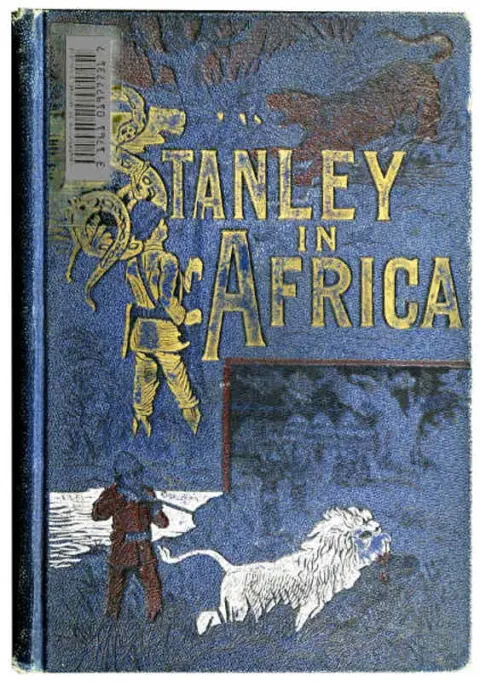
Stanley in Africa The Wonderful Discoveries and Thrilling Adventures of the Great African Explorer, and Other Travelers, Pioneers and Missionaries
James P. (James Penny) Boyd
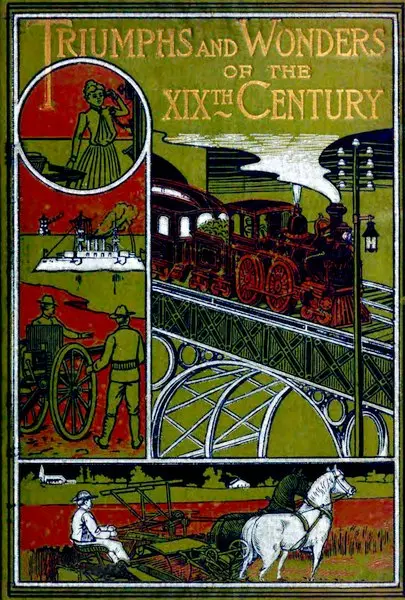
THE CLASSIC COLLECTION · 1899
"Triumphs and Wonders of the 19th Century: The True Mirror of a Phenomenal Era" by James P. Boyd is a historical account written in the late 19th century. This work aims to review and reflect on the significant achievements and advancements made during the 19th century, touching on various domains such as material, intellectual, social, and moral progress. It presents a comprehensive overview of the era's progress, showcasing the spirit and energy that defined the time and served to illustrate its remarkable contributions to human civilization. The opening of the book sets the stage for a grand examination of the incredible changes that took place throughout the 19th century, highlighting the transformation in numerous fields such as industry, science, art, and literature. Boyd emphasizes the unique character of the 19th century as a period of unparalleled innovation compared to prior eras, citing various advancements that have improved human life. Additionally, he explains the structure of the volume and introduces the numerous authors who will contribute to exploring these themes with specialized knowledge, promising readers an enlightening journey through the remarkable achievements of this phenomenal era.
Introduction adapted from the source catalogue; source summaries may be automatically generated.
Free to read · English · 300,037 words · No account needed
MAKE TIME FOR A GOOD BOOK
On by default. Untick to stop anonymous reading totals. Each page counts after 10 seconds in view. How this works.
Anonymous counting is on unless you have switched it off.
PHILANTHROPISTS.—Stephen Girard (b. May 24, 1750; d. December 26, 1831) was crabbed, unapproachable, penurious, irreligious, yet strangely liberal in large public or charitable affairs. Twice he helped the government with large loans. Public charities and improvements, hospitals, and paradoxically enough, even churches, were indebted to him for munificent gifts. The greatest monument to his philanthropy is Girard College, founded by a bequest of $8,000,000, for the education of poor white male orphans.
James Smithson, of England (b. about 1765; d. June 27, 1829), was possibly the first philanthropist to bestow a large endowment upon the United States. With the sum of $500,000 to $600,000, which came to it from this benevolent foreigner, the young republic founded and endowed the splendid Smithsonian Institute at Washington for the spread and increase of knowledge, thus putting Mr. Smithson in the highest rank of the world’s benefactors, and erecting an imperishable monument at another turning-point in the progress of civilization.
George Peabody (b. February 18, 1795; d. November 14, 1869) ranks as one of the century’s greatest philanthropists. Among his noblest gifts were $3,500,000 for free education and the training of teachers in the Southern States, $1,000,000 for a scientific institute at Baltimore, large sums to Harvard University, and a great amount to his native town, Danvers, Mass., for educational purposes. Dying in England, he left $2,500,000 to London, to found workingmen’s homes.
John Jacob Astor (b. July 17, 1763; d. March 29, 1848) used much of his colossal fortune in philanthropy. Perhaps his largest single gift, at least that by which he is best known as a benefactor, was the sum of $400,000 to found the Astor Library of New York city. This noble institution is conducted on the public plan, and contains nearly 300,000 volumes.
James Lick (b. August 25, 1796; d. October 1, 1876) amassed a fortune in California, out of which he provided a trust fund for certain public and charitable purposes. This fund amounted to $5,000,000 at the time of his death. To him is due the famous Lick Telescope in the University of California, which cost $700,000; the California School of Mechanic Arts, costing $540,000; the free public baths of San Francisco, costing $150,000; and numerous other charities and benefactions.
Leland Stanford (b. March 9, 1824; d. June 20, 1893) acquired a great fortune in California. Inspired by a dream at the time of his little son’s death, he determined to found and endow an institution of learning in his State. The result was the Leland Stanford Junior University, whose direct endowment was princely, and whose indirect endowment is expected to amount to $20,000,000 or more.
Your reading position is saved on this browser. Take it to another device with a library code. Reading pages adapt to text, rather than matching a printed edition.
BEHIND THE BOOK
This eBook is for the use of anyone anywhere in the United States and most other parts of the world at no cost and with almost no restrictions whatsoever. You may copy it, give it away or re-use it under the terms of the Project Gutenberg License included with this eBook or online at www.gutenberg.org. If you are not located in the United States, you will have to check the laws of the country where you are located before using this eBook. Read the source licence.
The original source file, including credits and licence, is retained by this library. Request an original-format copy at no charge. Please include the book title and Project Gutenberg identifier #55390.
KEEP YOUR CURIOSITY GOING
Cécile Tormay

Moritz Busch
John L. Ransom
Frances Wright
Cécile Tormay

Mabel Potter Daggett