
Stanley in Africa The Wonderful Discoveries and Thrilling Adventures of the Great African Explorer, and Other Travelers, Pioneers and Missionaries
James P. (James Penny) Boyd
THE CLASSIC COLLECTION · 1899
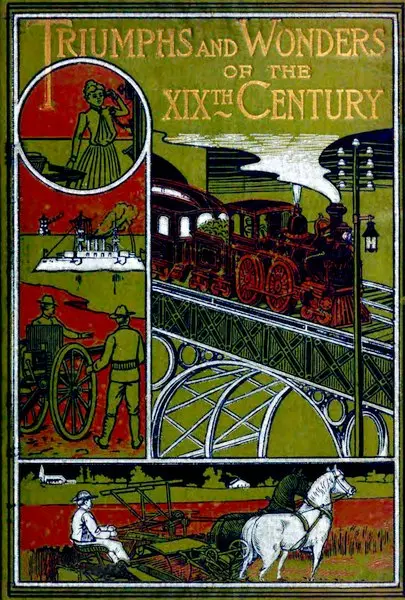
"Triumphs and Wonders of the 19th Century: The True Mirror of a Phenomenal Era" by James P. Boyd is a historical account written in the late 19th century. This work aims to review and reflect on the significant achievements and advancements made during the 19th century, touching on various domains such as material, intellectual, social, and moral progress. It presents a comprehensive overview of the era's progress, showcasing the spirit and energy that defined the time and served to illustrate its remarkable contributions to human civilization. The opening of the book sets the stage for a grand examination of the incredible changes that took place throughout the 19th century, highlighting the transformation in numerous fields such as industry, science, art, and literature. Boyd emphasizes the unique character of the 19th century as a period of unparalleled innovation compared to prior eras, citing various advancements that have improved human life. Additionally, he explains the structure of the volume and introduces the numerous authors who will contribute to exploring these themes with specialized knowledge, promising readers an enlightening journey through the remarkable achievements of this phenomenal era.
Introduction adapted from the source catalogue; source summaries may be automatically generated.
Free to read · English · 300,037 words · No account needed
MAKE TIME FOR A GOOD BOOK
On by default. Untick to stop anonymous reading totals. Each page counts after 10 seconds in view. How this works.
Anonymous counting is on unless you have switched it off.
At certain intervals the national government, States, cities, and hundreds of industrial enterprises distribute earnings and accrued interest to those entitled to the same. The vast sums of money drawn out of thousands of banks and banking institutions represent millions of dollars of canceled debts. Within a few days after these distributions take place, at least nine tenths of this money finds its way back into the strong boxes that parted with it. One tenth of the money is, perhaps, held in the pockets of the people, to be gradually disbursed for current needs until the next pay arrives. I do not remember having received a statement or statistical report referring to the building association share in these distributions.
True, there are no set dates for building societies to part with money, but in Pennsylvania alone these coöperative companies distribute $20,000,000 annually in matured shares and withdrawals. This is no insignificant sum. To-day their accumulated wealth (mostly savings of people in the humbler ranks of life) is over $107,000,000, and in the United States fully $600,000,000. The annual outgo for canceled shares is about $100,000,000, or fully $8,000,000 every month.
Since these associations were organized, quite one thousand five hundred million dollars have been returned to the members in the value of homes clear of debt and in cash for withdrawn and matured shares. Despite these vast disbursements, there has been a gradual increase in their assets from year to year.
Beginning with one association in 1831, their number increased in a small way until probably not over two hundred societies existed in 1800. From that date until the present moment it is estimated that over 8000 have been organized throughout the land, increasing at a rapid rate every year, and leaving at present, after closing out a great number, nearly 5000 active associations distributed among the States as follows:—
--------------+------------+-------------+------------- | No. of | | States. | Societies. | Membership. | Assets. --------------+------------+-------------+------------- Pennsylvania | 1200 | 300,000 | $111,714,871 Ohio | 761 | 297,787 | 99,770,161 Illinois | 682 | 180,000 | 73,309,192 New Jersey | 300 | 116,739 | 41,038,934 Indiana | 492 | 137,510 | 37,624,418 New York | 317 | 102,902 | 37,385,642 Massachusetts | 123 | 65,419 | 24,507,843 Missouri | 255 | 49,462 | 22,497,700 California | 138 | 19,153 | 17,938,100 Iowa | 87 | 25,000 | 6,594,778 Michigan | 70 | 20,497 | 6,495,307 Minnesota | 69 | 9,000 | 4,260,666 Tennessee | 34 | 6,166 | 3,771,354 Nebraska | 68 | 11,821 | 3,554,788 Connecticut | 15 | 11,208 | 3,243,935 Maine | 33 | 8,230 | 2,912,963 Other States | 228 | 281,284 | 104,320,367 | | +------------- Totals | 4872 | 1,642,178 | $600,941,019 --------------+------------+-------------+-------------
It is estimated that of the above named membership over 325,000 are women. Of the $600,000,000 of assets, at least $100,000,000 is a gain credit to the sharer. It is believed that an average of at least three members of a family contribute toward the payment of the dues and interest, and although seventeen hundred thousand names are on the books, nearly five million persons actually contribute.
Your reading position is saved on this browser. Take it to another device with a library code. Reading pages adapt to text, rather than matching a printed edition.
BEHIND THE BOOK
This eBook is for the use of anyone anywhere in the United States and most other parts of the world at no cost and with almost no restrictions whatsoever. You may copy it, give it away or re-use it under the terms of the Project Gutenberg License included with this eBook or online at www.gutenberg.org. If you are not located in the United States, you will have to check the laws of the country where you are located before using this eBook. Read the source licence.
The original source file, including credits and licence, is retained by this library. Request an original-format copy at no charge. Please include the book title and Project Gutenberg identifier #55390.
KEEP YOUR CURIOSITY GOING
Cécile Tormay

Moritz Busch
John L. Ransom
Frances Wright
Cécile Tormay

Mabel Potter Daggett