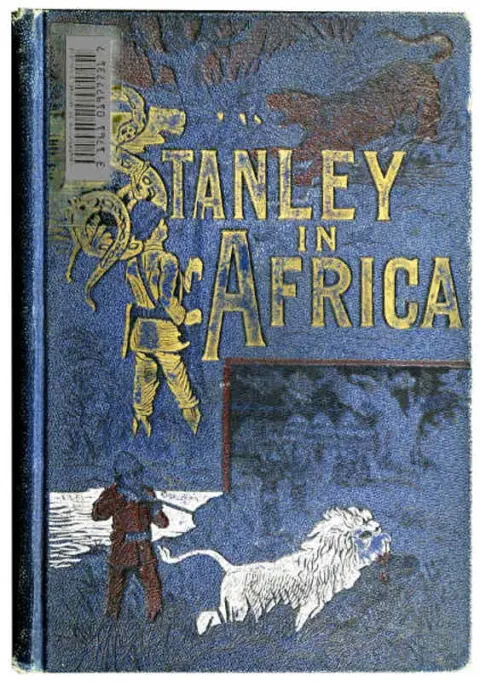
Stanley in Africa The Wonderful Discoveries and Thrilling Adventures of the Great African Explorer, and Other Travelers, Pioneers and Missionaries
James P. (James Penny) Boyd
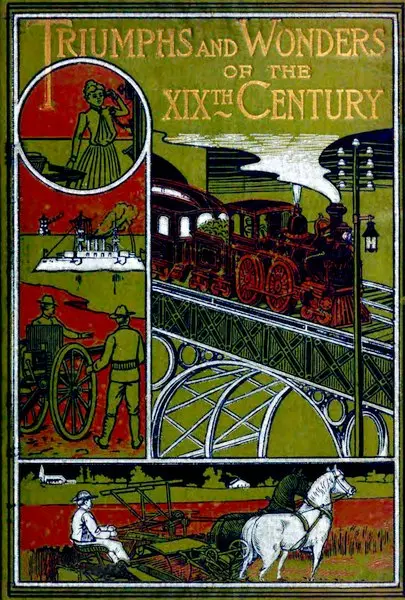
THE CLASSIC COLLECTION · 1899
"Triumphs and Wonders of the 19th Century: The True Mirror of a Phenomenal Era" by James P. Boyd is a historical account written in the late 19th century. This work aims to review and reflect on the significant achievements and advancements made during the 19th century, touching on various domains such as material, intellectual, social, and moral progress. It presents a comprehensive overview of the era's progress, showcasing the spirit and energy that defined the time and served to illustrate its remarkable contributions to human civilization. The opening of the book sets the stage for a grand examination of the incredible changes that took place throughout the 19th century, highlighting the transformation in numerous fields such as industry, science, art, and literature. Boyd emphasizes the unique character of the 19th century as a period of unparalleled innovation compared to prior eras, citing various advancements that have improved human life. Additionally, he explains the structure of the volume and introduces the numerous authors who will contribute to exploring these themes with specialized knowledge, promising readers an enlightening journey through the remarkable achievements of this phenomenal era.
Introduction adapted from the source catalogue; source summaries may be automatically generated.
Free to read · English · 300,037 words · No account needed
MAKE TIME FOR A GOOD BOOK
On by default. Untick to stop anonymous reading totals. Each page counts after 10 seconds in view. How this works.
Anonymous counting is on unless you have switched it off.
In France, the advance of sculpture has been more continual and consistent, the national artistic temperament finding abundant means of expression in the plastic art. The French dramatic instinct has a sure perception of the effect of a pose, the value of graceful or vigorous lines and the balance of proportion, so that whether under bonds to academic tradition in matters of technique, or broken loose and working under individual inspiration, the French sculptor is likely to create an artistic result. The minds of the common people are more awakened to artistic impressions through the general excellence of the public monuments and sculptural decorations, so freely displayed throughout the land, than are the masses in countries where art is at a low standard. Until after the middle of the century, French sculpture, like the rest, was mainly of smooth and delicate finish and inclined to be romantic, though François Rude was powerful and vigorous, as shown in his patriotic group “Le Chant du Départ” on the Arc de Triomphe. In England, the seeds of Flaxman’s sowing slowly began to bear fruit in an awakening public interest, though the earlier efforts were sedate and conventional rather than spirited, the most important works being dignified and stately monuments and memorials. Westmacott (1777–1856), Francis Chantrey (1782–1841), whose large fortune was bequeathed to the Royal Academy as the “Chantrey Fund;” John Gibson (1791–1866), a pupil of Canova; Henry Weeks (1807–1877), who made the first bust of Victoria as Queen; and Alfred G. Stevens (1817–1875), are a few of the more notable men of the past generation. Thomas Woolner (1825–1892) expressed the feeling of the pre-Raphaelite movement in sculpture, as did Hunt, Burne-Jones, and Rossetti in painting.
American sculpture began with the new century and, like most American growths, began in a very small way; for although Rush had made a few figures, notably a fountain now in Fairmount Park, one of the first pieces of sculptural work in the country was that of a poor New Jersey stone-cutter, John Frazee, who tried to comfort himself for the death of his child by making a memorial figure of him, although he had never seen a statue. From this meagre beginning started a line of ever-increasing strength, until now, in the plastic arts, as in all others, we can hold our own with the best in the world. Of course the earlier students, led by Horatio Greenough, of Boston, Hiram Powers, of Vermont, and Thomas Crawford, of New York, made their way to Rome, where they applied the traditional methods to traditional subjects with conventional results. Greenough’s colossal statue of Washington is in the Capitol grounds; Powers’s “Greek Slave” is owned by the Duke of Cleveland; and Crawford’s “Orpheus seeking Eurydice,” now in the Boston Museum, and “Colossal Liberty” in the Capitol, are his best-known works. Erastus Palmer, of Albany, contemporary with these, developed his talent at home, and secured models and subjects from his own neighborhood, giving a distinctly American character to his work. Among the most noted of the American colony at Rome, although not particularly given to American subjects, was William Wetmore Story, of Salem, Mass., born in 1819. Thomas Ball, born in the same State in the same year, was of the same class in Rome; but his themes are more patriotic, notably the “Emancipation” group in Washington. Harriet Hosmer is the first feminine name on the American list of sculptors. She also settled in Rome, where she completed many works. William Henry Rinehart and Randolph Rogers were both of the idealist school, the latter completing Crawford’s unfinished Washington monument at Richmond. The name of Rogers is more commonly connected with the familiar little statuette groups of every-day domestic scenes so appealing to the popular taste. The sculptor John Rogers, of Massachusetts, has also made a few large works, among them the equestrian statue of General Reynolds, before the City Hall, Philadelphia. Henry Kirke Browne (1814–1886) made a number of equestrian statues of note, one of Washington being the first bronze actually cast in America. His figure of General Scott was cast from captured cannon, relics of the Mexican war. His pupils, Larkin Meade and J. Q. A. Ward, both attained high places, the latter being especially prominent in the progress of American sculpture through such works as his colossal Washington for the New York Treasury Building, and his “Indian Hunter,” “Pilgrim,” and “Shakespeare,” in Central Park.
Your reading position is saved on this browser. Take it to another device with a library code. Reading pages adapt to text, rather than matching a printed edition.
BEHIND THE BOOK
This eBook is for the use of anyone anywhere in the United States and most other parts of the world at no cost and with almost no restrictions whatsoever. You may copy it, give it away or re-use it under the terms of the Project Gutenberg License included with this eBook or online at www.gutenberg.org. If you are not located in the United States, you will have to check the laws of the country where you are located before using this eBook. Read the source licence.
The original source file, including credits and licence, is retained by this library. Request an original-format copy at no charge. Please include the book title and Project Gutenberg identifier #55390.
KEEP YOUR CURIOSITY GOING
Cécile Tormay

Moritz Busch
John L. Ransom
Frances Wright
Cécile Tormay

Mabel Potter Daggett