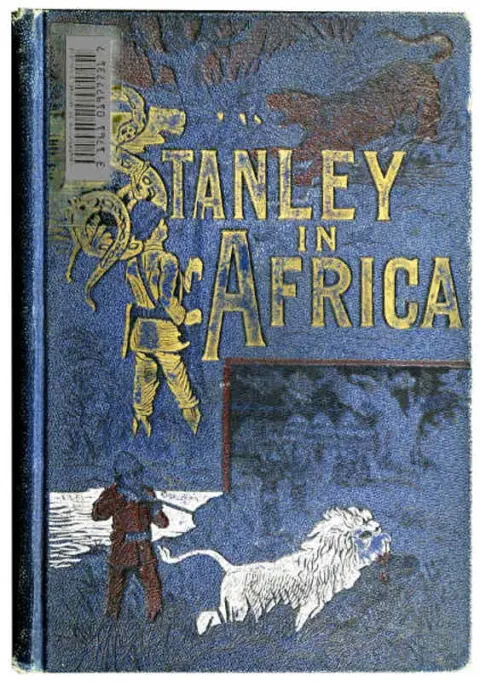
Stanley in Africa The Wonderful Discoveries and Thrilling Adventures of the Great African Explorer, and Other Travelers, Pioneers and Missionaries
James P. (James Penny) Boyd
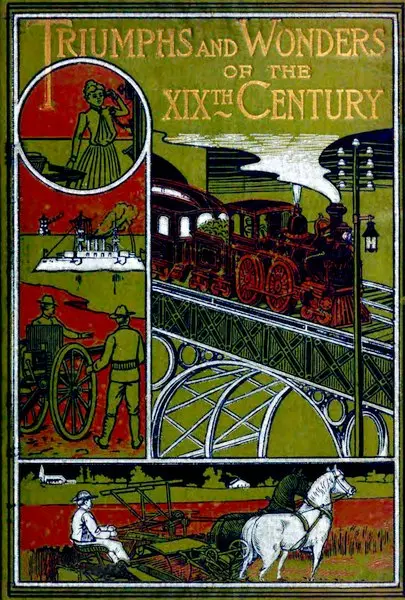
THE CLASSIC COLLECTION · 1899
"Triumphs and Wonders of the 19th Century: The True Mirror of a Phenomenal Era" by James P. Boyd is a historical account written in the late 19th century. This work aims to review and reflect on the significant achievements and advancements made during the 19th century, touching on various domains such as material, intellectual, social, and moral progress. It presents a comprehensive overview of the era's progress, showcasing the spirit and energy that defined the time and served to illustrate its remarkable contributions to human civilization. The opening of the book sets the stage for a grand examination of the incredible changes that took place throughout the 19th century, highlighting the transformation in numerous fields such as industry, science, art, and literature. Boyd emphasizes the unique character of the 19th century as a period of unparalleled innovation compared to prior eras, citing various advancements that have improved human life. Additionally, he explains the structure of the volume and introduces the numerous authors who will contribute to exploring these themes with specialized knowledge, promising readers an enlightening journey through the remarkable achievements of this phenomenal era.
Introduction adapted from the source catalogue; source summaries may be automatically generated.
Free to read · English · 300,037 words · No account needed
MAKE TIME FOR A GOOD BOOK
On by default. Untick to stop anonymous reading totals. Each page counts after 10 seconds in view. How this works.
Anonymous counting is on unless you have switched it off.
The total product of gold in the United States from 1792 up to 1896 was $2,113,034,769, and of silver $1,444,970,000, making a grand total of the precious metals of $3,558,004,769. The total value of the entire world’s production of gold, between the years 1493 and 1896, was $8,983,320,600, and of silver $10,556,700,800, making a grand total of gold and silver of $19,540,021,400.
As a comparison of the money status of the United States at the beginning and end of the century, the following figures are interesting: In 1800 the population was 5,308,483; the estimated bank notes outstanding, $10,500,000; the estimated specie in the country, $17,500,000; the total money in the United States, $28,000,000; the specie in the Treasury, $1,500,000; the money in circulation, $26,500,000; the amount per capita, $4.99. In 1898 the population was 74,522,000; the total coin in the United States, including bullion in the Treasury, $1,498,993,249; total paper money, $1,138,440,126; total money of all kinds, $2,637,433,375; coin, bullion, and paper money in the Treasury, $799,537,480; total circulation, $1,837,859,895; circulation per capita, $24.66.
Perhaps no law relating to the coins and currency of the United States has been so widely discussed, or has borne more directly on the attitude and influence of political parties than the Coinage Act of 1873. This act grew out of a proposition to revise our coinage laws, made by John Jay Knox to the Secretary of the Treasury, in April, 1870. Mr. Knox, in his rough draft of a bill, provided for a silver dollar of 384 grains, to be a legal tender for sums not exceeding $5.00. Thus, the standard silver dollar of 412½ grains was eliminated. It did not appear in the bill as it passed the Senate, January 10, 1871, nor in that reported to the House, March 9, 1871. The bill underwent protracted and thorough discussion, and on May 27, 1872, was passed in the House. As passed, it contained the original provision for coining a silver dollar of the weight of 384 grains—twice the weight of the silver half dollar. These dollars were to be a legal tender for amounts not exceeding $5.00. The Senate amended this House bill, by substituting a trade dollar of the weight of 420 grains for that of 384 grains, at the same time preserving the legal-tender limit of $5.00. In the amended form, it passed the Senate, January 17, 1873, and the House, February 7, 1873, and became a law. It will be seen that the standard silver dollar of 412½ grains was never in the bill, and could not, therefore, have been secretly omitted, as was afterwards charged. It was omitted from the first draft, and all through, because none were being coined, and those that had been coined were exported, the silver bullion in them being, at that time, worth more as bullion than coin. By joint resolution of Congress, approved July 22, 1876, the trade dollars provided for in the act were deprived of their legal-tender quality. It was supposed they would circulate in China, but they proved useless even for that purpose.
Your reading position is saved on this browser. Take it to another device with a library code. Reading pages adapt to text, rather than matching a printed edition.
BEHIND THE BOOK
This eBook is for the use of anyone anywhere in the United States and most other parts of the world at no cost and with almost no restrictions whatsoever. You may copy it, give it away or re-use it under the terms of the Project Gutenberg License included with this eBook or online at www.gutenberg.org. If you are not located in the United States, you will have to check the laws of the country where you are located before using this eBook. Read the source licence.
The original source file, including credits and licence, is retained by this library. Request an original-format copy at no charge. Please include the book title and Project Gutenberg identifier #55390.
KEEP YOUR CURIOSITY GOING
Cécile Tormay

Moritz Busch
John L. Ransom
Frances Wright
Cécile Tormay

Mabel Potter Daggett