
Stanley in Africa The Wonderful Discoveries and Thrilling Adventures of the Great African Explorer, and Other Travelers, Pioneers and Missionaries
James P. (James Penny) Boyd
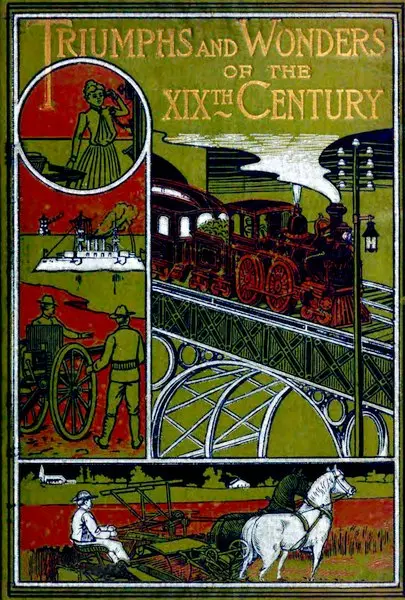
THE CLASSIC COLLECTION · 1899
"Triumphs and Wonders of the 19th Century: The True Mirror of a Phenomenal Era" by James P. Boyd is a historical account written in the late 19th century. This work aims to review and reflect on the significant achievements and advancements made during the 19th century, touching on various domains such as material, intellectual, social, and moral progress. It presents a comprehensive overview of the era's progress, showcasing the spirit and energy that defined the time and served to illustrate its remarkable contributions to human civilization. The opening of the book sets the stage for a grand examination of the incredible changes that took place throughout the 19th century, highlighting the transformation in numerous fields such as industry, science, art, and literature. Boyd emphasizes the unique character of the 19th century as a period of unparalleled innovation compared to prior eras, citing various advancements that have improved human life. Additionally, he explains the structure of the volume and introduces the numerous authors who will contribute to exploring these themes with specialized knowledge, promising readers an enlightening journey through the remarkable achievements of this phenomenal era.
Introduction adapted from the source catalogue; source summaries may be automatically generated.
Free to read · English · 300,037 words · No account needed
MAKE TIME FOR A GOOD BOOK
On by default. Untick to stop anonymous reading totals. Each page counts after 10 seconds in view. How this works.
Anonymous counting is on unless you have switched it off.
The principal buildings, with their cost, were those of Manufactures and Liberal Arts, the largest of all, 1687 by 787 feet, $1,500,000; Machinery, $1,285,000; Fine Arts, $670,000; Agriculture, $618,000; Administration, $435,000; Electricity, $401,000; United States Government, $400,000; Live Stock, $385,000; Transportation, $370,000; Horticulture, $300,000; Mines, $265,000; Fisheries, $224,000; Woman’s, $138,000; Forestry, $100,000; and a brick imitation of a modern United States battleship, with complete armament and equipment, $100,000. Foreign governments appropriated a total of $6,571,520 for their respective buildings and exhibits, France leading with $650,000, and being followed by Japan, $630,000; Brazil, $600,000; Germany, $214,200; and Austria, $149,100; and the States and Territories, a total of $6,020,850. The entire cost of construction was $18,322,622.
According to the original Act of Congress, the buildings then completed were dedicated on Columbus Day, October 21, 1892, with prayer, music, and an oration by Chauncey M. Depew, and during that week a number of State buildings were also dedicated. The exposition was formally opened with exceedingly brilliant ceremonies on May 1, 1893, and was closed with an entire lack of formality on October 30, following, in consequence of the assassination of Carter Harrison, mayor of Chicago, two days before. Up to November 12, the receipts from all sources aggregated $33,290,065, and the expenditures, $31,117,353. The total number of paid admissions, excluding those prior to the opening and after the closing, was 21,477,218, and of all, 27,529,400; smallest single-day number, 10,791; largest, on “Chicago Day,” 729,203. In all there were 65,422 exhibitors, and medals were awarded to 23,757 of them, the jury examining and reporting on more than 250,000 separate exhibits.
Present space will only permit the briefest summarizing of this greatest of all international expositions hitherto held,—matchless in extent, in completeness of composition, in grandeur of setting. A pleasing evidence of the influence the undertaking was expected to yield is found in the remarkably large number of international congresses that were held during its progress. This feature alone called for 1245 separate sessions, at which there were 5974 speakers and a special attendance of more than 700,000 persons, chiefly adults. Almost every conceivable branch of human thought and effort had its individual congress. Particularly noticeable among these formal gatherings was the Parliament of Religions, in which Christian, Protestant, Catholic, Jew, and Buddhist expounded their doctrinal beliefs and narrated the story of their sectarian progress and hopes.
The Cotton States’ and International Exposition, opened in Atlanta on September 18, 1895, had its origin in two purposes: the first, to give the industrial conditions of the Southern States a more adequate display than they had at Chicago, owing to the constitutional inability of their Legislatures to appropriate public money for such a purpose; the second, to promote larger trade relations between the South and the Latin-American republics and with Europe. It was set on foot by private enterprise, and received its largest official aid from the city council of Atlanta, which appropriated $75,000.
Your reading position is saved on this browser. Take it to another device with a library code. Reading pages adapt to text, rather than matching a printed edition.
BEHIND THE BOOK
This eBook is for the use of anyone anywhere in the United States and most other parts of the world at no cost and with almost no restrictions whatsoever. You may copy it, give it away or re-use it under the terms of the Project Gutenberg License included with this eBook or online at www.gutenberg.org. If you are not located in the United States, you will have to check the laws of the country where you are located before using this eBook. Read the source licence.
The original source file, including credits and licence, is retained by this library. Request an original-format copy at no charge. Please include the book title and Project Gutenberg identifier #55390.
KEEP YOUR CURIOSITY GOING
Cécile Tormay

Moritz Busch
John L. Ransom
Frances Wright
Cécile Tormay

Mabel Potter Daggett