
Stanley in Africa The Wonderful Discoveries and Thrilling Adventures of the Great African Explorer, and Other Travelers, Pioneers and Missionaries
James P. (James Penny) Boyd
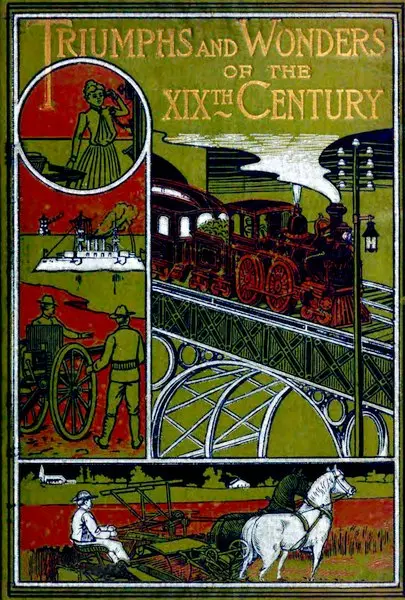
THE CLASSIC COLLECTION · 1899
"Triumphs and Wonders of the 19th Century: The True Mirror of a Phenomenal Era" by James P. Boyd is a historical account written in the late 19th century. This work aims to review and reflect on the significant achievements and advancements made during the 19th century, touching on various domains such as material, intellectual, social, and moral progress. It presents a comprehensive overview of the era's progress, showcasing the spirit and energy that defined the time and served to illustrate its remarkable contributions to human civilization. The opening of the book sets the stage for a grand examination of the incredible changes that took place throughout the 19th century, highlighting the transformation in numerous fields such as industry, science, art, and literature. Boyd emphasizes the unique character of the 19th century as a period of unparalleled innovation compared to prior eras, citing various advancements that have improved human life. Additionally, he explains the structure of the volume and introduces the numerous authors who will contribute to exploring these themes with specialized knowledge, promising readers an enlightening journey through the remarkable achievements of this phenomenal era.
Introduction adapted from the source catalogue; source summaries may be automatically generated.
Free to read · English · 300,037 words · No account needed
MAKE TIME FOR A GOOD BOOK
On by default. Untick to stop anonymous reading totals. Each page counts after 10 seconds in view. How this works.
Anonymous counting is on unless you have switched it off.
Troops were called for by Lincoln. Lieutenant-General Scott, the veteran hero of Mexico, was in command of the army. In three months, three hundred thousand men were in the field. One hundred thousand had swarmed to the Confederate ranks. General McClellan was sent to the front and, after the resignation of Scott in the latter part of the year, was made commander of the army.
July 21, the battle of Bull Run was fought. The Union troops were disastrously routed and retreated in confusion to Washington. The army did little more during this year.
April 21, after setting fire to and destroying the Navy Yard and ships, Norfolk was evacuated by the Union forces. The frigate Merrimac, which had been sunk, was raised by the Confederates, plated with iron, renamed “Virginia,” and became the scourge of the shipping off the Virginia coast.
The navy, as is usual, and because of its very organization, got in its effective work much earlier than did the army, and the seizure of the forts and ports on the coast of the seceded States began at once. Fort Hatteras was taken August 29; Port Royal, in South Carolina, November 7. November 7 a naval officer, by overhauling an English mail steamer and taking off Messrs. Mason and Slidell, who had been appointed commissioners of the Confederate States to France and England, very nearly caused a complication with the latter power. Mr. Seward’s diplomacy settled the incident amicably, and the commissioners were allowed to proceed upon their mission, which, however, proved futile. By the close of the year, Maryland, Kentucky, and Missouri, at first doubtful, were securely in the Union, though many of their citizens were in the Southern army.
1862.—February 6, General Grant, commanding the army of the Tennessee, with the assistance of Commodore Foote and his gunboats, captured Fort Henry, on the Tennessee River, and, on the 16th, Fort Donelson on the Cumberland. The Federal forces had reached the number of four hundred and fifty thousand, of which McClellan had two hundred thousand.
May 23, at Front Royal, and May 25, at Winchester, “Stonewall” Jackson defeated the Union troops and forced them across the Potomac. Banks, Fremont, and McDowell, concentrating their forces, bore down on Jackson, who slipped through their lines, and, on June 9, defeated Shields at Fort Republic.
The cry of the Northern press was, “On to Richmond,” and McClellan endeavored to obey the command. He had arrived not far from the city, between the York and James rivers, when he was defeated in the bloody battle of Seven Pines, May 31 and June 1. The Confederate General Johnston was wounded, and General Lee was assigned to the command of the army of Northern Virginia, which he retained until the end.
Your reading position is saved on this browser. Take it to another device with a library code. Reading pages adapt to text, rather than matching a printed edition.
BEHIND THE BOOK
This eBook is for the use of anyone anywhere in the United States and most other parts of the world at no cost and with almost no restrictions whatsoever. You may copy it, give it away or re-use it under the terms of the Project Gutenberg License included with this eBook or online at www.gutenberg.org. If you are not located in the United States, you will have to check the laws of the country where you are located before using this eBook. Read the source licence.
The original source file, including credits and licence, is retained by this library. Request an original-format copy at no charge. Please include the book title and Project Gutenberg identifier #55390.
KEEP YOUR CURIOSITY GOING
Cécile Tormay

Moritz Busch
John L. Ransom
Frances Wright
Cécile Tormay

Mabel Potter Daggett