
Stanley in Africa The Wonderful Discoveries and Thrilling Adventures of the Great African Explorer, and Other Travelers, Pioneers and Missionaries
James P. (James Penny) Boyd
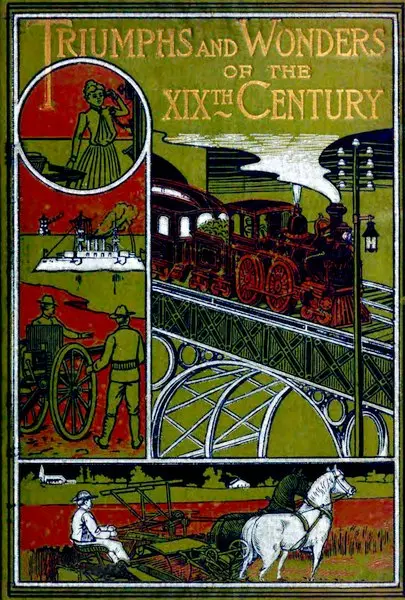
THE CLASSIC COLLECTION · 1899
"Triumphs and Wonders of the 19th Century: The True Mirror of a Phenomenal Era" by James P. Boyd is a historical account written in the late 19th century. This work aims to review and reflect on the significant achievements and advancements made during the 19th century, touching on various domains such as material, intellectual, social, and moral progress. It presents a comprehensive overview of the era's progress, showcasing the spirit and energy that defined the time and served to illustrate its remarkable contributions to human civilization. The opening of the book sets the stage for a grand examination of the incredible changes that took place throughout the 19th century, highlighting the transformation in numerous fields such as industry, science, art, and literature. Boyd emphasizes the unique character of the 19th century as a period of unparalleled innovation compared to prior eras, citing various advancements that have improved human life. Additionally, he explains the structure of the volume and introduces the numerous authors who will contribute to exploring these themes with specialized knowledge, promising readers an enlightening journey through the remarkable achievements of this phenomenal era.
Introduction adapted from the source catalogue; source summaries may be automatically generated.
Free to read · English · 300,037 words · No account needed
MAKE TIME FOR A GOOD BOOK
On by default. Untick to stop anonymous reading totals. Each page counts after 10 seconds in view. How this works.
Anonymous counting is on unless you have switched it off.
In 1861, Reis, of Germany, came into notice as the inventor of a telephone which transmitted sound very clearly, but failed to reproduce syllabified speech. However, the principle and shape of his transmitter and receiver were accepted by those who followed him. Two men now came upon the scene who had reached the conclusion already arrived at by Drawbaugh, and who became rivals over his head for the honor and profit of an invention by means of which the quality of the voice in speaking could be transmitted. These two were Elisha Gray, of Chicago, and Alexander Graham Bell, of Boston. Their respective devices seem to have been akin, and to have been presented to the patent office almost simultaneously; so nearly so, at least, as to make them a part of that long, costly, and acrimonious legal contention over priority of invention which did not end till 1887.
Both Bell and Gray reached the conclusion that the transmission of articulate speech was impossible unless they could produce electrical undulations corresponding exactly with the vibrations of the air or sound waves. They brought this similarity about by introducing a variable resistance into the electric current by means of an interposing liquid, just as Drawbaugh had done years before with his tumbler of powdered charcoal. Bell exhibited his instrument with comparative success at the Centennial Exhibition in 1876 in Philadelphia; but much had yet to be done to perfect a telephone of real commercial value.
The years 1877–78 were years of great activity among electricians, whose prime object was to perfect a telephone transmitter and receiver, by means of whose mutual operations at opposite ends of a circuit all the modulations of speech could be preserved and passed. To this end Berliner introduced into a transmitter or sender the then well-known principle of the microphone (Gr. mikros, small, phone, sound), which magnified the faint sounds by the variation in electrical resistance, caused by variation of pressure at loose contact between two metal points or electrodes. Edison quickly followed with a similar transmitter or sender, in which one of the electrodes was of soft carbon, the other of metal. Then came (1878) Hughes and Blake with senders, in which both of the electrodes were of hard carbon. Subsequently came other and rapid modifications of the sender, both in the United States and Europe, till the form of telephone now in popular use was arrived at, and which, strange to say, is, in its method of securing the necessary variable resistance in the circuit, quite like that employed by Mr. Drawbaugh; to wit, the introduction of fine carbon granules into a small metal cup just behind the vibrating diaphragm or disk of the sender. The circuit goes into the diaphragm in front, passing through the carbon granules and out through the back of the instrument. The action of talking into the sender causes the granules to be agitated, thus opening and closing the circuit and producing the conditions necessary to the transmission of articulate speech. The diaphragm or disk is the very thin covering of the cup containing the granules. It is sometimes made of carbon, but generally of hard metal, as steel. On being struck by the sound waves of the voice, it vibrates to correspond. The same vibrations are reproduced in the receiver at the opposite end of the circuit, and thus one listens to the phenomenon of transmitted human speech. The current for telephonic purposes is furnished by one or more batteries or cells, whose effect is heightened by the presence of an induction coil. The tendency now is to make “bipolars”—two contacts at the diaphragm—in place of a single contact. This style is becoming more in vogue in order to meet the demands of long-distance work. To each telephone is attached a generator or device for ringing a little bell as a signal that some one wishes to communicate. To such perfection have telephones been brought that it is quite possible to converse intelligibly at the distance of a thousand miles, with a less satisfactory service at twice or thrice that distance. The possibilities of clear speech-transmission at indefinite distance are without measure. Like the telegraph, the telephone has opened an immense and profitable industry, involving hundreds of millions of dollars. At the end of the century it is, unfortunately, monopolistic; but the time is near when a reasonable charge for service will enable every business house to communicate with its customers, and when even the remote corners of counties will be brought into touch with their capitals and with one another. Along the lines of civilizing contact the telephone fairly divides the wonders of the century with the telegraph, while for intimate intellectual communication it is a triumph of genius without parallel. It is the dispenser of speech in city, town, and village; in factory and mine, in army and navy; throughout government departments; and in Budapest, Hungary, it is a purveyor of general news, like the newspaper, for the “Telephone Gazette” of that city has a list of regular subscribers, to whom it transmits, at private houses, clubs, cafes, restaurants, and public buildings, its editorials, telegrams, local news, and advertisements.
Your reading position is saved on this browser. Take it to another device with a library code. Reading pages adapt to text, rather than matching a printed edition.
BEHIND THE BOOK
This eBook is for the use of anyone anywhere in the United States and most other parts of the world at no cost and with almost no restrictions whatsoever. You may copy it, give it away or re-use it under the terms of the Project Gutenberg License included with this eBook or online at www.gutenberg.org. If you are not located in the United States, you will have to check the laws of the country where you are located before using this eBook. Read the source licence.
The original source file, including credits and licence, is retained by this library. Request an original-format copy at no charge. Please include the book title and Project Gutenberg identifier #55390.
KEEP YOUR CURIOSITY GOING
Cécile Tormay

Moritz Busch
John L. Ransom
Frances Wright
Cécile Tormay

Mabel Potter Daggett