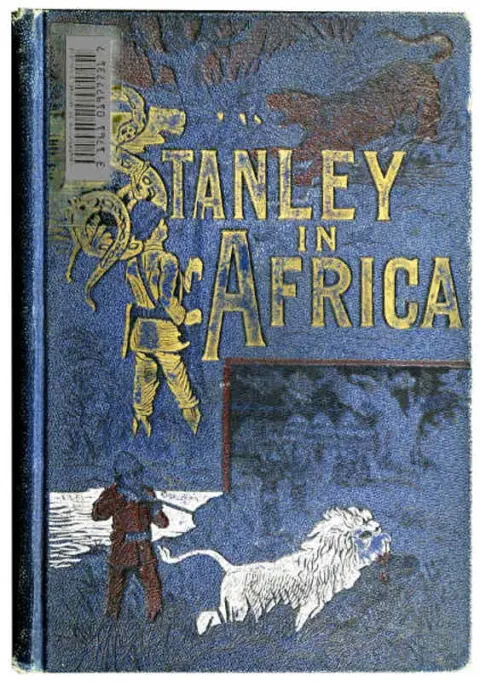
Stanley in Africa The Wonderful Discoveries and Thrilling Adventures of the Great African Explorer, and Other Travelers, Pioneers and Missionaries
James P. (James Penny) Boyd
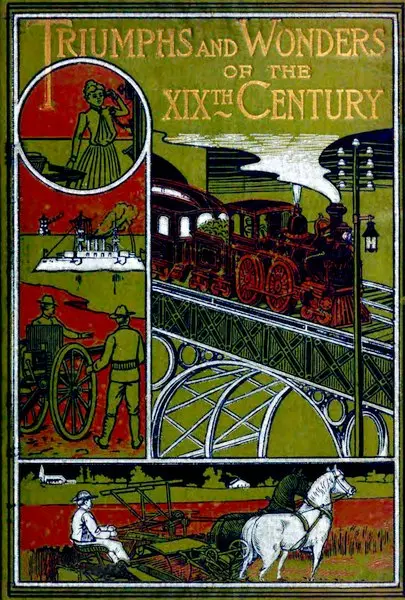
THE CLASSIC COLLECTION · 1899
"Triumphs and Wonders of the 19th Century: The True Mirror of a Phenomenal Era" by James P. Boyd is a historical account written in the late 19th century. This work aims to review and reflect on the significant achievements and advancements made during the 19th century, touching on various domains such as material, intellectual, social, and moral progress. It presents a comprehensive overview of the era's progress, showcasing the spirit and energy that defined the time and served to illustrate its remarkable contributions to human civilization. The opening of the book sets the stage for a grand examination of the incredible changes that took place throughout the 19th century, highlighting the transformation in numerous fields such as industry, science, art, and literature. Boyd emphasizes the unique character of the 19th century as a period of unparalleled innovation compared to prior eras, citing various advancements that have improved human life. Additionally, he explains the structure of the volume and introduces the numerous authors who will contribute to exploring these themes with specialized knowledge, promising readers an enlightening journey through the remarkable achievements of this phenomenal era.
Introduction adapted from the source catalogue; source summaries may be automatically generated.
Free to read · English · 300,037 words · No account needed
MAKE TIME FOR A GOOD BOOK
On by default. Untick to stop anonymous reading totals. Each page counts after 10 seconds in view. How this works.
Anonymous counting is on unless you have switched it off.
Ponchielli, who was born in 1834 and died in 1886, will be principally remembered by his remarkably beautiful opera, “La Gioconda” (produced in 1876), which, together with a re-written version of his first opera, “I Promessi Sposi,” gave him great popularity in Italy and spread his reputation to other countries.
As for Italy’s young composers that profess to represent the modern Italian school of opera, they are led by Puccini, whose “Manon Lescaut” and “La Bohême” are melodious and full of merit.
Mascagni and Leoncavallo, whose “Cavalleria Rusticana” and “I Pagliacci” achieved popularity, have not realized expectations. Nor has Giordano, whose “Andrea Chenier” was well received in Italy.
Bizet, whose “Carmen” is one of the most remarkable of modern operas, died in Paris in 1875. “Carmen” has remained in the repertoire. His other opera, “Les Pécheurs de Perles,” only achieved a moderate success.
One of France’s greatest musicians, Hector Berlioz, was born in 1803 and died in 1869. His operas, “Les Troyens,” “Benvenuto Cellini,” his “Damnation de Faust,” his “Roméo et Juliette” symphony, are all great and afforded Wagner a model that he imitated persistently.
In 1871 France lost one of its most talented operatic composers, Auber, whose “Masaniello” and “Fra Diavolo” are two of the most popular operas ever written by a Frenchman. Auber composed comic operas charmingly, and his “Domino Noir,” “Diamants de la Couronne,” “Haydée,” and other works of a similar character, entertained the French people for many years. Auber’s death has left a vacancy that has not been filled.
The modern French composers cannot be called great. Saint-Saens, whose most successful work is “Samson et Dalila” (which is more of an oratorio than an opera, and which was produced in 1877), has composed other operas, such as “Henri VIII.,” “Ascanio,” et cetera, which lack originality and inspiration.
Massenet has composed “Le Roi de Lahore,” “Hérodiade,” “Manon,” “Werther,” et cetera, that have had passing successes.
Both Saint-Saens and Massenet have attempted to follow Wagner in their sonorous orchestration; but their works lack distinction. The French composers of to-day have been demoralized by Wagner’s affectations.
The death of Ambroise Thomas, in 1895, caused France the loss of one of her most successful and accomplished operatic composers, whose “Mignon” will be long admired as a very charming opera comique, while his “Hamlet,” though containing portions that are ably written, has never attained outside France any remarkable success.
Reyer, whose “Sigurd” was produced in 1884 with considerable success, is a follower of Meyerbeer. His “Salammbo” was produced in 1890, but did not attract the attention expected outside of France.
Your reading position is saved on this browser. Take it to another device with a library code. Reading pages adapt to text, rather than matching a printed edition.
BEHIND THE BOOK
This eBook is for the use of anyone anywhere in the United States and most other parts of the world at no cost and with almost no restrictions whatsoever. You may copy it, give it away or re-use it under the terms of the Project Gutenberg License included with this eBook or online at www.gutenberg.org. If you are not located in the United States, you will have to check the laws of the country where you are located before using this eBook. Read the source licence.
The original source file, including credits and licence, is retained by this library. Request an original-format copy at no charge. Please include the book title and Project Gutenberg identifier #55390.
KEEP YOUR CURIOSITY GOING
Cécile Tormay

Moritz Busch
John L. Ransom
Frances Wright
Cécile Tormay

Mabel Potter Daggett