
Stanley in Africa The Wonderful Discoveries and Thrilling Adventures of the Great African Explorer, and Other Travelers, Pioneers and Missionaries
James P. (James Penny) Boyd
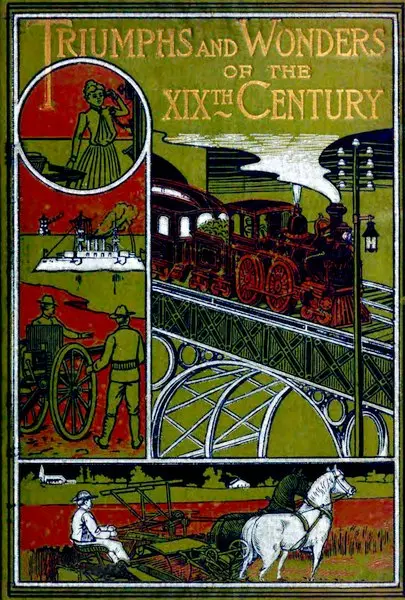
THE CLASSIC COLLECTION · 1899
"Triumphs and Wonders of the 19th Century: The True Mirror of a Phenomenal Era" by James P. Boyd is a historical account written in the late 19th century. This work aims to review and reflect on the significant achievements and advancements made during the 19th century, touching on various domains such as material, intellectual, social, and moral progress. It presents a comprehensive overview of the era's progress, showcasing the spirit and energy that defined the time and served to illustrate its remarkable contributions to human civilization. The opening of the book sets the stage for a grand examination of the incredible changes that took place throughout the 19th century, highlighting the transformation in numerous fields such as industry, science, art, and literature. Boyd emphasizes the unique character of the 19th century as a period of unparalleled innovation compared to prior eras, citing various advancements that have improved human life. Additionally, he explains the structure of the volume and introduces the numerous authors who will contribute to exploring these themes with specialized knowledge, promising readers an enlightening journey through the remarkable achievements of this phenomenal era.
Introduction adapted from the source catalogue; source summaries may be automatically generated.
Free to read · English · 300,037 words · No account needed
MAKE TIME FOR A GOOD BOOK
On by default. Untick to stop anonymous reading totals. Each page counts after 10 seconds in view. How this works.
Anonymous counting is on unless you have switched it off.
A pioneer of the system of free libraries, and the one which comes next to the Library of Congress in the number of its volumes, is the Public Library of Boston, founded in 1848. It has had a phenomenal growth, and is the centre of a wide range of literary influence. Its numerous branches extend throughout the city and surrounding towns, bringing free reading to every locality. The number of its volumes exceeds 700,000. The free library system stands sponsor for a host of libraries throughout the larger cities. The Public Library of Cincinnati was founded upon this basis in 1867. It at once attained great popularity and speedily grew till, by the end of the century, its volumes numbered approximately 220,000. The same popularity and rate of growth characterized the Public Library of Chicago and that of Philadelphia. The former was founded in 1872, and now contains over 220,000 volumes. The latter was not founded until 1891, but by the year 1900 it grew to contain 203,102 volumes, with fifteen branches, or divisions, throughout the city, and an annual circulation of 1,778,387 volumes.
Other libraries of the United States founded or rehabilitated during the nineteenth century, and which ere its close have taken rank as libraries containing over 100,000 volumes, are the New York State Library, at Albany, with approximately 190,000; the State Library at Annapolis, Md., with 100,000 volumes; the Enoch Pratt Free Library, at Baltimore, with 165,000 volumes; the Peabody Institute Library, at Baltimore, with 125,000 volumes; the Athenæum Library, at Boston, with 185,000 volumes; the City Library, at Brooklyn, N.Y., with 120,000 volumes; the University Library, at Chicago, with nearly 400,000 volumes; the Newberry Library, at Chicago, with 125,000 volumes; the Public Library at Detroit, with 135,000 volumes; the Cornell University Library, at Ithaca, N. Y., with 175,000 volumes; the library of the State Historical Society, at Madison, Wis., with 110,000 volumes; the Mercantile Library, at Philadelphia, with 175,000 volumes; the library of the University of Pennsylvania, with 120,000 volumes; the Astor Library, New York City, with 265,000 volumes; the Mercantile Library, New York City, with 250,000 volumes; the Public Library at St. Louis, Mo., with 105,000 volumes; the Sutro Library, at San Francisco, with 210,000 volumes.
Of those libraries founded during the century in the United States, and which have secured a rank as over 20,000-volume libraries, there are very many that approach the 100,000 mark, and their average of volumes would gravitate around 50,000. It is by no means true that the importance and usefulness of a library must be measured by its number of volumes. Very many of the best managed, serviceable, and popular libraries contain even less than 20,000 volumes.
Your reading position is saved on this browser. Take it to another device with a library code. Reading pages adapt to text, rather than matching a printed edition.
BEHIND THE BOOK
This eBook is for the use of anyone anywhere in the United States and most other parts of the world at no cost and with almost no restrictions whatsoever. You may copy it, give it away or re-use it under the terms of the Project Gutenberg License included with this eBook or online at www.gutenberg.org. If you are not located in the United States, you will have to check the laws of the country where you are located before using this eBook. Read the source licence.
The original source file, including credits and licence, is retained by this library. Request an original-format copy at no charge. Please include the book title and Project Gutenberg identifier #55390.
KEEP YOUR CURIOSITY GOING
Cécile Tormay

Moritz Busch
John L. Ransom
Frances Wright
Cécile Tormay

Mabel Potter Daggett