
Stanley in Africa The Wonderful Discoveries and Thrilling Adventures of the Great African Explorer, and Other Travelers, Pioneers and Missionaries
James P. (James Penny) Boyd
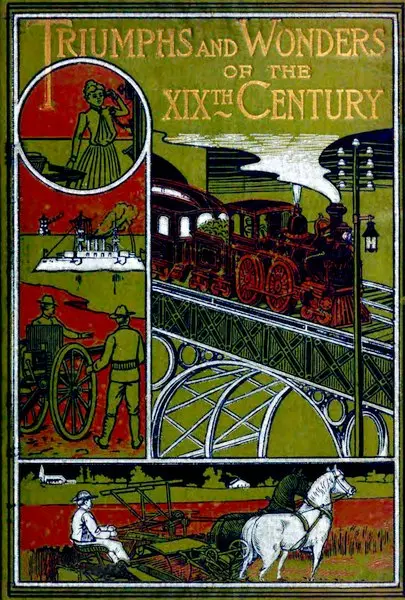
THE CLASSIC COLLECTION · 1899
"Triumphs and Wonders of the 19th Century: The True Mirror of a Phenomenal Era" by James P. Boyd is a historical account written in the late 19th century. This work aims to review and reflect on the significant achievements and advancements made during the 19th century, touching on various domains such as material, intellectual, social, and moral progress. It presents a comprehensive overview of the era's progress, showcasing the spirit and energy that defined the time and served to illustrate its remarkable contributions to human civilization. The opening of the book sets the stage for a grand examination of the incredible changes that took place throughout the 19th century, highlighting the transformation in numerous fields such as industry, science, art, and literature. Boyd emphasizes the unique character of the 19th century as a period of unparalleled innovation compared to prior eras, citing various advancements that have improved human life. Additionally, he explains the structure of the volume and introduces the numerous authors who will contribute to exploring these themes with specialized knowledge, promising readers an enlightening journey through the remarkable achievements of this phenomenal era.
Introduction adapted from the source catalogue; source summaries may be automatically generated.
Free to read · English · 300,037 words · No account needed
MAKE TIME FOR A GOOD BOOK
On by default. Untick to stop anonymous reading totals. Each page counts after 10 seconds in view. How this works.
Anonymous counting is on unless you have switched it off.
Germany, with her multiplicity of minor capitals, her love of books and book-making, her numerous universities, excels every other European country in the number, extent, and value of her libraries. The largest is the Royal Library at Berlin, with approximately 1,000,000 volumes. It was founded by the “Great Elector” Frederick William, and opened as a public library in 1661. The Royal Library at Munich long rated as the largest in Germany, with its 1,200,000 volumes, inclusive of pamphlets, the latter numbering some 500,000. But it was thought to be unfair to class so many small and inconsequential works as books, so that the library at Berlin was given precedence. Still the Munich library is particularly rich in incunabula and other treasures derived from the monasteries, which were closed in 1803. The University library at Munich is also very rich in similar treasures. It contains well nigh 500,000 volumes. The other large libraries of Germany are the University library at Leipsic, with over 500,000 volumes; the Royal and City library at Augsburg, with 123,000; the Royal, at Bamberg, with 300,000 volumes; the University at Bonn, with 220,000 volumes; the Grand Ducal at Darmstadt, with 400,000 volumes; the Royal Public, at Dresden, with 410,000 volumes; the University at Erlangen, with 185,000 volumes; the City, at Frankfort, with 190,000 volumes; the University at Freiburg, with 250,000 volumes; the University at Giessen, with 160,000 volumes; the Ducal Public, at Gotha, with 210,000 volumes; the Royal University at Göttingen, with 490,000 volumes; the City at Hamburg, with 510,000 volumes; the University at Heidelberg, with 410,000 volumes; the University at Jena, with 200,000 volumes; the University at Kiel, with 225,000 volumes; the University at Rostock, with 310,000 volumes; the University at Strassburg, with over 700,000 volumes; the University at Tübingen, with 320,000 volumes; the Grand Ducal at Weimar, with 230,000 volumes; the Brunswick Ducal, at Wolfenbüttel, with over 300,000 volumes. Besides these there are numerous others attached to various universities or publicly organized which have 100,000 volumes each.
In Austria-Hungary, the largest library is that of the Imperial Public, at Vienna. It was founded in 1440 by Emperor Frederick III., and has ever since been munificently supported by the Austrian princes. Few libraries in Europe contain more important collections or are better organized and housed. Its volumes number 540,000. Admission to its reading room is free, but the books are loaned out under rigid restrictions. The University Library of Vienna was founded by Maria Theresa, and has grown very rapidly, numbering nearly 500,000 volumes. In Vienna alone the number of libraries exceed one hundred, many of them of considerable extent. The various university libraries throughout Austria-Hungary are rich in volumes, particularly that at Cracow, with over 306,000 volumes, and at Innsbruck, with 175,000 volumes. The National Library at Budapest, Hungary, and also the University at the same place, have rich collections, numbering 465,000 and 212,000 volumes respectively.
Your reading position is saved on this browser. Take it to another device with a library code. Reading pages adapt to text, rather than matching a printed edition.
BEHIND THE BOOK
This eBook is for the use of anyone anywhere in the United States and most other parts of the world at no cost and with almost no restrictions whatsoever. You may copy it, give it away or re-use it under the terms of the Project Gutenberg License included with this eBook or online at www.gutenberg.org. If you are not located in the United States, you will have to check the laws of the country where you are located before using this eBook. Read the source licence.
The original source file, including credits and licence, is retained by this library. Request an original-format copy at no charge. Please include the book title and Project Gutenberg identifier #55390.
KEEP YOUR CURIOSITY GOING
Cécile Tormay

Moritz Busch
John L. Ransom
Frances Wright
Cécile Tormay

Mabel Potter Daggett