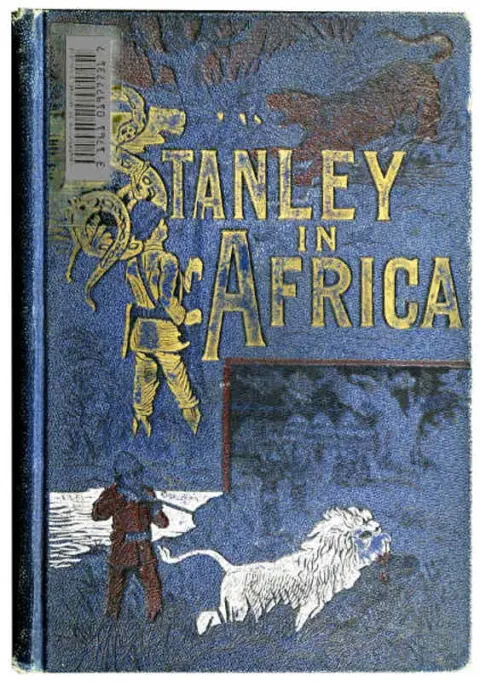
Stanley in Africa The Wonderful Discoveries and Thrilling Adventures of the Great African Explorer, and Other Travelers, Pioneers and Missionaries
James P. (James Penny) Boyd
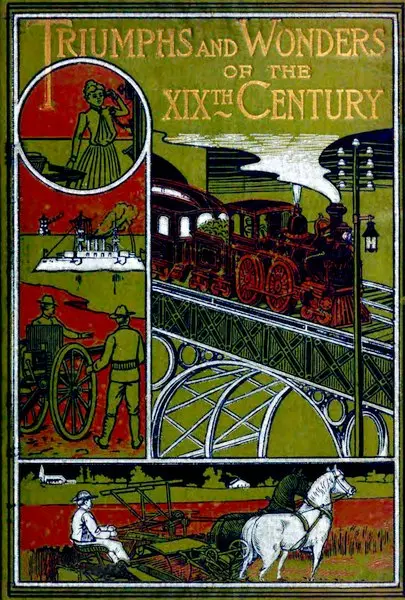
THE CLASSIC COLLECTION · 1899
"Triumphs and Wonders of the 19th Century: The True Mirror of a Phenomenal Era" by James P. Boyd is a historical account written in the late 19th century. This work aims to review and reflect on the significant achievements and advancements made during the 19th century, touching on various domains such as material, intellectual, social, and moral progress. It presents a comprehensive overview of the era's progress, showcasing the spirit and energy that defined the time and served to illustrate its remarkable contributions to human civilization. The opening of the book sets the stage for a grand examination of the incredible changes that took place throughout the 19th century, highlighting the transformation in numerous fields such as industry, science, art, and literature. Boyd emphasizes the unique character of the 19th century as a period of unparalleled innovation compared to prior eras, citing various advancements that have improved human life. Additionally, he explains the structure of the volume and introduces the numerous authors who will contribute to exploring these themes with specialized knowledge, promising readers an enlightening journey through the remarkable achievements of this phenomenal era.
Introduction adapted from the source catalogue; source summaries may be automatically generated.
Free to read · English · 300,037 words · No account needed
MAKE TIME FOR A GOOD BOOK
On by default. Untick to stop anonymous reading totals. Each page counts after 10 seconds in view. How this works.
Anonymous counting is on unless you have switched it off.
Absorbed in the struggles going on in their own lands, Protestants made but little effort for the extension of the gospel in foreign fields, save the few but successful attempts made by the Moravians of Germany, always the most zealous of all Protestant bodies in lines of missionary service. What, however, was lacking in the way of missionary effort in the seventeenth and eighteenth centuries has been more than made good in the glorious nineteenth, the distinctive missionary century of the Christian era. In the room of seven societies organized for world-wide gospel evangelization at the end of the last century, there are now in Europe and America between seventy and eighty organizations, employing a force of nearly three thousand American and European missionaries, and perhaps four times that number of native assistants. Full $10,000,000 are annually raised among the Protestant bodies alone for missionary service, while the great Roman Catholic Church prosecutes its work with a zeal equally unflagging. A brief survey of the progress of a hundred years of missionary effort will make it clear to all minds that the day is not far distant when the declaration of the prophet, “The earth shall be filled with the knowledge of the glory of the Lord, even as the waters cover the sea,” shall have abundant and magnificent realization.
At the beginning of this century, every island of the vast Pacific was closed against the gospel. To-day, nearly every one is under the influence, more or less extended, of Christian civilization. India, from Cape Comorin to the Punjaub, from the Punjaub to the Himalayas, from the Himalayas to Thibet,—at whose gates the gospel is now knocking,—has been covered with a network of mission stations, schools, colleges, and churches, closer by far in its interlacings than that which at the close of the third century had spread itself over the vast empire of the Cæsars. Of the Indian Archipelago, Sumatra, Java, Borneo, the Celebes, New Guinea, not to mention smaller groups of islands, are feeling the new life ever imparted by the advent of the Cross. Japan, too, hungry for reform, and full of the stir of the age, by granting entrance to the gospel, has within its borders already a numerous Christian population with scores of evangelical congregations. The same is true of the hermit nation, Corea. In the lands of Islam, from Bagdad to the Balkans, from Egypt to Persia, and throughout all Turkey, are to be found centres of missionary enterprise, the vast influence of which is now being sensibly felt in the changing life of those remarkable peoples. In Burmah, and recently in Siam, after years of patient and apparently hopeless service, fields are everywhere “white unto the harvest.” China, most populous of all heathen lands, is open to missionary effort from Canton to Peking, from Shanghai to Hon-Chow. Africa also, once, in its northern sections at least, the home of the learning, the art, the science, the religion of the world, awakening from the sleep of long and dreary centuries under the influence of Christian civilization, again demands the attention of the great nations of the world. Everywhere, east, west, north, south, it is being invaded all along the line of Cecil Rhodes’ great railway, stretching northward from Cape Town for three thousand miles, to meet the twenty-six hundred pushing down from the north,—from Senegal to Gaboon and from Gaboon to the Congo; on the shores of Tanganyika and along the banks of the Zambesi shine the lights of the gospel, which, wherever it has gone, has been the harbinger of a new and brighter day. Within the mighty domains of our own continent, upon the immense plains reaching from Labrador to the Pacific, upon the sterile coasts of Alaska, in the land of the Montezumas, in Central America, in South America, from Panama to Terra-del-Fuego, equally marvelous have been the steady gains resulting from a Christianity the forces of which, like the waters that enrich the continent, penetrate all the bays and estuaries of human society and influence all classes and conditions of men. Looking upon the transformations effected by the labors of a single century of Christian effort, one may surely say, “The peoples that walked in darkness have seen a great light; they that dwell in the land of the shadow of death, upon them hath the light shined.”
Your reading position is saved on this browser. Take it to another device with a library code. Reading pages adapt to text, rather than matching a printed edition.
BEHIND THE BOOK
This eBook is for the use of anyone anywhere in the United States and most other parts of the world at no cost and with almost no restrictions whatsoever. You may copy it, give it away or re-use it under the terms of the Project Gutenberg License included with this eBook or online at www.gutenberg.org. If you are not located in the United States, you will have to check the laws of the country where you are located before using this eBook. Read the source licence.
The original source file, including credits and licence, is retained by this library. Request an original-format copy at no charge. Please include the book title and Project Gutenberg identifier #55390.
KEEP YOUR CURIOSITY GOING
Cécile Tormay

Moritz Busch
John L. Ransom
Frances Wright
Cécile Tormay

Mabel Potter Daggett