
Stanley in Africa The Wonderful Discoveries and Thrilling Adventures of the Great African Explorer, and Other Travelers, Pioneers and Missionaries
James P. (James Penny) Boyd
THE CLASSIC COLLECTION · 1899
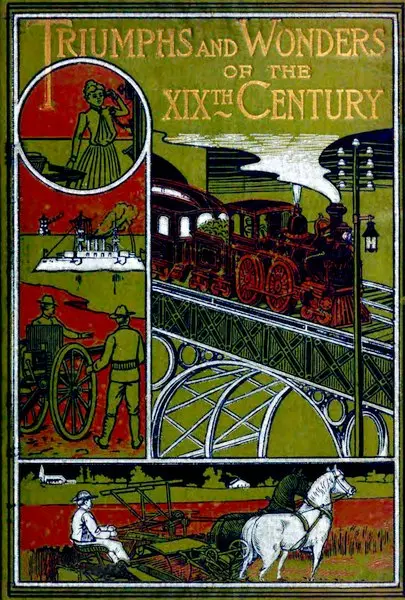
"Triumphs and Wonders of the 19th Century: The True Mirror of a Phenomenal Era" by James P. Boyd is a historical account written in the late 19th century. This work aims to review and reflect on the significant achievements and advancements made during the 19th century, touching on various domains such as material, intellectual, social, and moral progress. It presents a comprehensive overview of the era's progress, showcasing the spirit and energy that defined the time and served to illustrate its remarkable contributions to human civilization. The opening of the book sets the stage for a grand examination of the incredible changes that took place throughout the 19th century, highlighting the transformation in numerous fields such as industry, science, art, and literature. Boyd emphasizes the unique character of the 19th century as a period of unparalleled innovation compared to prior eras, citing various advancements that have improved human life. Additionally, he explains the structure of the volume and introduces the numerous authors who will contribute to exploring these themes with specialized knowledge, promising readers an enlightening journey through the remarkable achievements of this phenomenal era.
Introduction adapted from the source catalogue; source summaries may be automatically generated.
Free to read · English · 300,037 words · No account needed
MAKE TIME FOR A GOOD BOOK
On by default. Untick to stop anonymous reading totals. Each page counts after 10 seconds in view. How this works.
Anonymous counting is on unless you have switched it off.
The number of enrolled communicants, or members, however, by no means expresses the real strength of the religious life of the nation. To get at that, we must multiply each Protestant communicant by the 2.5 adherents allowed in all statistical calculations. Proceeding on this basis, omitting for the time all Catholics, Jews, Theosophists, members of Societies for Ethical Culture, Spiritualists, Latter-Day Saints, and kindred bodies, and multiplying the 15,200,000 Protestant members by 2.5, we have over 50,000,000 as the total Protestant population of the country. Adding to these 50,000,000 the Catholic population, estimated by Catholic authorities as being 15 per cent. larger than the number of Catholic communicants, we have 57,062,000 as the total Christian population, leaving only about 7,000,000 who are neither communicants nor adherents. Of the 7,000,000 opposed, for various reasons, to the churches, comparatively few are to be reckoned as either infidels or atheists; while, on the other hand, it is true that of the 57,000,000 reckoned as either communicants or adherents, millions are Christians only in name, either never attending the services of the churches, or at the best only at rare intervals. Gratifying as is this splendid exhibit of religious devotion on the part of the American people, the fact that there are millions in our land whose allegiance to Christian doctrine is but nominal, with millions more upon whose lives religion exercises no appreciable influence whatever, is a sufficient proof of the enormous task yet confronting the churches of Christ, if we are to stand before the nations as the great distinctive Christian nation of the world. The stupendous gain, however, in ninety-four years, of over 14,853,076 in Protestant churches alone is a record of religious progress unparalleled in the history of the world.
Advancing to the question of distribution of the religious forces enumerated, we find that while these forces are distributed throughout every State and under one hundred and forty-three denominational names, they are, nevertheless, massed largely in a few denominations and in a comparatively few States. Competent authorities estimate that the five largest denominations comprise fully 60 per cent. of the entire number of communicants; the ten largest, 75 per cent. With respect to communicants, the Catholic Church is first, with 7,510,000; the Methodist (all bodies) second, with 5,405,076; the Baptist third, with 3,717,373; the Presbyterian fourth, with 1,278,332; the Lutheran fifth, with 1,233,072.
With respect to population, reckoning the Catholic population at 7,510,000—which figures include children under ten years of age—and adding to the communicant strength of the four other bodies mentioned the 2.5 adherents allowed for each communicant, we have the following: Methodist population, 18,918,466; Baptist, 12,990,805; Presbyterian, 5,525,162; Lutheran, 4,358,752; total Protestant population, 50,000,000; Catholic, 7,510,000.
Your reading position is saved on this browser. Take it to another device with a library code. Reading pages adapt to text, rather than matching a printed edition.
BEHIND THE BOOK
This eBook is for the use of anyone anywhere in the United States and most other parts of the world at no cost and with almost no restrictions whatsoever. You may copy it, give it away or re-use it under the terms of the Project Gutenberg License included with this eBook or online at www.gutenberg.org. If you are not located in the United States, you will have to check the laws of the country where you are located before using this eBook. Read the source licence.
The original source file, including credits and licence, is retained by this library. Request an original-format copy at no charge. Please include the book title and Project Gutenberg identifier #55390.
KEEP YOUR CURIOSITY GOING
Cécile Tormay

Moritz Busch
John L. Ransom
Frances Wright
Cécile Tormay

Mabel Potter Daggett