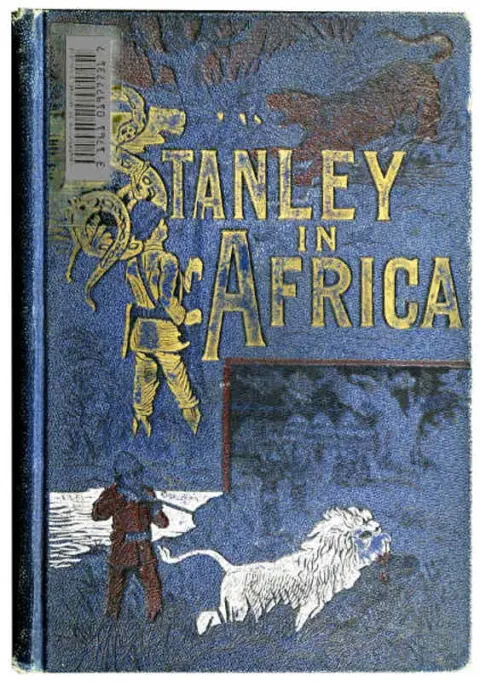
Stanley in Africa The Wonderful Discoveries and Thrilling Adventures of the Great African Explorer, and Other Travelers, Pioneers and Missionaries
James P. (James Penny) Boyd
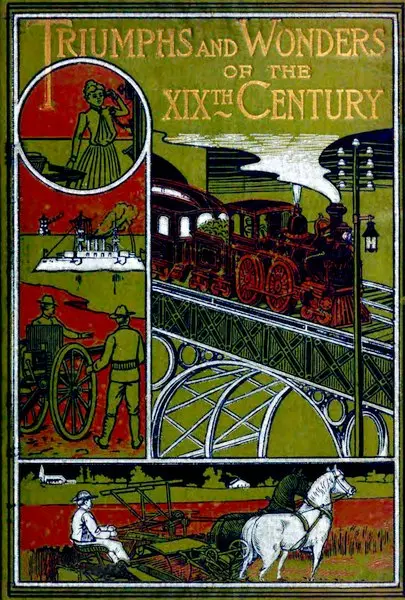
THE CLASSIC COLLECTION · 1899
"Triumphs and Wonders of the 19th Century: The True Mirror of a Phenomenal Era" by James P. Boyd is a historical account written in the late 19th century. This work aims to review and reflect on the significant achievements and advancements made during the 19th century, touching on various domains such as material, intellectual, social, and moral progress. It presents a comprehensive overview of the era's progress, showcasing the spirit and energy that defined the time and served to illustrate its remarkable contributions to human civilization. The opening of the book sets the stage for a grand examination of the incredible changes that took place throughout the 19th century, highlighting the transformation in numerous fields such as industry, science, art, and literature. Boyd emphasizes the unique character of the 19th century as a period of unparalleled innovation compared to prior eras, citing various advancements that have improved human life. Additionally, he explains the structure of the volume and introduces the numerous authors who will contribute to exploring these themes with specialized knowledge, promising readers an enlightening journey through the remarkable achievements of this phenomenal era.
Introduction adapted from the source catalogue; source summaries may be automatically generated.
Free to read · English · 300,037 words · No account needed
MAKE TIME FOR A GOOD BOOK
On by default. Untick to stop anonymous reading totals. Each page counts after 10 seconds in view. How this works.
Anonymous counting is on unless you have switched it off.
At the beginning of the eighteenth century there were but few occupations in which women were permitted to engage. Their abilities and ambitions were restricted to the school and the home. In the latter they received food and shelter as compensation; in the former, but one half or one third the salary allowed to male teachers. The first noticeable change in woman’s condition, when she became something more than a mere household drudge, whose busy hands carded and wove, spun and knit, the family supply of cloth, dates from the first bale of cotton grown in this country in the early years of the eighteenth century. In that bale of cotton lay the seeds of not only a new movement in labor, but the beginning of a new epoch for woman, in which her work and wages were destined to take coherent shape and form. In all industrial progress since that time women have taken an active part while receiving a meagre share of the product. Forced by the course of events to emerge from seclusion and repression, she has passed from one stage of development to another, always a step or two behind man in the progress of social evolution, till the close of the nineteenth century reveals myriad changes and the actual realization of Tennyson’s prophetic lines in the “Princess,” “We have prudes for proctors, dowagers for deans.”
One hundred years ago it was the duty of a woman to efface herself. She was expected to make of herself a mental blank-book upon which her husband might inscribe what he would. Thus it is only lately that women have begun actively to compete with men in expression of any kind. Indeed, previous to that time, with a few notable exceptions, they were denied recognition of individual life. The woman, if unmarried, was merged in the family, or, if married, merged in the husband. Her name, her religion, her gods, were changed on marriage. But, married or single, the absorption was complete. So it has happened that woman, throbbing with poetic sympathy, has, with the exception of Sappho, produced less high and unmistakable poetry than man. With more harmony, more music in her nature, her very soul attuned to symphony and rhythm, she has been little known as a composer. With far vision and clear literary insight, she has been suppressed in art and literature. George Eliot gave her sublime literary productions to the world under a masculine nom de plume, because of the prejudice of even that not remote day. Fanny Mendelssohn was compelled by her family to publish her musical compositions as her brother’s. Mary Somerville met only discouragement and ridicule in her mathematical studies. In every sphere, in every department of science and art, abuse, injustice, and the croaking of reactionary frogs have greeted each step of her upward way. The wonder is, then, not that she has accomplished so little, but that she is not in the same condition to-day that she was when Paul thrust a gag in her mouth in the shape of a Corinthian text, “And if a woman would learn anything, let her ask her husband at home.” It will be seen, therefore, that the oft-repeated assertion that women have not given to the world as much evidence of genius as men is a Lilliputian assertion tainted somewhat with envy. “There has been no Shakespeare among women,” says the advocates of man’s supremacy. With all the world as their own, and the gates of boundless opportunities swinging wide, there has been but one Shakespeare among men. It has been asserted that George Eliot is the Shakespeare among women and Mrs. Browning the counterpart of Bacon. But their immortality has not been tested. They lived but a little while ago. But there is one woman, at least, who has established her claim thoroughly, and whose genius twenty-five centuries have tested. Sappho is truly immortal. Her fame and genius have been sealed by the approval of all the great literati of the centuries. Coleridge, who occupies no uncertain place in the world of letters, says of her, “Of all the poets of the world, of all the illustrious artists of all literature, Sappho is the one whose every word has a peculiar and unmistakable poetic perfume, a seal of absolute perfection and illimitable grace.” Swinburne, the greatest living master in the world of verbal music, declares that, “Her verses are the supreme success, the final achievement, of poetic art.” Sappho’s claim to immortality exceeds that of Shakespeare’s by twenty-three hundred years.
Your reading position is saved on this browser. Take it to another device with a library code. Reading pages adapt to text, rather than matching a printed edition.
BEHIND THE BOOK
This eBook is for the use of anyone anywhere in the United States and most other parts of the world at no cost and with almost no restrictions whatsoever. You may copy it, give it away or re-use it under the terms of the Project Gutenberg License included with this eBook or online at www.gutenberg.org. If you are not located in the United States, you will have to check the laws of the country where you are located before using this eBook. Read the source licence.
The original source file, including credits and licence, is retained by this library. Request an original-format copy at no charge. Please include the book title and Project Gutenberg identifier #55390.
KEEP YOUR CURIOSITY GOING
Cécile Tormay

Moritz Busch
John L. Ransom
Frances Wright
Cécile Tormay

Mabel Potter Daggett