THE CLASSIC COLLECTION✦Little Guzzy, and other storiesCLASSIC FREE BOOKS
Little Guzzy, and other stories
John Habberton
THE CLASSIC COLLECTION · 1897
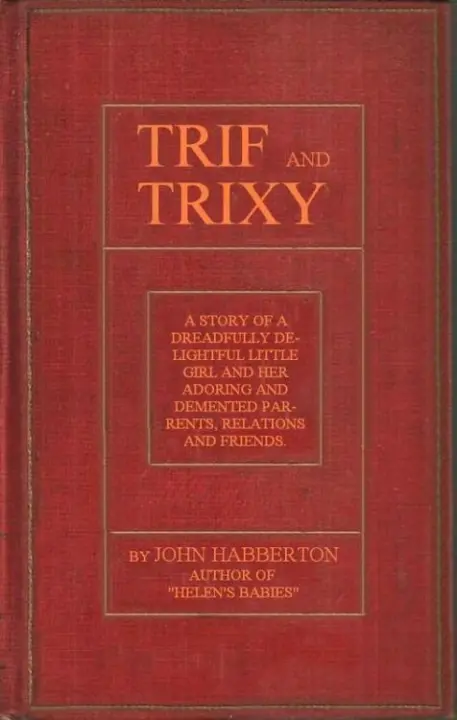
"Trif and Trixy" by John Habberton is a novel written in the late 19th century. The story revolves around the delightful escapades of Trixy, a precocious seven-year-old girl, and her mother Trif, who navigates the challenges of parenthood amid Trixy's endearing antics. The narrative delves into the dynamics of family interactions, childhood innocence, and the various relationships that form around Trixy, who is often described as a "dreadfully delightful" character. At the start of the book, we are introduced to Trixy, who has recently turned seven, but her family continues to refer to her as the "baby." Her mother, Trif, is described as both proud and loving, handling her daughter's lively and unfiltered nature with a mixture of affection and exasperation. The opening chapters set up various family dynamics, including Trif's sister Fenie's infatuation with young men and the comedic situations arising from Trixy's candid observations and misunderstandings. Through Trixy's interactions with her family and the adult world around her, the reader gets a glimpse of the humor and warmth that characterize Habberton's storytelling, establishing a tone that suggests both lightheartedness and deeper explorations of relationships as the story unfolds.
Introduction adapted from the source catalogue; source summaries may be automatically generated.
Free to read · English · 60,373 words · No account needed
MAKE TIME FOR A GOOD BOOK
On by default. Untick to stop anonymous reading totals. Each page counts after 10 seconds in view. How this works.
Anonymous counting is on unless you have switched it off.
She stepped quickly toward the grate, extended her hand, stopped,
turned her head and said:
"As some reward for my self-sacrifice, mayn't I read the letter before
I burn it?"
"You poor child!" murmured Trif.
"What? Was it as bad as that?"
"Look at it, Kate," said Phil, "and you will know what Trif means."
In a second Kate was under the chandelier and turning the sheet, but as she looked her face became blank, for Phil, supposing the paper was to go into the hands of a lot of business men, had penned over every line so skillfully, after the manner of commercial correspondents who make erasures in letters, that not a word of the original writing was decipherable.
"You shall know it all, you dear disappointed girl," said Trif. "I shall tell you every word of it this very evening--this very moment. Come with me; I know the others will excuse us under the circumstances."
Together they started to leave the room, but encountered Trixy, who was
just entering.
"I most forgot about that s'prise," said the child to Jermyn, as she stopped before him. "The dinner was so good, and you folks talked so much, that I didn't get a chance to say nothin', and then I got sleepy while you was singin', and I'd have forgot all about it entirely if you hadn't begun to talk about throwin' money to dogs, and papa explained how it was."
Then she raised both hands high in the air and shouted:
"Here's your old pictures."
"Come on, boys," shouted the Admiral, springing forward, and snatching both sketches. He explained afterward, very sheepishly, that he believed his mind had been weakened by long anxiety about those sketches, for he imagined himself young again, and taking part in a landing party in Mexico.
"Oh, Trixy," exclaimed Trif, snatching her child into her arms, "you naughty, precious, dreadful, blessed, awful, angelic, terrible, lovely darling!"
"Jermyn!" exclaimed Kate, and Jermyn opened his arms, while Fenie gasped "Harry!" and Harry made haste to support her. The ladies being thus disposed of, the Admiral and Phil could only shake hands, which they did with a vigor that made each man wince. Finally Phil said:
"My dear, will you kindly stop kissing that child long enough for me to ask her a question? Trixy, where did you get those sketches?"
Your reading position is saved on this browser. Take it to another device with a library code. Reading pages adapt to text, rather than matching a printed edition.
John Habberton

John Habberton
John Habberton

John Habberton
BEHIND THE BOOK
This eBook is for the use of anyone anywhere in the United States and most other parts of the world at no cost and with almost no restrictions whatsoever. You may copy it, give it away or re-use it under the terms of the Project Gutenberg License included with this eBook or online at www.gutenberg.org. If you are not located in the United States, you will have to check the laws of the country where you are located before using this eBook. Read the source licence.
The original source file, including credits and licence, is retained by this library. Request an original-format copy at no charge. Please include the book title and Project Gutenberg identifier #51788.
KEEP YOUR CURIOSITY GOING
Coulson Kernahan

Maurice Baring
Frances Wright
Cécile Tormay

Frederic Jesup Stimson

W. H. P. (William Henry Pope) Jarvis