THE CLASSIC COLLECTION✦Travels into North America, Volume 3 (of 3)CLASSIC FREE BOOKS
Travels into North America, Volume 3 (of 3)
Pehr Kalm
THE CLASSIC COLLECTION · 1771
"Travels into North America, Volume 2 (of 3)" by Pehr Kalm is a scientific travel narrative written in the mid-18th century. The work presents an in-depth exploration of North America's natural history, agriculture, and the social practices of its inhabitants, with Kalm drawing on his personal observations and experiences during his travels. The book combines detailed descriptions of botany, agriculture, and the ecological interactions between settlers and indigenous populations, offering readers a nuanced perspective on early American society. At the start of the narrative, Kalm recounts his experiences in New Jersey on December 7, 1748, highlighting the favorable conditions that contribute to higher population growth in the region compared to Europe. He shares anecdotes about local families, detailing their large progeny and longevity, which illustrates the opportunities and social freedoms available in colonial America. Kalm continues by discussing various insects native to the area, including mosquitoes, locusts, and caterpillars, emphasizing their impacts on local agriculture. His observations on the natural environment are enriched with descriptions of the flora, fauna, and daily life of the colonists, setting the stage for a comprehensive study of North America as he saw it in the 18th century.
Introduction adapted from the source catalogue; source summaries may be automatically generated.
Free to read · English · 76,463 words · No account needed
MAKE TIME FOR A GOOD BOOK
On by default. Untick to stop anonymous reading totals. Each page counts after 10 seconds in view. How this works.
Anonymous counting is on unless you have switched it off.
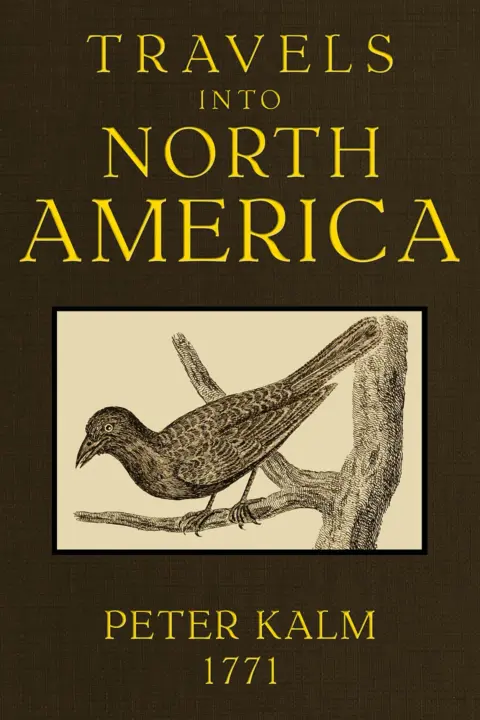
A few of these birds are said to winter in swamps, which are quite overgrown with thick woods; and they only appear in mild weather. But the greatest number go to the south at the approach of winter. To-day I saw them, for the first time this year. They flew in great flocks already. Their chief and most agreeable food is maize. They come in great swarms in spring, soon after the maize is put under ground. They scratch up the grains of maize, and eat them. As soon as the leaf comes out, they take hold of it with their bills, and pluck it up, together with the corn or grain; and thus they give a great deal of trouble to the country people, even so early in spring. To lessen their greediness of maize, some people dip the grains of that plant in a decoct of the root of the veratrum album, or white hellebore, (of which I shall speak in the sequel) and plant them afterwards. When the maize-thief eats a grain or two, which are so prepared, his head is disordered, and he falls down: this frightens his companions, and they dare not venture to the place again. But they repay themselves amply towards autumn, when the maize grows ripe; for at that time, they are continually feasting. They assemble by thousands in the maize-fields, and live at discretion. They are very bold; for when they are disturbed, they only go and settle in another part of the field. In that manner, they always go from one end of the field to the other, and do not leave it till they are quite satisfied. They fly in incredible swarms in autumn; and it can hardly be conceived whence such immense numbers of them should come. When they rise in the air they darken the sky, and make it look quite black. They are then in such great numbers, and so close together, that it is surprising how they find room to move their wings. I have known a person shoot a great number of them on one side of a maize-field, which was far from frightening the rest; for they only just took flight, and dropped at about the distance of a musket-shot in another part of the field, and always changed their place when their enemy approached. They tired the sportsman, before he could drive them from off the maize, though he killed a great many of them at every shot. They likewise eat the seeds of the aquatic tare-grass (Zizania aquatica) commonly late in autumn, after the maize is got in. I am told, they likewise eat buck-wheat, and oats. Some people say, that they even eat wheat, barley, and rye, when pressed by hunger; yet, from the best information I could obtain, they have not been found to do any damage to these species of corn. In spring, they sit in numbers on the trees, near the farms; and their note is pretty agreeable. As they are so destructive to maize, the odium of the inhabitants against them is carried so far, that the laws of Pensylvania and New Jersey have settled a premium of three-pence a dozen for dead maize-thieves. In New England, the people are still greater enemies to them; for Dr. Franklin told me, in the spring of the year 1750, that, by means of the premiums which have been settled for killing them in New England, they have been so extirpated, that they are very rarely seen, and in a few places only. But as, in the summer of the year 1749, an immense quantity of worms appeared on the meadows, which devoured the grass, and did great damage, the people have abated their enmity against the maize-thieves; for they thought they had observed, that those birds lived chiefly on these worms before the maize is ripe, and consequently extirpated them, or at least prevented their spreading too much. They seem therefore to be entitled, as it were, to a reward for their trouble. But after these enemies and destroyers of the worms (the maize-thieves) were extirpated, the worms were more at liberty to multiply; and therefore they grew so numerous, that they did more mischief now than the birds did before. In the summer 1749, the worms left so little hay in New England, that the inhabitants were forced to get hay from Pensylvania, and even from Old England. The maize-thieves have enemies besides the human species. A species of little hawks live upon them, and upon other little birds. I saw some of these hawks driving up the maize-thieves, which were in the greatest security, and catching them in the air. Nobody eats the flesh of the purple maize-thieves or daws (Gracula quiscula); but that of the red-winged maize-thieves, or stares (Oriolus Phœniceus) is sometimes eaten. Some old people have told me, that this part of America, formerly called New Sweden, still contained as many maize-thieves as it did formerly. The cause of this they derive from the maize, which is now sown in much greater quantity than formerly; and they think that the birds can get their food with more ease at present.
Your reading position is saved on this browser. Take it to another device with a library code. Reading pages adapt to text, rather than matching a printed edition.
BEHIND THE BOOK
This eBook is for the use of anyone anywhere in the United States and most other parts of the world at no cost and with almost no restrictions whatsoever. You may copy it, give it away or re-use it under the terms of the Project Gutenberg License included with this eBook or online at www.gutenberg.org. If you are not located in the United States, you will have to check the laws of the country where you are located before using this eBook. Read the source licence.
The original source file, including credits and licence, is retained by this library. Request an original-format copy at no charge. Please include the book title and Project Gutenberg identifier #72103.
KEEP YOUR CURIOSITY GOING
Wilfrid Scawen Blunt
Wilfrid Scawen Blunt

E. W. (Edgar Watson) Howe
Cécile Tormay

Moritz Busch
John L. Ransom