THE CLASSIC COLLECTION✦Travels into North America, Volume 3 (of 3)CLASSIC FREE BOOKS
Travels into North America, Volume 3 (of 3)
Pehr Kalm
THE CLASSIC COLLECTION · 1771
"Travels into North America, Volume 2 (of 3)" by Pehr Kalm is a scientific travel narrative written in the mid-18th century. The work presents an in-depth exploration of North America's natural history, agriculture, and the social practices of its inhabitants, with Kalm drawing on his personal observations and experiences during his travels. The book combines detailed descriptions of botany, agriculture, and the ecological interactions between settlers and indigenous populations, offering readers a nuanced perspective on early American society. At the start of the narrative, Kalm recounts his experiences in New Jersey on December 7, 1748, highlighting the favorable conditions that contribute to higher population growth in the region compared to Europe. He shares anecdotes about local families, detailing their large progeny and longevity, which illustrates the opportunities and social freedoms available in colonial America. Kalm continues by discussing various insects native to the area, including mosquitoes, locusts, and caterpillars, emphasizing their impacts on local agriculture. His observations on the natural environment are enriched with descriptions of the flora, fauna, and daily life of the colonists, setting the stage for a comprehensive study of North America as he saw it in the 18th century.
Introduction adapted from the source catalogue; source summaries may be automatically generated.
Free to read · English · 76,463 words · No account needed
MAKE TIME FOR A GOOD BOOK
On by default. Untick to stop anonymous reading totals. Each page counts after 10 seconds in view. How this works.
Anonymous counting is on unless you have switched it off.
February the 17th. Cranes (Ardea Canadensis) were sometimes seen flying in the day-time, to the northward. They commonly stop here early in spring, for a short time, but they do not make their nests here, for they proceed on more to the north. Certain old Swedes told me, that in their younger years, as the country was not yet much cultivated, an incredible number of cranes were here every spring; but at present they are not so numerous. Several people who have settled here, eat their flesh, when they can shoot them. They are said to do no harm to corn, or the like.
February the 23d. This morning I went down to Penn’s Neck, and returned
in the evening.
Snow lay yet in several parts of the woods, especially where the trees stood very thick, and the sun could not make its way: however it was not above four inches deep. All along the roads was ice, especially in the woods, and therefore it was very difficult to ride horses, which were not sharp shoed. The people who are settled here know little of sledges, but ride on horseback to church in winter, though the snow is sometimes near a foot deep. It lays seldom above a week before it melts, and then some fresh snow falls.
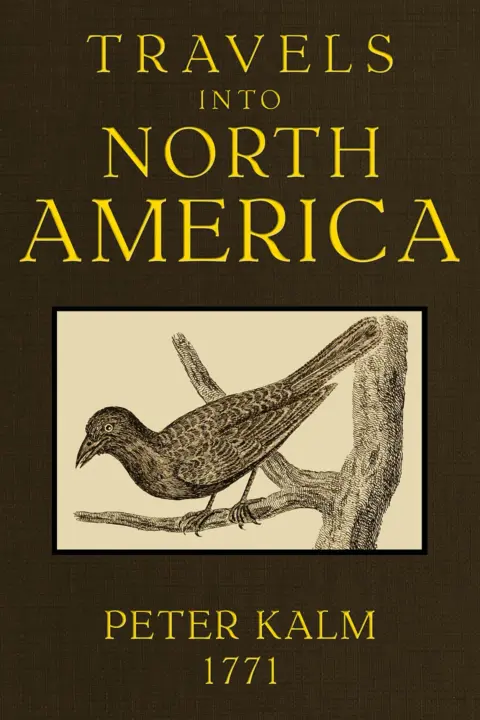
A species of birds, called by the Swedes, maize-thieves, do the greatest mischief in this country. They have given them that name, because they eat maize, both publicly and secretly, just after it is sown and covered with the ground, and when it is ripe. The English call them blackbirds. There are two species of them, both described and drawn by Catesby [14]. Though they are very different in species, yet there is so great a friendship between them, that they frequently accompany each other in mixed flocks. However, in Pensylvania, the first sort are more obvious, and often fly together, without any of the red-winged stares. The first sort, or the purple daws, bear, in many points, so great a likeness to the daw, the stare, and the thrush, that it is difficult to determine to which genus they are to be reckoned, but seem to come nearest to the stare; for the bill is exactly the same with that of the thrush, but the tongue, the flight, their sitting on the trees, their song and shape, make it entirely a stare; at a distance they look almost black, but close by they have a very blue or purple cast, but not so much as Catesby’s print: their size is that of a stare; the bill is conic, almost subulated, strait, convex, naked at the base, black, with almost equal mandibles, the upper being only a very little longer than the lower; the nostrils are oblong, yet a little angulated, so as to form almost squares; they are placed obliquely at the base of the bill, and have no hair; there is a little horny knob, or a small prominence on the upper side of them; the tongue is sharp and bifid at the point; the iris of the eyes is pale; the forehead, the crown, the nucha, the upper part and the sides of the neck are of an obscure blue and green shining colour; the sides of the head under the eyes are obscurely blue; all the back and coverts of the wings are purple; the upper coverts of the tail are not of so conspicuous a purple colour, but as it were blackened with soot; the nine primary quill-feathers are black; the other secundary ones are likewise black, but their outward margin is purple; the twelve tail feathers have a blackish purple colour, and their tips are round; those on the outside are the shortest, and the middle extremely long. When the tail is spread, it looks round towards the extremity. The throat is blueish green, and shining; the breast is likewise black or shining green, according as you turn it to the light; the belly is blackish, and the vent feathers are obscurely purple-coloured; the parts of the breast and belly which are covered by the wings, are purple-coloured; the wings are black below, or rather sooty; and the thighs have blackish feathers; the legs (tibiæ), and the toes are of a shining black. It has four toes, as most birds have. The claws are black, and that on the back toe is longer than the rest. Dr. Linnæus calls this bird Gracula Quiscula.
Your reading position is saved on this browser. Take it to another device with a library code. Reading pages adapt to text, rather than matching a printed edition.
BEHIND THE BOOK
This eBook is for the use of anyone anywhere in the United States and most other parts of the world at no cost and with almost no restrictions whatsoever. You may copy it, give it away or re-use it under the terms of the Project Gutenberg License included with this eBook or online at www.gutenberg.org. If you are not located in the United States, you will have to check the laws of the country where you are located before using this eBook. Read the source licence.
The original source file, including credits and licence, is retained by this library. Request an original-format copy at no charge. Please include the book title and Project Gutenberg identifier #72103.
KEEP YOUR CURIOSITY GOING
Wilfrid Scawen Blunt
Wilfrid Scawen Blunt

E. W. (Edgar Watson) Howe
Cécile Tormay

Moritz Busch
John L. Ransom