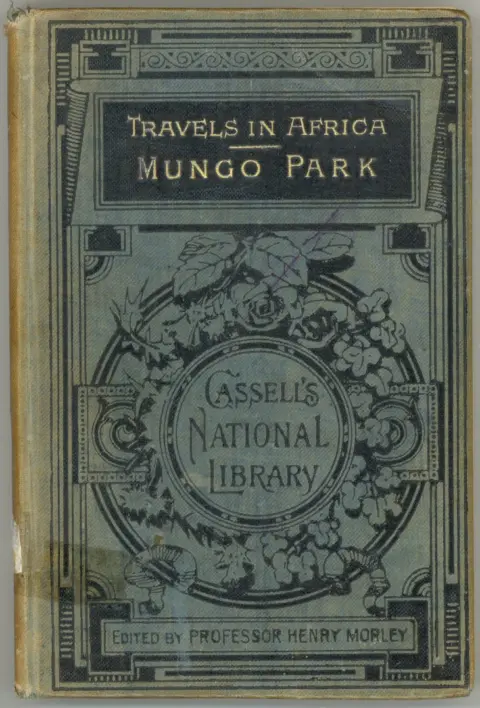
Travels in the interior districts of Africa: performed under the direction and patronage of the African Association, in the years 1795, 1796, and 1797
At this island I remained ten days; when the Chesterfield Packet, homeward bound from the Leeward Islands, touching at St. John’s for the Antigua mail, I took my passage in that vessel. We sailed on the 24th of November; and, after a short but tempestuous voyage, arrived at Falmouth on the 22d of December: from whence I immediately set out for London; having been absent from England two years and seven months.
THE END.
[Footnote 25: Vide p. 34.]
A VOCABULARY OF THE MANDINGO LANGUAGE. * * * * *
Above, santo.
Absent, inteegee; (literally, “not here.”)
Abuse, v. anenni.
Add, akeejee.
Afraid, silantee.
Afternoon, oora.
Air, fonio.
Alike, beakillin.
Alive, a beegee, (is here.)
All, bea.
Always, toomotoma.
And, ning.
Angry, jusu bota; (literally, “the heart comes out.”)
Angel, melika.
Arm, boulla; (the same for hand.)
Arrived, footăta.
Arrow, binni.
Ascend, silli.
Asleep, sinouta.
Assist, maquoi.
Axe, terang.
Back, ko.
Bad, jou.
Bag, bota.
Barter, v. fallan.
Bastard, janka ding; (literally, “nobody’s child.”)
Beads, connoo.
Beard, bora.
Beat, v. agossi.
Bees, leekissi.
Bed, larong.
Beer, dolo; (the same for strong liquor of any kind.)
Before, neata; (“within sight.”)
Behind, kofi.
Belly, konno.
Big, awarata.
Bind or tie, aseeti.
Bird, cono.
Bite, v. keeng.
Black, fing.
Blood, jollie.
Blue, fingma; (blackish.)
Boil, v. fagee.
Bone, cooloo.
Book, kittāba.
Borrow, la.
Bottom, joo.
Bow, kalla.
Boy, kea ding; (literally, “male child”.)
Brave, fattee.
Bread, munko.
Break, v. affāra; (the same word signifies “to kill” or
“to destroy.”)
Breasts, sonjoo.
Bring, insambo.
Brother, ba-ding-kea; (literally “mother’s male child.”)
Burn, v. agēni.
Buy (or sell), saun.
Call, v. akilli.
Carry, asāmbo.
Cat, neancon.
Catch, v. amuta.
Chest or coffer, koonio.
Child, ding; (if very young, dingding)
Cloth, fauno.
Cold, ninno.
Come, na.
Coming abenāli.
Completely, betiki.
Cook, v. tabbee.
Corn, neo.
Country, doo.
Cow, nessee moosa.
Crowd, n. setima.
Cry, v. akumbo.
Cunning, n. a. kissee.
Cut, v. tegi.
Danger, torro.
Dark, dibbie.
Daughter, ding moosa; (literally “female child.”)
Day, teelee.
Dead, asāta.
Deep, adoonta.
Desist, attoo.
Dew, combi.
Die, v. sa.
Dirt, no.
Disease, jankra.
Dispute, degama.
Dog, woola.
Door, da; (this is a word of very extensive use, being applied
to whatever opens and shuts.)
Down, ad. dooma.
Dream, v. sibota.
Dream, n. s. sibo.
Drink, v. ameen.
Dry, (arid) ajāta.
Ear, toola.
Earth, (soil) banko.
Earth, (globe) banko kang.
East, teelee bo; (“sunrise.”)
Eat, adummo.
Elephant, samma.
Empty, fing tigee; (“nothing here.”)
Enough, keyento.
Entertain, (a guest) fanda.
Expert, cumering; (“active, clever, &c.”)
Eye, nea.
Face, (the same as for the eye.)
Fall, v. bui.
Far off, jangfata.
Fast, v. soong.
Fat, keng.
Father, fa.
Fear, v. seelan.
Feather, tee; (it signifies also hair and wool.)