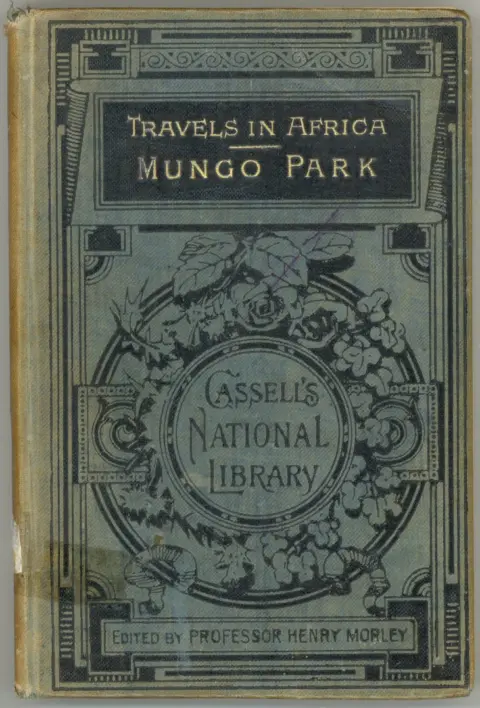
Travels in the interior districts of Africa: performed under the direction and patronage of the African Association, in the years 1795, 1796, and 1797
A little before sunset, I descended on the north-west side of this ridge of hills, and as I was looking about for a convenient tree, under which to pass the night (for I had no hopes of reaching any town), I descended into a delightful valley, and soon afterwards arrived at a romantic village called Kooma. This village is surrounded by a high wall, and is the sole property of a Mandingo merchant, who fled hither with his family, during a former war. The adjacent fields yield him plenty of corn, his cattle roam at large in the valley, and the rocky hills secure him from the depredations of war. In this obscure retreat he is seldom visited by strangers, but whenever this happens he makes the weary traveller welcome. I soon found myself surrounded by a circle of the harmless villagers. They asked a thousand questions about my country; and, in return for my information, brought corn and milk for myself, and grass for my horse; kindled a fire in the hut where I was to sleep, and appeared very anxious to serve me.
Aug. 25th. I departed from Kooma, accompanied by two shepherds, who were going towards Sibidooloo. The road was very steep and rocky, and as my horse had hurt his feet much in coming from Bammakoo, he travelled slowly and with great difficulty; for in many places the ascent was so sharp, and the declivities so great, that if he had made one false step, he must inevitably have been dashed to pieces. The shepherds being anxious to proceed, gave themselves little trouble about me or my horse, and kept walking on at a considerable distance. It was about eleven o’clock, as I stopped to drink a little water at a rivulet (my companions being near a quarter of a mile before me), that I heard some people calling to each other, and presently a loud screaming, as from a person in great distress. I immediately conjectured that a lion had taken one of the shepherds, and mounted my horse to have a better view of what had happened. The noise, however, ceased; and I rode slowly towards the place from whence I thought it had proceeded, calling out; but without receiving any answer. In a little time, however, I perceived one of the shepherds lying among the long grass near the road; and though I could see no blood upon him, I concluded he was dead. But when I came close to him, he whispered to me to stop; telling me that a party of armed men had seized upon his companion, and shot two arrows at himself, as he was making his escape. I stopped to consider what course to take, and looking round, saw at a little distance a man sitting upon the stump of a tree: I distinguished also the heads of six or seven more, sitting among the grass, with muskets in their hands. I had now no hopes of escaping, and therefore determined to ride forward towards them. As I approached them, I was in hopes they were elephant hunters; and by way of opening the conversation, inquired if they had shot any thing; but without returning an answer, one of them ordered me to dismount; and then, as if recollecting himself, waved with his hand for me to proceed. I accordingly rode past, and had with some difficulty crossed a deep rivulet, when I heard somebody holloa; and looking behind, saw those I had taken for elephant hunters, running after me, and calling out to me to turn back. I stopped until they were all come up; when they informed me, that the King of the Foulahs had sent them on purpose to bring me, my horse, and every thing that belonged to me, to Fooladoo; and that therefore I must turn back, and go along with them. Without hesitating a moment, I turned round and followed them, and we travelled together near a quarter of a mile, without exchanging a word; when coming to a dark place in the wood, one of them said, in the Mandingo language, “this place will do;” and immediately snatched my hat from my head. Though I was by no means free of apprehension, yet I resolved to shew as few signs of fear as possible, and therefore told them, that unless my hat was returned to me, I should proceed no further. But before I had time to receive an answer, another drew his knife, and seizing upon a metal button which remained upon my waistcoat, cut it off, and put it into his pocket. Their intentions were now obvious; and I thought that the easier they were permitted to rob me of every thing, the less I had to fear. I therefore allowed them to search my pockets without resistance, and examine every part of my apparel, which they did with the most scrupulous exactness. But observing that I had one waistcoat under another, they insisted that I should cast them both off; and at last, to make sure work, they stripped me quite naked. Even my half boots (though the sole of one of them was tied on to my foot with a broken bridle-rein), were minutely inspected. Whilst they were examining the plunder, I begged them, with great earnestness, to return my pocket compass; but when I pointed it out to them, as it was lying on the ground, one of the banditti, thinking I was about to take it up, cocked his musket and swore that he would lay me dead upon the spot, if I presumed to put my hand upon it. After this, some of them went away with my horse, and the remainder stood considering whether they should leave me quite naked, or allow me something to shelter me from the sun. Humanity at last prevailed: they returned me the worst of the two shirts, and a pair of trowsers; and, as they went away, one of them threw back my hat, in the crown of which I kept my memorandums; and this was probably the reason they did not wish to keep it. After they were gone, I sat for some time, looking around me with amazement and terror. Which ever way I turned, nothing appeared but danger and difficulty. I saw myself in the midst of a vast wilderness, in the depth of the rainy season; naked and alone; surrounded by savage animals, and men still more savage. I was five hundred miles from the nearest European settlement. All these circumstances crowded at once on my recollection; and I confess that my spirits began to fail me. I considered my fate as certain, and that I had no alternative, but to lie down and perish. The influence of religion, however, aided and supported me. I reflected that no human prudence or foresight, could possibly have averted my present sufferings. I was indeed a stranger in a strange land, yet I was still under the protecting eye of that Providence who has condescended to call himself the stranger’s friend. At this moment, painful as my reflections were, the extraordinary beauty of a small moss, in fructification, irresistibly caught my eye. I mention this to shew from what trifling circumstances the mind will sometimes derive consolation; for though the whole plant was not larger than the top of one of my fingers, I could not contemplate the delicate conformation of its roots, leaves, and capsula, without admiration. Can that Being (thought I), who planted, watered, and brought to perfection, in this obscure part of the world, a thing which appears of so small importance, look with unconcern upon the situation and sufferings of creatures formed after his own image?—surely not! Reflections like these, would not allow me to despair. I started up, and disregarding both hunger and fatigue, travelled forwards, assured that relief was at hand; and I was not disappointed. In a short time I came to a small village, at the entrance of which I overtook the two shepherds who had come with me from Kooma. They were much surprised to see me; for they said, they never doubted that the Foulahs, when they had robbed, had murdered me. Departing from this village, we travelled over several rocky ridges, and at sunset, arrived at Sibidooloo; the frontier town of the kingdom of Manding.