THE CLASSIC COLLECTION✦On the Nature of ThingsCLASSIC FREE BOOKS
On the Nature of Things
Titus Lucretius Carus
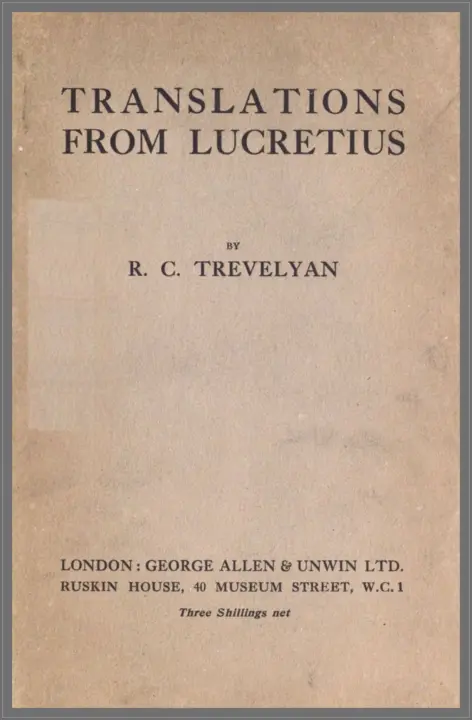
THE CLASSIC COLLECTION · 1920
"Translations from Lucretius" by Titus Lucretius Carus is a philosophical text written in the early 1st century BC. This work offers a poetic interpretation of Lucretius' original ideas, focusing on themes of nature, reality, and the human condition. The text serves to explore and explain the nature of existence, the universe, and the principles of atomism, providing insights into life, death, and the pursuit of happiness. The beginning of "Translations from Lucretius" sets the stage for these profound themes by invoking Venus, the goddess associated with love and creation, as a muse for the poet’s exploration of nature. The opening lines elaborate on the influence of Venus over all living things and seek her assistance in articulating complex thoughts about the natural world. Lucretius argues against the cruelty of religion, advocating instead for a rational understanding of the universe founded on the principles of atomism. The text delves into discussions on matter, the cycle of life and death, and the innate fears humans have regarding mortality and divine punishment, laying the groundwork for a philosophical inquiry into the essence of existence and the futility of fearing death.
Introduction adapted from the source catalogue; source summaries may be automatically generated.
Free to read · English · 29,507 words · No account needed
MAKE TIME FOR A GOOD BOOK
On by default. Untick to stop anonymous reading totals. Each page counts after 10 seconds in view. How this works.
Anonymous counting is on unless you have switched it off.
Afterwards, when they had learnt the use of huts,
And skins, and fire; when woman, joined with man
In wedlock, dwelt apart in one abode,
And they saw offspring born out of themselves,
Then first the human race began to soften.
For fire made their chilly bodies now
Less able to endure the cold beneath
The roof of heaven: Venus impaired their strength:
And children easily by their blandishments
Broke down the haughty temper of their parents.
Then too neighbours began to join in bonds
Of friendship, wishing neither to inflict
Nor suffer violence: and for womankind
And children they would claim kind treatment, pleading
With cries and gestures inarticulately
That all men ought to have pity on the weak.
And though harmony could not everywhere
Be established, yet the most part faithfully
Observed their covenants, or man’s whole race
Would even then have perished, nor till now
Could propagation have preserved their kind.
But it was Nature that constrained their tongues To utter various sounds; and need struck out The names of things, in the same way almost As impotence of tongue is itself seen To teach gesture to infants, prompting them To point at things around them. For all creatures Divine by instinct how far they can use Their natural powers. Thus before horns are born And stand out on the forehead of a calf, When he is angry, he butts and charges with it. Then panther cubs and lion whelps will fight With claws and feet and teeth, even at a time When teeth and claws have hardly yet been formed. Also we see how the whole race of birds Trusting their wings, will seek a fluttering succour From new-fledged pinions. Therefore to suppose That somebody once apportioned names to things, And that from him men learnt to use words first, Is mere folly. For why should this one man Be able to denote all things by words And with his tongue form varied sounds, yet others At the same time be deemed incapable To have done the like? Besides, if others too Had not made use of words among themselves, Whence was the preconception of their usefulness Implanted in this man, and whence was given him The primal power to know and comprehend What he desired to do? Again, one man Could not subdue by force the wills of many And compel them to learn the names of things. It is no easy labour to convince Deaf men, and teach them what they ought to do; Since not for long would they endure his voice, Nor suffer unintelligible sounds Fruitlessly to be dinned into their ears. Lastly what should there be to wonder at So much in this, that mankind, when their voice And tongue were in full vigour, should name things By different sounds as different feelings bade them, Since dumb cattle, and even the wild beasts, Are wont to emit distinct and varied sounds, When they feel fear or pain, or when joy moves them. This indeed may be learnt from manifest facts. When the large soft mouths of Molossian dogs Begin to growl, angrily laying bare Their hard teeth, then far different is the tone In which they threaten, savagely thus drawn back, From the clear sound which, when they bark outright, Fills the whole neighbourhood. And when they essay In gentle mood to lick their cubs, or when They toss them with their paws, and snapping at them Tenderly make as though they would devour them With half-closed teeth, thus fondling them they yelp With a quite different sound from their deep bay When left alone in houses, or from the whimper With which crouching they shrink away from blows. Furthermore does not a young stallion’s neigh Seem different, when he rages among the mares Pierced in his flower of age by winged love’s goads, From when with wide-stretched nostrils he snorts out The battle signal, or when at other times Perchance he whinnies trembling in all his limbs? Lastly the race of fowl and varied birds, Hawks and ospreys and gulls that seek their living In the salt waters of the ocean waves, Utter at different times quite different cries From those they make when they fight over food, Or struggle with their prey. And some will change Their harsh notes in accordance with the weather, As do the long-lived tribes of crows, and flocks Of rooks, when they are said to call for rain, Or sometimes to be summoning wind-storms. Since therefore various feelings can compel Animals, speechless though they be, to utter Such varying sounds, how much more natural Is it that in those days men could denote Dissimilar things by many different sounds!
Your reading position is saved on this browser. Take it to another device with a library code. Reading pages adapt to text, rather than matching a printed edition.
BEHIND THE BOOK
This eBook is for the use of anyone anywhere in the United States and most other parts of the world at no cost and with almost no restrictions whatsoever. You may copy it, give it away or re-use it under the terms of the Project Gutenberg License included with this eBook or online at www.gutenberg.org. If you are not located in the United States, you will have to check the laws of the country where you are located before using this eBook. Read the source licence.
The original source file, including credits and licence, is retained by this library. Request an original-format copy at no charge. Please include the book title and Project Gutenberg identifier #64024.
KEEP YOUR CURIOSITY GOING

David Patterson (Spirit) Hatch
Coulson Kernahan

Ralph Waldo Emerson
Frances Wright

Edwin Abbott Abbott

Joseph Droz