THE CLASSIC COLLECTION✦On the Nature of ThingsCLASSIC FREE BOOKS
On the Nature of Things
Titus Lucretius Carus
THE CLASSIC COLLECTION · 1920
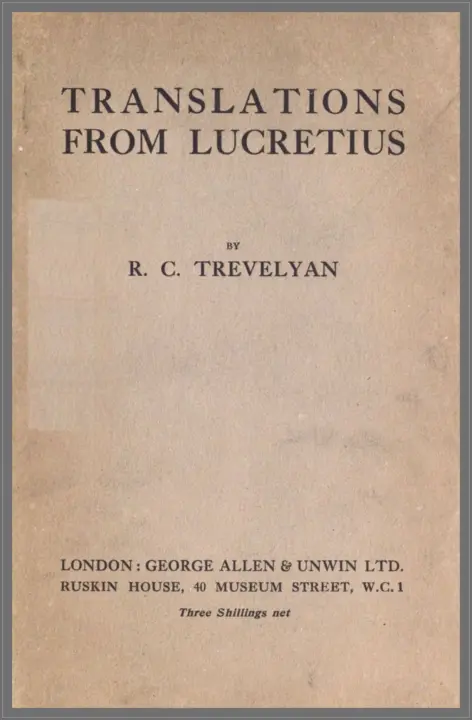
"Translations from Lucretius" by Titus Lucretius Carus is a philosophical text written in the early 1st century BC. This work offers a poetic interpretation of Lucretius' original ideas, focusing on themes of nature, reality, and the human condition. The text serves to explore and explain the nature of existence, the universe, and the principles of atomism, providing insights into life, death, and the pursuit of happiness. The beginning of "Translations from Lucretius" sets the stage for these profound themes by invoking Venus, the goddess associated with love and creation, as a muse for the poet’s exploration of nature. The opening lines elaborate on the influence of Venus over all living things and seek her assistance in articulating complex thoughts about the natural world. Lucretius argues against the cruelty of religion, advocating instead for a rational understanding of the universe founded on the principles of atomism. The text delves into discussions on matter, the cycle of life and death, and the innate fears humans have regarding mortality and divine punishment, laying the groundwork for a philosophical inquiry into the essence of existence and the futility of fearing death.
Introduction adapted from the source catalogue; source summaries may be automatically generated.
Free to read · English · 29,507 words · No account needed
MAKE TIME FOR A GOOD BOOK
On by default. Untick to stop anonymous reading totals. Each page counts after 10 seconds in view. How this works.
Anonymous counting is on unless you have switched it off.
But that first race of men in the open fields Was hardier far, (small wonder, since hard Earth Had brought it forth,) built too around a frame Of bones more large and solid, knit together By powerful sinews; nor was it easily Impaired by heat or cold, nor by strange foods, Nor yet by any bodily disease. And during many revolving periods Of the sun through the sky, they lived their lives After the roving habit of wild beasts. No one was then the bent plough’s stalwart guide, None yet had knowledge how to till the fields With iron, or plant young saplings in the soil, Nor how to lop old boughs from the tall trees With pruning-hooks. What suns and rains had given, What of her own free will Earth had brought forth, Was enough bounty to content their hearts. ’Neath acorn-bearing oak-trees their wont was To alleviate their hunger; and those berries Which now upon the arbutus you see Ripening to scarlet hues in winter-time, The Earth then bore more plentifully and larger Than in these days. Moreover then the world’s Luxuriant youth gave birth to many kinds Of coarse food, ample enough for wretched men. But to allay their thirst rivers and springs Invited, as now waters, tumbling down From the great mountains with clear-sounding plash, Summon from far the thirsting tribes of beasts. Furthermore in their roamings they would visit Those renowned silvan precincts of the Nymphs, Caverns wherefrom they knew that copious streams, Gushing forth smoothly, bathed the dripping rocks, (The dripping rocks, o’er green moss trickling down,) Or sometimes welled up over the level plain. As yet they knew not how to employ fire, Or to make use of skins, and clothe their bodies With spoils of wild beasts; but inhabiting Woods, mountains, caves and forests, they would shelter Their squalid limbs in thickets, when compelled To shun the buffeting of winds and rains. No regard could they have to a general good, Nor did they know how to make use in common Of any laws or customs. Whatsoever Fortune might set before him, that would each Take as his prize, cunning to thrive and live As best might please him, each one for himself. And in the woods Venus would join the bodies Of lovers, whether a mutual desire, Or the man’s violence and vehement lust Had won the woman over, or a bribe Of acorns, arbute-berries or choice pears. Endowed with marvellous strength of hands and feet They chased the forest-roaming tribes of beasts; And many with flung stones and ponderous club They overcame, some few they would avoid In hiding-places. And like bristly swine Just as they were they flung their savage limbs Naked upon the ground, when night o’ertook them, Enveloping themselves with leaves and boughs. Nor did they call for daylight and the sun Wandering terror-stricken about the fields With loud wails through the shadows of the night, But silently, buried in sleep they lay Waiting until the sun with rosy torch Brought light into the sky. For since from childhood They had been wont to see darkness and light Alternately begotten without fail, Never could they feel wonder or misgiving Lest night eternal should possess the earth And the sun’s light for ever be withdrawn. But ’twas a worse anxiety that wild beasts Often made sleep unsafe for these poor wretches. For driven from their homes in sheltering rocks They fled at the entrance of a foaming boar Or strong lion, yielding up at dead of night Their leaf-strewn beds in panic to fierce guests. Yet no more often in those days than now Would mortal men leave the sweet light of life With lamentation. Each one by himself Would doubtless be more likely then than now To be seized and devoured by wild beasts’ teeth, A living food, and with his groans would fill Mountains and forests, while he saw his own Live flesh in a live monument entombed. But those whom flight had saved with mangled body, From that time forth would hold their trembling hands Over their noisome scars, with dreadful cries Invoking death, till agonising throes Rid them of life, with none to give them aid, Ignorant of what wounds required. But then A single day did not consign to death Thousands on thousands, marshalled beneath standards, Nor did the turbulent waters of the deep Shatter upon the rocks both ships and men. At that time vainly, without aim or result The sea would often rise up and turmoil; Nor could the winsome wiles of the calm deep Lure men on treacherously with laughing waves, While reckless seamanship was yet unknown. Moreover lack of food would then consign Their fainting limbs to death: now rather plenty Sinks men to ruin. Often for themselves Would they pour poison out unwittingly: To others now with subtler skill they give it.
Your reading position is saved on this browser. Take it to another device with a library code. Reading pages adapt to text, rather than matching a printed edition.
BEHIND THE BOOK
This eBook is for the use of anyone anywhere in the United States and most other parts of the world at no cost and with almost no restrictions whatsoever. You may copy it, give it away or re-use it under the terms of the Project Gutenberg License included with this eBook or online at www.gutenberg.org. If you are not located in the United States, you will have to check the laws of the country where you are located before using this eBook. Read the source licence.
The original source file, including credits and licence, is retained by this library. Request an original-format copy at no charge. Please include the book title and Project Gutenberg identifier #64024.
KEEP YOUR CURIOSITY GOING

David Patterson (Spirit) Hatch
Coulson Kernahan

Ralph Waldo Emerson
Frances Wright

Edwin Abbott Abbott

Joseph Droz