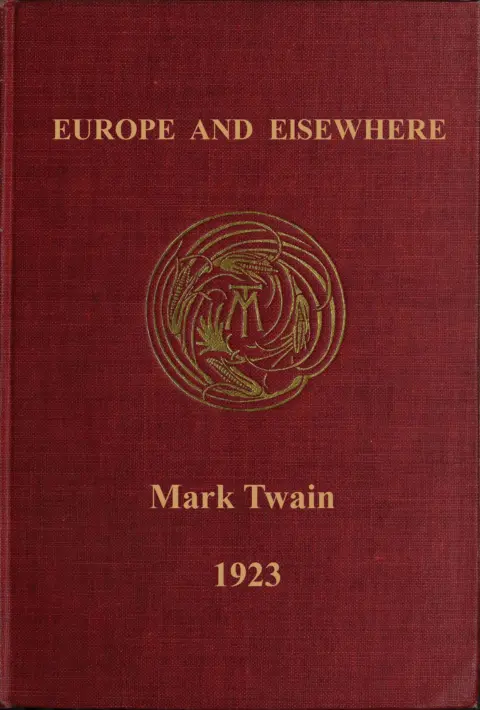
Europe and elsewhere
Mark Twain
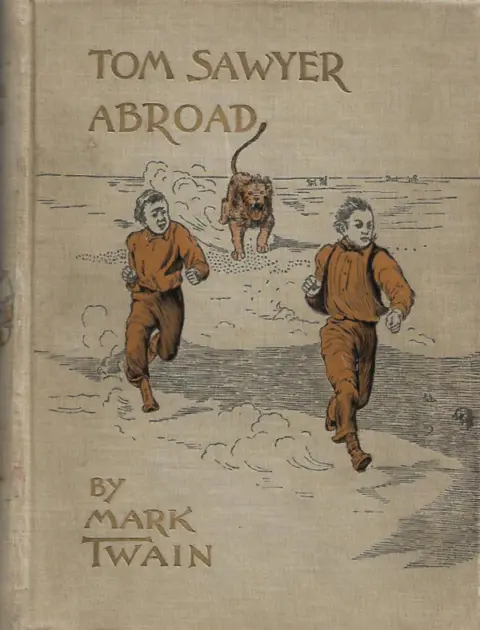
THE CLASSIC COLLECTION · 1894
"Tom Sawyer Abroad" by Mark Twain is a novel published in 1894. Tom Sawyer, Huckleberry Finn, and Jim accidentally stow away on a futuristic hot air balloon bound for Europe. After the ship's owner falls overboard during a storm, the trio finds themselves sailing solo across uncharted skies. Their journey takes an unexpected turn toward Africa, where they encounter lions, robbers, and ancient wonders like the Pyramids and Sphinx in this parody of Jules Verne-style adventure tales.
Introduction adapted from the source catalogue; source summaries may be automatically generated.
Free to read · English · 35,559 words · No account needed
MAKE TIME FOR A GOOD BOOK
On by default. Untick to stop anonymous reading totals. Each page counts after 10 seconds in view. How this works.
Anonymous counting is on unless you have switched it off.
After breakfast Tom learned me and Jim how to steer, and divided us all up into four-hour watches, turn and turn about; and when his watch was out I took his place, and he got out the professor’s papers and pens and wrote a letter home to his aunt Polly, telling her everything that had happened to us, and dated it “In the Welkin, approaching England,” and folded it together and stuck it fast with a red wafer, and directed it, and wrote above the direction, in big writing, “From Tom Sawyer, the Erronort,” and said it would stump old Nat Parsons, the postmaster, when it come along in the mail. I says:
“Tom Sawyer, this ain’t no welkin, it’s a balloon.”
“Well, now, who said it was a welkin, smarty?”
“You’ve wrote it on the letter, anyway.”
“What of it? That don’t mean that the balloon’s the welkin.”
“Oh, I thought it did. Well, then, what is a welkin?”
I see in a minute he was stuck. He raked and scraped around in his mind, but he couldn’t find nothing, so he had to say:
“I don’t know, and nobody don’t know. It’s just a word, and it’s a mighty good word, too. There ain’t many that lays over it. I don’t believe there’s any that does.”
“Shucks!” I says. “But what does it mean?—that’s the p’int.”
“I don’t know what it means, I tell you. It’s a word that people uses for—for—well, it’s ornamental. They don’t put ruffles on a shirt to keep a person warm, do they?”
“Course they don’t.”
“But they put them on, don’t they?”
“Yes.”
“All right, then; that letter I wrote is a shirt, and the welkin’s the
ruffle on it.”
I judged that that would gravel Jim, and it did.
“Now, Mars Tom, it ain’t no use to talk like dat; en, moreover, it’s sinful. You knows a letter ain’t no shirt, en dey ain’t no ruffles on it, nuther. Dey ain’t no place to put ’em on; you can’t put em on, and dey wouldn’t stay ef you did.”
“Oh do shut up, and wait till something’s started that you know
something about.”
“Why, Mars Tom, sholy you can’t mean to say I don’t know about shirts, when, goodness knows, I’s toted home de washin’ ever sence—”
“I tell you, this hasn’t got anything to do with shirts. I only—”
“Why, Mars Tom, you said yo’self dat a letter—”
Your reading position is saved on this browser. Take it to another device with a library code. Reading pages adapt to text, rather than matching a printed edition.
BEHIND THE BOOK
This eBook is for the use of anyone anywhere in the United States and most other parts of the world at no cost and with almost no restrictions whatsoever. You may copy it, give it away or re-use it under the terms of the Project Gutenberg License included with this eBook or online at www.gutenberg.org. If you are not located in the United States, you will have to check the laws of the country where you are located before using this eBook. Read the source licence.
The original source file, including credits and licence, is retained by this library. Request an original-format copy at no charge. Please include the book title and Project Gutenberg identifier #91.
KEEP YOUR CURIOSITY GOING
Coulson Kernahan

Maurice Baring
Frances Wright
Cécile Tormay

Frederic Jesup Stimson

W. H. P. (William Henry Pope) Jarvis