Mary Regan
Leroy Scott
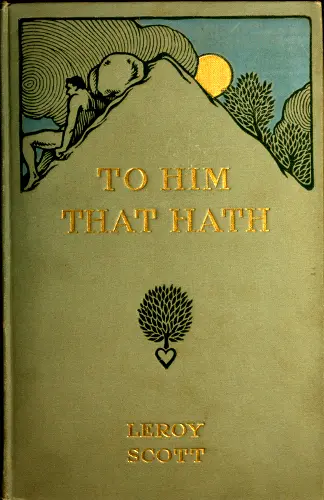
THE CLASSIC COLLECTION · 1906
“To Him That Hath” by Leroy Scott is a novel written in the early 20th century. The story revolves around David Aldrich, a struggling author who faces profound grief and moral dilemmas following the death of his close friend, Reverend Philip Morton. The narrative dives deep into themes of loss, guilt, and the societal expectations surrounding success and failure, setting the stage for David's internal conflict as he grapples with his sense of worth and responsibility. At the start of the book, David is thrust into a whirlwind of emotions upon receiving news of Morton's unexpected death. Overwhelmed by grief, he reflects on his friendship with Morton and the impact his mentor had on the community through his humanitarian efforts. As David prepares for the funeral, he is confronted not only with the loss of a dear friend but also with the stark reality of their contrasting lives—Morton as a respected and beloved figure, and himself as a struggling writer. The opening chapters establish a poignant tone, exploring David's feelings of inadequacy and foreshadowing the moral choices he will have to make in the face of mortality and legacy.
Introduction adapted from the source catalogue; source summaries may be automatically generated.
Free to read · English · 99,054 words · No account needed
MAKE TIME FOR A GOOD BOOK
On by default. Untick to stop anonymous reading totals. Each page counts after 10 seconds in view. How this works.
Anonymous counting is on unless you have switched it off.
Mr. Chambers again thought for a minute. "I think you exaggerate the effect of the truth on St. Christopher's. However, for the moment, I'll grant you're right. From what you told me I gather Mr. Aldrich has some rather large philanthropic ideas. Well, if he will clear himself, I'll settle upon you any amount you wish--ten million, twenty million. That will enable him to carry out his ideas on any scale he may like. The good he can do will more than balance any injury that may be done to St. Christopher's. On the one hand, he will have, and you with him, powerless disgrace. On the other, clear name, love, fortune, unlimited power to do good."
She slowly shook her head. "It's all thought over--he can't do it."
"And nothing can change your determination to marry him?"
She held out a hand to him. "No. Forgive me, father," she whispered.
He gazed steadily at her--and again his quick mind was searching for a solution to the situation. He pressed her hand. "I want to think. We'll speak of this again."
He started out, but she stepped before him. "Wait--there's something I must say. But first, you must never tell what you've just found out."'
He did not answer.
His silence stirred a sudden new fear. She crept close to him and peered up into his face. "Father--you're not going to tell, are you?"
Again he was silent.
Her face paled with consternation. She drew a long breath, and her voice came out a thin whisper. "You are going to tell, father! I see it."
He looked into her wide brown eyes and at her quivering face. "I think, Helen, you can leave the proper action to my discretion."
She swayed slightly, and then her whole body tightened with effort. "You are going to make his innocence public," she said, with slow accusation. "You can't deny it."
"I am," he said shortly.
She stepped a pace nearer him. "You must not! You must not!" she cried.
His jaw tightened and his brows drew together. "I shall!--you hear me?"
"But, father--it isn't your secret. You haven't the right."
"I have the right to protect my own daughter and myself!"
"But to destroy others?" she implored. "You know it will ruin hundreds. Have you the right to do that?"
"A man's first duty is to those nearest him."
"But don't you see?--you destroy hundreds to save yourself, and me!"
"You have my answer," he said.
She looked at him despairingly. "Then nothing can stop you?"
"Nothing." His face was firm, his voice hard. "And now, Helen, I'm going," he said shortly. "There's nothing more to be said."
Your reading position is saved on this browser. Take it to another device with a library code. Reading pages adapt to text, rather than matching a printed edition.
BEHIND THE BOOK
This eBook is for the use of anyone anywhere in the United States and most other parts of the world at no cost and with almost no restrictions whatsoever. You may copy it, give it away or re-use it under the terms of the Project Gutenberg License included with this eBook or online at www.gutenberg.org. If you are not located in the United States, you will have to check the laws of the country where you are located before using this eBook. Read the source licence.
The original source file, including credits and licence, is retained by this library. Request an original-format copy at no charge. Please include the book title and Project Gutenberg identifier #41180.
KEEP YOUR CURIOSITY GOING
Coulson Kernahan

Maurice Baring
Frances Wright
Cécile Tormay

Frederic Jesup Stimson

W. H. P. (William Henry Pope) Jarvis