Mary Regan
Leroy Scott
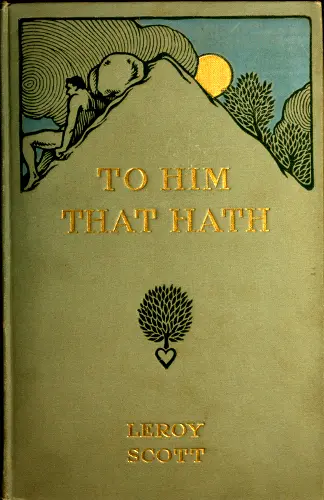
THE CLASSIC COLLECTION · 1906
“To Him That Hath” by Leroy Scott is a novel written in the early 20th century. The story revolves around David Aldrich, a struggling author who faces profound grief and moral dilemmas following the death of his close friend, Reverend Philip Morton. The narrative dives deep into themes of loss, guilt, and the societal expectations surrounding success and failure, setting the stage for David's internal conflict as he grapples with his sense of worth and responsibility. At the start of the book, David is thrust into a whirlwind of emotions upon receiving news of Morton's unexpected death. Overwhelmed by grief, he reflects on his friendship with Morton and the impact his mentor had on the community through his humanitarian efforts. As David prepares for the funeral, he is confronted not only with the loss of a dear friend but also with the stark reality of their contrasting lives—Morton as a respected and beloved figure, and himself as a struggling writer. The opening chapters establish a poignant tone, exploring David's feelings of inadequacy and foreshadowing the moral choices he will have to make in the face of mortality and legacy.
Introduction adapted from the source catalogue; source summaries may be automatically generated.
Free to read · English · 99,054 words · No account needed
MAKE TIME FOR A GOOD BOOK
On by default. Untick to stop anonymous reading totals. Each page counts after 10 seconds in view. How this works.
Anonymous counting is on unless you have switched it off.
At the end of the afternoon, a few days later, a fierce battle was being waged in the basement room that was the Aldrich home, when a knock made David lower his defensive fists.
"Ah, don't stop, pard," Tom begged of his cornered enemy. "Let 'em pound. It's just somebody else kickin' about de heat."
"We'll only stop a second. Ask what they want, and say I'll attend to it
at once."
Tom, grumbling fiercely, opened the door. "What's de matter?" he demanded. "Ain't you got no heat?"
But it was not an angry tenant who stepped in from the darkness of the hall. It was Helen Chambers. She was flushed, and excitement quivered in her eyes. She looked from one pillow-fisted belligerent to the other, and said, smiling tremulously:
"I had thought there was no heat, but after looking at you I've decided there's plenty. Is this the way you always receive complainants?"
Tom glanced guiltily at David, then darted behind Helen and through the door. David gazed at her, loose-jawed. Suddenly he remembered his shirt-sleeves.
"I beg your pardon," he said, and in his bewilderment he tried to thrust his huge fists into his coat.
"Perhaps you can do that"--again the tremulous smile--"but I really
don't think you can."
"I should take the gloves off, of course," he stammered. He frantically unlaced them, slipped into his coat, and then looked at her, throbbing with wonderment as to why she had come.
She did not leave him in an instant's doubt. She stepped toward him with outstretched hand, her smile gone, on her face eager, appealing earnestness.
"I have come to ask your forgiveness," she said with her old, direct simplicity. "I believed that you and the boy were--pardon me!--were stealing together; that you were letting yourself slip downward. This afternoon the boy came to me at St. Christopher's and told me the real story. I could hardly wait till I was free so that I could hurry to you and ask you to forgive me."
"Forgive you!" David said slowly.
"Forgive me for my unjust judgment," she went on, a quaver in her voice. "I judged from mere appearance, mere guess-work. I was cold--horrid. I am ashamed. Forgive me."
Her never-expected coming, her never-expected words, rendered him for the moment speechless. He could only gaze into her fresh face, so full of earnestness, of appeal.
"You do not forgive me?" she asked.
David thrilled at the tremulous note in her voice. "I have nothing to forgive. You could not help judging as you did."
Her deep brown eyes, looking straight into his face, continued the
appeal.
Your reading position is saved on this browser. Take it to another device with a library code. Reading pages adapt to text, rather than matching a printed edition.
BEHIND THE BOOK
This eBook is for the use of anyone anywhere in the United States and most other parts of the world at no cost and with almost no restrictions whatsoever. You may copy it, give it away or re-use it under the terms of the Project Gutenberg License included with this eBook or online at www.gutenberg.org. If you are not located in the United States, you will have to check the laws of the country where you are located before using this eBook. Read the source licence.
The original source file, including credits and licence, is retained by this library. Request an original-format copy at no charge. Please include the book title and Project Gutenberg identifier #41180.
KEEP YOUR CURIOSITY GOING
Coulson Kernahan

Maurice Baring
Frances Wright
Cécile Tormay

Frederic Jesup Stimson

W. H. P. (William Henry Pope) Jarvis