
The Diary of a Goose Girl
Kate Douglas Smith Wiggin
THE CLASSIC COLLECTION · 1890
"Timothy's Quest" by Kate Douglas Smith Wiggin is a children's novel written in the late 19th century. The story revolves around a young boy named Timothy Jessup, who takes on parental responsibilities for his baby sister, Lady Gay, after their mother, Flossy Morrison, passes away. Faced with the harsh realities of life in a dilapidated urban environment, Timothy’s quest is to find a loving home for himself and Lady Gay, showcasing themes of love, resilience, and the search for belonging. At the start of the narrative, Flossy Morrison has recently died, leaving behind her two children, Timothy and Lady Gay. The opening describes the dreary and impoverished setting of Minerva Court, where Timothy lives. As two women discuss the fate of the children, little Timothy quietly resolves to save Lady Gay from being taken to an orphan asylum. He devises a plan to escape with her, embarking on a daring journey with their loyal dog, Rags. Timothy dreams of finding a mother who will love Lady Gay as he does, setting the stage for their adventures.
Introduction adapted from the source catalogue; source summaries may be automatically generated.
Free to read · English · 38,711 words · No account needed
MAKE TIME FOR A GOOD BOOK
On by default. Untick to stop anonymous reading totals. Each page counts after 10 seconds in view. How this works.
Anonymous counting is on unless you have switched it off.
"Joel Whitten's widder's just drawed his pension along o' his bein' in the war o' 1812. ... It's took 'em all these years to fix it. ... Massy sakes! don't some folks have their luck buttered in this world?... She was his fourth wife, 'n' she never lived with him but thirteen days 'fore he up 'n' died. ... It doos seem's if the guv'ment might look after things a little mite closer.... Talk about Joel Whitten's bein' in the war o' 1812! Everybody knows Joel Whitten wouldn't have fit a skeeter! He never got any further 'n Scratch Corner, any way, 'n' there he clim a tree or hid behind a hen-coop somewheres till the regiment got out o' sight.... Yes: one, two, three, four,--Huldy was his fourth wife. His first was a Hogg, from Hoggses Mills. The second was Dorcas Doolittle, aunt to Jabe Slocum; she didn't know enough to make soap, Dorcas didn't.... Then there was Delia Weeks, from the lower corner.... She didn't live long.... There was some thin' wrong with Delia.... She was one o' the thin-blooded, white-livered kind.... You couldn't get her warm, no matter how hard you tried. ... She'd set over a roarin' fire in the cook-stove even in the prickliest o' the dog-days. ... The mill-folks used to say the Whittens burnt more cut-roun's 'n' stickens 'n any three fam'lies in the village. ... Well, after Delia died, then come Huldy's turn, 'n' it's she, after all, that's drawed the pension.... Huldy took Joel's death consid'able hard, but I guess she'll perk up, now she's come int' this money. ... She's awful leaky-minded, Huldy is, but she's got tender feelin's.... One day she happened in at noon-time, 'n' set down to the table with Si 'n' I.... All of a suddent she bust right out cryin' when Si was offerin' her a piece o' tripe, 'n' then it come out that she couldn't never bear the sight o' tripe, it reminded her so of Joel! It seems tripe was a favorite dish o' Joel's. All his wives cooked it firstrate.... Jabe Slocum seems to set consid'able store by them children, don't he?... I guess he'll never ketch up with his work, now he's got them hangin' to his heels.... He doos beat all for slowness! Slocum's a good name for him, that's certain. An' 's if that wa'n't enough, his mother was a Stillwell, 'n' her mother was a Doolittle!... The Doolittles was the slowest fam'ly in Lincoln County. (Thank you, I'm well helped, Samanthy.) Old Cyrus Doolittle was slower 'n a toad funeral. He was a carpenter by trade, 'n' he was twenty-five years buildin' his house; 'n' it warn't no great, either.... The stagin' was up ten or fifteen years, 'n' he shingled it four or five times before he got roun', for one patch o' shingles used to wear out 'fore he got the next patch on. He 'n' Mis' Doolittle lived in two rooms in the L. There was elegant banisters, but no stairs to 'em, 'n' no entry floors. There was a tip-top cellar, but there wa'n't no way o' gittin' down to it, 'n' there wa'n't no conductors to the cisterns. There was only one door panel painted in the parlor. Land sakes! the neighbors used to happen in 'bout every week for years 'n' years, hopin' he'd get another one finished up, but he never did,--not to my knowledge.... Why, it's the gospel truth that when Mis' Doolittle died he had to have her embalmed, so 't he could git the front door hung for the fun'ral! (No more tea, I thank you; my cup ain't out.) ... Speakin' o' slow folks, Elder Banks tells an awful good story 'bout Jabe Slocum.... There's another man down to Edgewood, Aaron Peek by name, that's 'bout as lazy as Jabe. An' one day, when the loafers roun' the store was talkin' 'bout 'em, all of a suddent they see the two of 'em startin' to come down Marm Berry's hill, right in plain sight of the store.... Well, one o' the Edgewood boys bate one o' the Pleasant River boys that they could tell which one of 'em was the laziest by the way they come down that hill.... So they all watched, 'n' bime by, when Jabe was most down to the bottom of the hill, they was struck all of a heap to see him break into a kind of a jog trot 'n' run down the balance o' the way. Well, then, they fell to quarrelin'; for o' course the Pleasant River folks said Aaron Peek was the laziest, 'n' the Edgewood boys declared he hedn't got no such record for laziness's Jabe Slocum hed; an' when they was explainin' of it, one way 'n' 'nother, Elder Banks come along, 'n' they asked him to be the judge. When he heerd tell how 't was, he said he agreed with the Edgewood folks that Jabe was lazier 'n Aaron. 'Well, I snum, I don't see how you make that out,' says the Pleasant River boys; 'for Aaron walked down, 'n' Jabe run a piece o' the way.' 'If Jabe Slocum run,' says the elder, as impressive as if he was preachin',--'if Jabe Slocum ever run, then 't was because he was too doggoned lazy to hold back! 'an' that settled it!... (No, I couldn't eat another mossel, Miss Cummins; I've made out a splendid supper.) ... You can't git such pie 'n' doughnuts anywhere else in the village, 'n' what I say I mean.... Do you make your riz doughnuts with emptin's? I want to know! Si says there's more faculty in cookin' flour food than there is in meat-victuals, 'n' I guess he's 'bout right."
Your reading position is saved on this browser. Take it to another device with a library code. Reading pages adapt to text, rather than matching a printed edition.
Kate Douglas Smith Wiggin
Kate Douglas Smith Wiggin
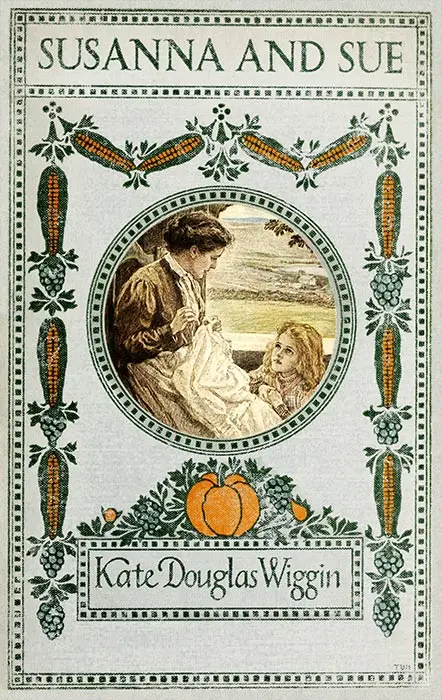
Kate Douglas Smith Wiggin
Kate Douglas Smith Wiggin & Nora Archibald Smith
BEHIND THE BOOK
This eBook is for the use of anyone anywhere in the United States and most other parts of the world at no cost and with almost no restrictions whatsoever. You may copy it, give it away or re-use it under the terms of the Project Gutenberg License included with this eBook or online at www.gutenberg.org. If you are not located in the United States, you will have to check the laws of the country where you are located before using this eBook. Read the source licence.
The original source file, including credits and licence, is retained by this library. Request an original-format copy at no charge. Please include the book title and Project Gutenberg identifier #18531.
KEEP YOUR CURIOSITY GOING
Coulson Kernahan

Maurice Baring
Frances Wright
Cécile Tormay

Frederic Jesup Stimson

W. H. P. (William Henry Pope) Jarvis