
The Diary of a Goose Girl
Kate Douglas Smith Wiggin
THE CLASSIC COLLECTION · 1890
"Timothy's Quest" by Kate Douglas Smith Wiggin is a children's novel written in the late 19th century. The story revolves around a young boy named Timothy Jessup, who takes on parental responsibilities for his baby sister, Lady Gay, after their mother, Flossy Morrison, passes away. Faced with the harsh realities of life in a dilapidated urban environment, Timothy’s quest is to find a loving home for himself and Lady Gay, showcasing themes of love, resilience, and the search for belonging. At the start of the narrative, Flossy Morrison has recently died, leaving behind her two children, Timothy and Lady Gay. The opening describes the dreary and impoverished setting of Minerva Court, where Timothy lives. As two women discuss the fate of the children, little Timothy quietly resolves to save Lady Gay from being taken to an orphan asylum. He devises a plan to escape with her, embarking on a daring journey with their loyal dog, Rags. Timothy dreams of finding a mother who will love Lady Gay as he does, setting the stage for their adventures.
Introduction adapted from the source catalogue; source summaries may be automatically generated.
Free to read · English · 38,711 words · No account needed
MAKE TIME FOR A GOOD BOOK
On by default. Untick to stop anonymous reading totals. Each page counts after 10 seconds in view. How this works.
Anonymous counting is on unless you have switched it off.
"I hope I shall relish my vittles to-night," said Aunt Hitty, as she poured her tea into her saucer, and set the cup in her little blue "cup-plate;" "but I've had the neuralgy so in my face that it's be'n more 'n ten days sence I've be'n able to carry a knife to my mouth.... Your meat vittles is always so tasty, Miss Cummins. I was sayin' to Mis' Sawyer last week I think she lets her beef hang too long. Its dretful tender, but I don't b'lieve its hullsome. For my part, as I've many a time said to Si, I like meat with some chaw to it.... Mis' Sawyer don't put half enough vittles on her table. She thinks it scares folks; it don't me a mite,--it makes me 's hungry as a wolf. When I set a table for comp'ny I pile on a hull lot, 'n' I find it kind o' discourages 'em.... Mis' Southwick's hevin' a reg'lar brash o' house-cleanin'. She's too p'ison neat for any earthly use, that woman is. She's fixed clam-shell borders roun' all her garding beds, an' got enough left for a pile in one corner, where she's goin' to set her oleander kag. Then she's bought a haircloth chair and got a new three-ply carpet in her parlor, 'n' put the old one in the spare-room 'n' the back-entry. Her daughter's down here from New Haven. She's married into one of the first families o' Connecticut, Lobelia has, 'n' she puts on a good many airs. She's rigged out her mother's parlor with lace curtains 'n' one thing 'n' 'other, 'n' wants it called the drawin'-room. Did ye ever hear tell such foolishness? 'Drawin'-room!' s' I to Si; 'what's it goin' to draw? Nothin' but flies, I guess likely!' ... Mis' Pennell's got a new girl to help round the house,--one o' them pindlin' light-complected Smith girls, from the Swamp,--look's if they was nussed on bonny-clabber. She's so hombly I sh'd think 't would make her back ache to carry her head round. She ain't very smart, neither. Her mother sent word she'd pick up 'n' do better when she got her growth. That made Mis' Pennell hoppin' mad. She said she didn't cal'late to pay a girl three shillin's a week for growin'. Mis' Pennell's be'n feelin' consid'able slim, or she wouldn't 'a' hired help; it's just like pullin' teeth for Deacon Pennell to pay out money for anything like that. He watches every mouthful the girl puts into her mouth, 'n' it's made him 'bout down sick to see her fleshin' up on his vittles.... They say he has her put the mornin' coffee-groun's to dry on the winder-sill, 'n' then has 'em scalt over for dinner; but, there! I don' know 's there's a mite o' truth in it, so I won't repeat it. They went to him to git a subscription for the new hearse the other day. Land sakes! we need one bad enough. I thought for sure, at the last funeral we had, that they'd never git Mis' Strout to the graveyard safe and sound. I kep' a-thinkin' all the way how she'd 'a' took on, if she'd be'n alive. She was the most timersome woman 't ever was. She was a Thomson, 'n' all the Thomsons was scairt at their own shadders. Ivory Strout rid right behind the hearse, 'n' he says his heart was in his mouth the hull durin' time for fear 't would break down. He didn't git much comfort out the occasion, I guess! Wa' n't he mad he hed to ride in the same buggy with his mother-in-law! The minister planned it all out, 'n' wrote down the order o' the mourners, 'n' passeled him out with old Mis' Thomson. I was stan'in' close by, 'n' I heard him say he s'posed he could go that way if he must, but 't would spile the hull blamed thing for him! ... Well, as I was sayin', the seleckmen went to Deacon Pennell to get a contribution towards buyin' the new hearse; an' do you know, he wouldn't give 'em a dollar? He told 'em he gave five dollars towards the other one, twenty years ago, 'n' hadn't never got a cent's worth o' use out of it. That's Deacon Pennell all over! As Si says, if the grace o' God wa'n't given to all of us without money 'n' without price, you wouldn't never hev ketched Deacon Pennell experiencin' religion! It's got to be a free gospel 't would convict him o' sin, that's certain! ... They say Seth Thatcher's married out in Iowy. His mother's tickled 'most to death. She heerd he was settin' up with a girl out there, 'n' she was scairt to death for fear he'd get served as Lemuel 'n' Cyrus was. The Thatcher boys never hed any luck gettin' married, 'n' they always took disappointments in love turrible hard. You know Cyrus set in that front winder o' Mis' Thatcher's, 'n' rocked back 'n' forth for ten year, till he wore out five cane-bottomed cheers, 'n' then rocked clean through, down cellar, all on account o' Crany Ann Sweat. Well, I hope she got her comeuppance in another world,--she never did in this; she married well 'n' lived in Boston.... Mis' Thatcher hopes Seth 'll come home to live. She's dretful lonesome in that big house, all alone. She'd oughter have somebody for a company-keeper. She can't see nothin' but trees 'n' cows from her winders.... Beats all, the places they used to put houses.... Either they'd get 'em right under foot so 't you'd most tread on 'em when you walked along the road, or else they'd set 'em clean back in a lane, where the women folks couldn't see face o' clay week in 'n' week out....
Your reading position is saved on this browser. Take it to another device with a library code. Reading pages adapt to text, rather than matching a printed edition.
Kate Douglas Smith Wiggin
Kate Douglas Smith Wiggin
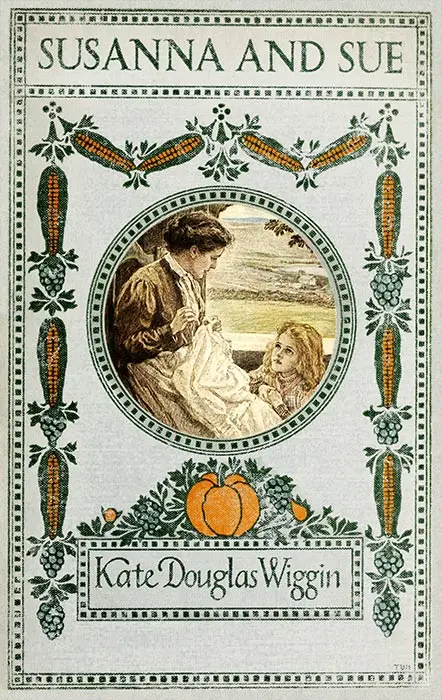
Kate Douglas Smith Wiggin
Kate Douglas Smith Wiggin & Nora Archibald Smith
BEHIND THE BOOK
This eBook is for the use of anyone anywhere in the United States and most other parts of the world at no cost and with almost no restrictions whatsoever. You may copy it, give it away or re-use it under the terms of the Project Gutenberg License included with this eBook or online at www.gutenberg.org. If you are not located in the United States, you will have to check the laws of the country where you are located before using this eBook. Read the source licence.
The original source file, including credits and licence, is retained by this library. Request an original-format copy at no charge. Please include the book title and Project Gutenberg identifier #18531.
KEEP YOUR CURIOSITY GOING
Coulson Kernahan

Maurice Baring
Frances Wright
Cécile Tormay

Frederic Jesup Stimson

W. H. P. (William Henry Pope) Jarvis