THE CLASSIC COLLECTION✦Creative EvolutionCLASSIC FREE BOOKS
Creative Evolution
Henri Bergson
THE CLASSIC COLLECTION · 1900
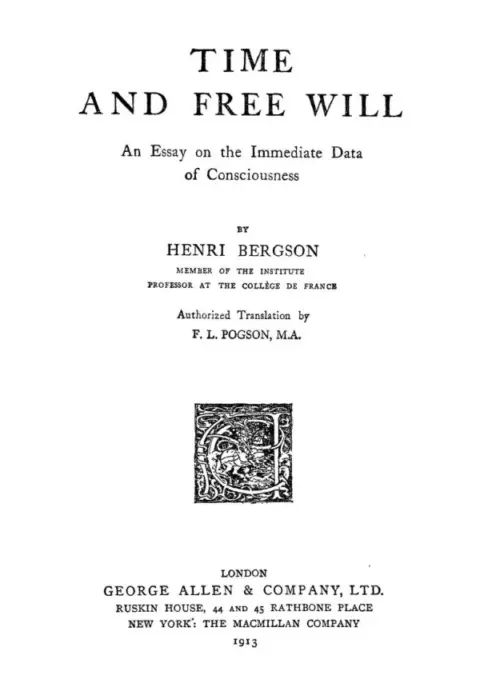
"Time and Free Will: An Essay on the Immediate Data of Consciousness" by Henri Bergson is a philosophical work written during the late 19th century. In this essay, Bergson explores the nature of time, consciousness, and the concept of free will, arguing against traditional deterministic views by emphasizing the importance of real duration and qualitative experiences. The opening of the text sets the stage for Bergson's exploration of the intensity of conscious states, questioning how we perceive and measure qualities such as emotions and sensations. He challenges the notion that these qualitative experiences can be quantified like physical magnitudes, advocating instead for an understanding of consciousness as a complex, interconnected flow of experiences. This critical examination of sensory intensity is just the beginning of Bergson's deeper inquiry into the relationship between consciousness and free will, preparing the reader for a philosophical journey that blends empirical observations with intuitive understanding.
Introduction adapted from the source catalogue; source summaries may be automatically generated.
Free to read · English · 66,044 words · No account needed
MAKE TIME FOR A GOOD BOOK
On by default. Untick to stop anonymous reading totals. Each page counts after 10 seconds in view. How this works.
Anonymous counting is on unless you have switched it off.
[Sidenote: This act consists in the intuition of an empty homogeneous medium: perhaps peculiar to man and not shared by animals.]
If we now seek to characterize this act, we see that it consists essentially in the intuition, or rather the conception, of an empty homogeneous medium. For it is scarcely possible to give any other definition of space: space is what enables us to distinguish a number of identical and simultaneous sensations from one another; it is thus a principle of differentiation other than that of qualitative differentiation, and consequently it is a reality with no quality. Someone may say, with the believers in the theory of local signs, that simultaneous sensations are never identical, and that, in consequence of the diversity of the organic elements which they affect, there are no two points of a homogeneous surface which make the same impression on the sight or the touch. We are quite ready to grant it, for if these two points affected us in the same way, there would be no reason for placing one of them on the right rather than on the left. But, just because we afterwards interpret this difference of quality in the sense of a difference of situation, it follows that we must have a clear idea of a homogeneous medium, i.e. of a simultaneity of terms which, although identical in quality, are yet distinct from one another. The more you insist on the difference between the impressions made on our retina by two points of a homogeneous surface, the more do you thereby make room for the activity of the mind, which perceives under the form of extensive homogeneity what is given it as qualitative heterogeneity. No doubt, though the representation of a homogeneous space grows out of an effort of the mind, there must be within the qualities themselves which differentiate two sensations some reason why they occupy this or that definite position in space. We must thus distinguish between the perception of extensity and the conception of space: they are no doubt implied in one another, but, the higher we rise in the scale of intelligent beings, the more clearly do we meet with the independent idea of a homogeneous space. It is therefore doubtful whether animals perceive the external world quite as we do, and especially whether they represent externality in the same way as ourselves. Naturalists have pointed out, as a remarkable fact, the surprising ease with which many vertebrates, and even some insects, manage to find their way through space. Animals have been seen to return almost in a straight line to their old home, pursuing a path which was hitherto unknown to them over a distance which may amount to several hundreds of miles. Attempts have been made to explain this feeling of direction by sight or smell, and, more recently, by the perception of magnetic currents which would enable the animal to take its bearings like a living compass. This amounts to saying that space is not so homogeneous for the animal as for us, and that determinations of space, or directions, do not assume for it a purely geometrical form. Each of these directions might appear to it with its own shade, its peculiar quality. We shall understand how a perception of this kind is possible if we remember that we ourselves distinguish our right from our left by a natural feeling, and that these two parts of our own extensity do then appear to us as if they bore a different quality; in fact, this is the very reason why we cannot give a proper definition of right and left. In truth, qualitative differences exist everywhere in nature, and I do not see why two concrete directions should not be as marked in immediate perception as two colours. But the conception of an empty homogeneous medium is something far more extraordinary, being a kind of reaction against that heterogeneity which is the very ground of our experience. Therefore, instead of saying that animals have a special sense of direction, we may as well say that men have a special faculty of perceiving or conceiving a space without quality. This faculty is not the faculty of abstraction: indeed, if we notice that abstraction assumes clean-cut distinctions and a kind of externality of the concepts or their symbols with regard to one another, we shall find that the faculty of abstraction already implies the intuition of a homogeneous medium. What we must say is that we have to do with two different kinds of reality, the one heterogeneous, that of sensible qualities, the other homogeneous, namely space. This latter, clearly conceived by the human intellect, enables us to use clean-cut distinctions, to count, to abstract, and perhaps also to speak.
Your reading position is saved on this browser. Take it to another device with a library code. Reading pages adapt to text, rather than matching a printed edition.
Henri Bergson
Henri Bergson
Henri Bergson
BEHIND THE BOOK
This eBook is for the use of anyone anywhere in the United States and most other parts of the world at no cost and with almost no restrictions whatsoever. You may copy it, give it away or re-use it under the terms of the Project Gutenberg License included with this eBook or online at www.gutenberg.org. If you are not located in the United States, you will have to check the laws of the country where you are located before using this eBook. Read the source licence.
The original source file, including credits and licence, is retained by this library. Request an original-format copy at no charge. Please include the book title and Project Gutenberg identifier #56852.
KEEP YOUR CURIOSITY GOING

David Patterson (Spirit) Hatch
Coulson Kernahan

Ralph Waldo Emerson
Frances Wright

Edwin Abbott Abbott

Joseph Droz