THE CLASSIC COLLECTION✦Creative EvolutionCLASSIC FREE BOOKS
Creative Evolution
Henri Bergson
THE CLASSIC COLLECTION · 1900
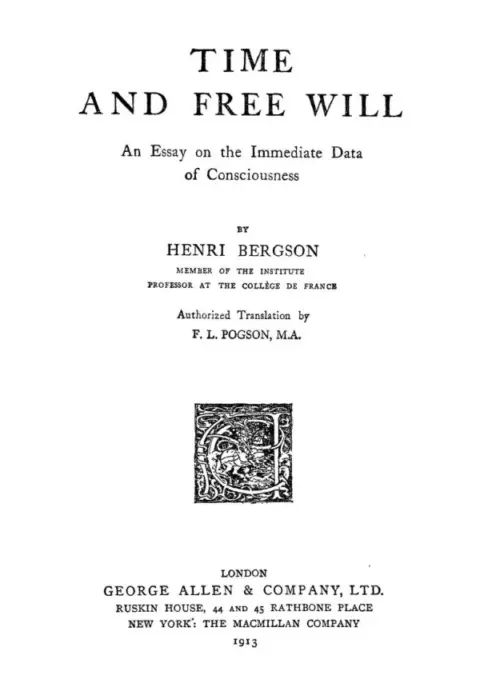
"Time and Free Will: An Essay on the Immediate Data of Consciousness" by Henri Bergson is a philosophical work written during the late 19th century. In this essay, Bergson explores the nature of time, consciousness, and the concept of free will, arguing against traditional deterministic views by emphasizing the importance of real duration and qualitative experiences. The opening of the text sets the stage for Bergson's exploration of the intensity of conscious states, questioning how we perceive and measure qualities such as emotions and sensations. He challenges the notion that these qualitative experiences can be quantified like physical magnitudes, advocating instead for an understanding of consciousness as a complex, interconnected flow of experiences. This critical examination of sensory intensity is just the beginning of Bergson's deeper inquiry into the relationship between consciousness and free will, preparing the reader for a philosophical journey that blends empirical observations with intuitive understanding.
Introduction adapted from the source catalogue; source summaries may be automatically generated.
Free to read · English · 66,044 words · No account needed
MAKE TIME FOR A GOOD BOOK
On by default. Untick to stop anonymous reading totals. Each page counts after 10 seconds in view. How this works.
Anonymous counting is on unless you have switched it off.
[Sidenote: Does space exist independently of its contents, as Kant
held?]
We shall not lay too much stress on the question of the absolute reality of space: perhaps we might as well ask whether space is or is not in space. In short, our senses perceive the qualities of bodies and space along with them: the great difficulty seems to have been to discover whether extensity is an aspect of these physical qualities--a quality of quality--or whether these qualities are essentially unextended, space coming in as a later addition, but being self-sufficient and existing without them. On the first hypothesis, space would be reduced to an abstraction, or, speaking more correctly, an extract; it would express the common element possessed by certain sensations called representative. In the second case, space would be a reality as solid as the sensations themselves, although of a different order. We owe the exact formulation of this latter conception to Kant: the theory which he works out in the Transcendental Aesthetic consists in endowing space with an existence independent of its content, in laying down as de jure separable what each of us separates de facto, and in refusing to regard extensity as an abstraction like the others. In this respect the Kantian conception of space differs less than is usually imagined from the popular belief. Far from shaking our faith in the reality of space, Kant has shown what it actually means and has even justified it.
[Sidenote: The empiricists really agree with Kant for extensity can not result from synthesis of unextended sensations without an act of the mind.]
Moreover, the solution given by Kant does not seem to have been seriously disputed since his time: indeed, it has forced itself, sometimes without their knowledge, on the majority of those who have approached the problem anew, whether nativists or empiricists. Psychologists agree in assigning a Kantian origin to the nativistic explanation of Johann Müller; but Lotze's hypothesis of local signs, Bain's theory, and the more comprehensive explanation suggested by Wundt, may seem at first quite independent of the Transcendental Aesthetic. The authors of these theories seem indeed to have put aside the problem of the nature of space, in order to investigate simply by what process our sensations come to be situated in space and to be set, so to speak, alongside one another: but this very question shows that they regard sensations as inextensive and make a radical distinction, just as Kant did, between the matter of representation and its form. The conclusion to be drawn from the theories of Lotze and Bain, and from Wundt's attempt to reconcile them, is that the sensations by means of which we come to form the notion of space are themselves unextended and simply qualitative: extensity is supposed to result from their synthesis, as water from the combination of two gases. The empirical or genetic explanations have thus taken up the problem of space at the very point where Kant left it: Kant separated space from its contents: the empiricists ask how these contents, which are taken out of space by our thought, manage to get back again. It is true that they have apparently disregarded the activity of the mind, and that they are obviously inclined to regard the extensive form under which we represent things as produced by a kind of alliance of the sensations with one another: space, without being extracted from the sensations, is supposed to result from their co-existence. But how can we explain such an origination without the active intervention of the mind? The extensive differs by hypothesis from the inextensive: and even if we assume that extension is nothing but a relation between inextensive terms, this relation must still be established by a mind capable of thus associating several terms. It is no use quoting the example of chemical combinations, in which the whole seems to assume, of its own accord, a form and qualities which did not belong to any of the elementary atoms. This form and these qualities owe their origin just to the fact that we gather up the multiplicity of atoms in a single perception: get rid of the mind which carries out this synthesis and you will at once do away with the qualities, that is to say, the aspect under which the synthesis of elementary parts is presented to our consciousness. Thus inextensive sensations will remain what they are, viz., inextensive sensations, if nothing be added to them. For their co-existence to give rise to space, there must be an act of the mind which takes them in all at the same time and sets them in juxtaposition: this unique act is very like what Kant calls an a priori form of sensibility.
Your reading position is saved on this browser. Take it to another device with a library code. Reading pages adapt to text, rather than matching a printed edition.
Henri Bergson
Henri Bergson
Henri Bergson
BEHIND THE BOOK
This eBook is for the use of anyone anywhere in the United States and most other parts of the world at no cost and with almost no restrictions whatsoever. You may copy it, give it away or re-use it under the terms of the Project Gutenberg License included with this eBook or online at www.gutenberg.org. If you are not located in the United States, you will have to check the laws of the country where you are located before using this eBook. Read the source licence.
The original source file, including credits and licence, is retained by this library. Request an original-format copy at no charge. Please include the book title and Project Gutenberg identifier #56852.
KEEP YOUR CURIOSITY GOING

David Patterson (Spirit) Hatch
Coulson Kernahan

Ralph Waldo Emerson
Frances Wright

Edwin Abbott Abbott

Joseph Droz