THE CLASSIC COLLECTION✦Creative EvolutionCLASSIC FREE BOOKS
Creative Evolution
Henri Bergson
THE CLASSIC COLLECTION · 1900
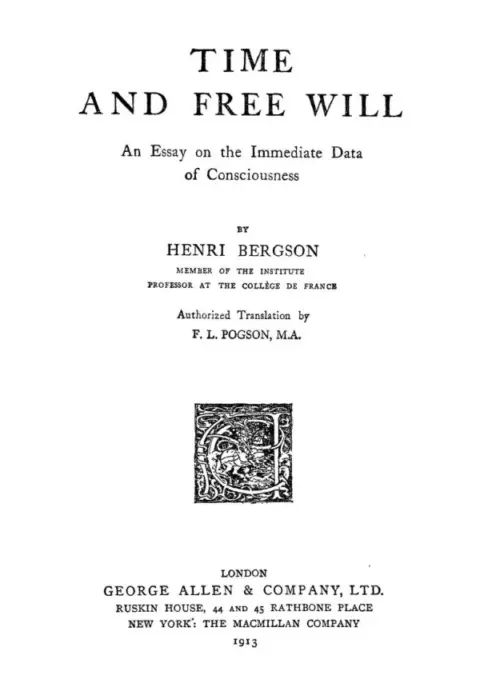
"Time and Free Will: An Essay on the Immediate Data of Consciousness" by Henri Bergson is a philosophical work written during the late 19th century. In this essay, Bergson explores the nature of time, consciousness, and the concept of free will, arguing against traditional deterministic views by emphasizing the importance of real duration and qualitative experiences. The opening of the text sets the stage for Bergson's exploration of the intensity of conscious states, questioning how we perceive and measure qualities such as emotions and sensations. He challenges the notion that these qualitative experiences can be quantified like physical magnitudes, advocating instead for an understanding of consciousness as a complex, interconnected flow of experiences. This critical examination of sensory intensity is just the beginning of Bergson's deeper inquiry into the relationship between consciousness and free will, preparing the reader for a philosophical journey that blends empirical observations with intuitive understanding.
Introduction adapted from the source catalogue; source summaries may be automatically generated.
Free to read · English · 66,044 words · No account needed
MAKE TIME FOR A GOOD BOOK
On by default. Untick to stop anonymous reading totals. Each page counts after 10 seconds in view. How this works.
Anonymous counting is on unless you have switched it off.
[Sidenote: Pleasures compared by bodily inclination.]
We have hardly any other means of comparing several pleasures with one another. What do we mean by a greater pleasure except a pleasure that is preferred? And what can our preference be, except a certain disposition of our organs, the effect of which is that, when two pleasures are offered simultaneously to our mind, our body inclines towards one of them? Analyse this inclination itself and you will find a great many little movements which begin and become perceptible in the organs concerned, and even in the rest of the body, as if the organism were coming forth to meet the pleasure as soon as it is pictured. When we define inclination as a movement, we are not using a metaphor. When confronted by several pleasures pictured by our mind, our body turns towards one of them spontaneously, as though by a reflex action. It rests with us to check it, but the attraction of the pleasure is nothing but this movement that is begun, and the very keenness of the pleasure, while we enjoy it, is merely the inertia of the organism, which is immersed in it and rejects every other sensation. Without this vis inertiae of which we become conscious by the very resistance which we offer to anything that might distract us, pleasure would be a state, but no longer a magnitude. In the moral as in the physical world, attraction serves to define movement rather than to produce it.
[Sidenote: The intensity of representative sensations. Many also affective and intensity is measured by reaction called forth. In others a new element enters.]
We have studied the affective sensations separately, but we must now notice that many representative sensations possess an affective character, and thus call forth a reaction on our part which we take into account in estimating their intensity. A considerable increase of light is represented for us by a characteristic sensation which is not yet pain, but which is analogous to dazzling. In proportion as the amplitude of sound-vibrations increases, our head and then our body seem to us to vibrate or to receive a shock. Certain representative sensations, those of taste, smell and temperature, have a fixed character of pleasantness or unpleasantness. Between flavours which are more or less bitter you will hardly distinguish anything but differences of quality; they are like different shades of one and the same colour. But these differences of quality are at once interpreted as differences of quantity, because of their affective character and the more or less pronounced movements of reaction, pleasure or repugnance, which they suggest to us. Besides, even when the sensation remains purely representative, its external cause cannot exceed a certain degree of strength or weakness without inciting us to movements which enable us to measure it. Sometimes indeed we have to make an effort to perceive this sensation, as if it were trying to escape notice; sometimes on the other hand it obsesses us, forces itself upon us and engrosses us to such an extent that we make every effort to escape from it and to remain ourselves. In the former case the sensation is said to be of slight intensity, and in the latter case very intense. Thus, in order to perceive a distant sound, to distinguish what we call a faint smell or a dim light, we strain all our faculties, we "pay attention." And it is just because the smell and the light thus require to be reinforced by our efforts that they seem to us feeble. And, inversely, we recognize a sensation of extreme intensity by the irresistible reflex movements to which it incites us, or by the powerlessness with which it affects us. When a cannon is fired off close to our ears or a dazzling light suddenly flares up, we lose for an instant the consciousness of our personality; this state may even last some time in the case of a very nervous subject. It must be added that, even within the range of the so-called medium intensities, when we are dealing on even terms with a representative sensation, we often estimate its importance by comparing it with another which it drives away, or by taking account of the persistence with which it returns. Thus the ticking of a watch seems louder at night because it easily monopolizes a consciousness almost empty of sensations and ideas. Foreigners talking to one another in a language which we do not understand seem to us to speak very loudly, because their words no longer call up any ideas in our mind, and thus break in upon a kind of intellectual silence and monopolize our attention like the ticking of a watch at night. With these so-called medium sensations, however, we approach a series of psychic states, the intensity of which is likely to possess a new meaning. For, in most cases, the organism hardly reacts at all, at least in a way that can be perceived; and yet we still make a magnitude out of the pitch of a sound, the intensity of a light, the saturation of a colour. Doubtless, a closer observation of what takes place in the whole of the organism when we hear such and such a note or perceive such and such a colour has more than one surprise in store for us. Has not C. Féré shown that every sensation is accompanied by an increase in muscular force which can be measured by the dynamometer?[16] But of an increase of this kind there is hardly any consciousness at all, and if we reflect on the precision with which we distinguish sounds and colours, nay, even weights and temperatures, we shall easily guess that some new element must come into play in our estimate of them.
Your reading position is saved on this browser. Take it to another device with a library code. Reading pages adapt to text, rather than matching a printed edition.
Henri Bergson
Henri Bergson
Henri Bergson
BEHIND THE BOOK
This eBook is for the use of anyone anywhere in the United States and most other parts of the world at no cost and with almost no restrictions whatsoever. You may copy it, give it away or re-use it under the terms of the Project Gutenberg License included with this eBook or online at www.gutenberg.org. If you are not located in the United States, you will have to check the laws of the country where you are located before using this eBook. Read the source licence.
The original source file, including credits and licence, is retained by this library. Request an original-format copy at no charge. Please include the book title and Project Gutenberg identifier #56852.
KEEP YOUR CURIOSITY GOING

David Patterson (Spirit) Hatch
Coulson Kernahan

Ralph Waldo Emerson
Frances Wright

Edwin Abbott Abbott

Joseph Droz