THE CLASSIC COLLECTION✦Creative EvolutionCLASSIC FREE BOOKS
Creative Evolution
Henri Bergson
THE CLASSIC COLLECTION · 1900
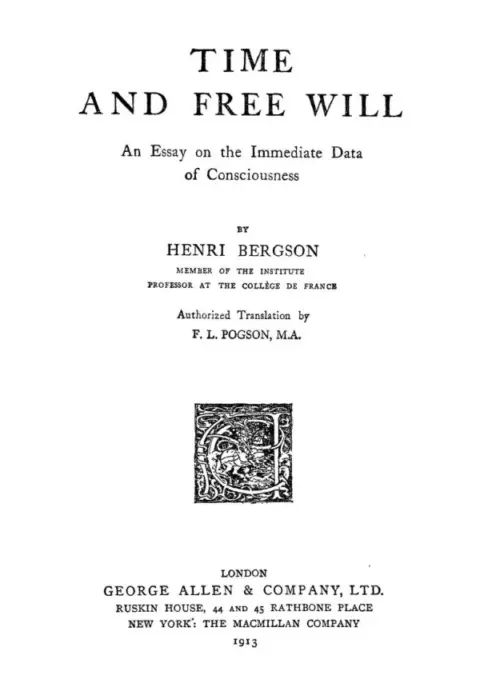
"Time and Free Will: An Essay on the Immediate Data of Consciousness" by Henri Bergson is a philosophical work written during the late 19th century. In this essay, Bergson explores the nature of time, consciousness, and the concept of free will, arguing against traditional deterministic views by emphasizing the importance of real duration and qualitative experiences. The opening of the text sets the stage for Bergson's exploration of the intensity of conscious states, questioning how we perceive and measure qualities such as emotions and sensations. He challenges the notion that these qualitative experiences can be quantified like physical magnitudes, advocating instead for an understanding of consciousness as a complex, interconnected flow of experiences. This critical examination of sensory intensity is just the beginning of Bergson's deeper inquiry into the relationship between consciousness and free will, preparing the reader for a philosophical journey that blends empirical observations with intuitive understanding.
Introduction adapted from the source catalogue; source summaries may be automatically generated.
Free to read · English · 66,044 words · No account needed
MAKE TIME FOR A GOOD BOOK
On by default. Untick to stop anonymous reading totals. Each page counts after 10 seconds in view. How this works.
Anonymous counting is on unless you have switched it off.
It is certainly not obvious at first sight how this hypothesis simplifies the problem. For we are trying to find what there can be in common, from the point of view of magnitude, between a physical phenomenon and a state of consciousness, and we seem to have merely turned the difficulty round by making the present state of consciousness a sign of the future reaction, rather than a psychic translation of the past stimulus. But the difference between the two hypotheses is considerable. For the molecular disturbances which were mentioned just now are necessarily unconscious, since no trace of the movements themselves can be actually perceived in the sensation which translates them. But the automatic movements which tend to follow the stimulus as its natural outcome are likely to be conscious as movements: or else the sensation itself, whose function is to invite us to choose between this automatic reaction and other possible movements, would be of no avail. The intensity of affective sensations might thus be nothing more than our consciousness of the involuntary movements which are being begun and outlined, so to speak, within these states, and which would have gone on in their own way if nature had made us automata instead of conscious beings.
[Sidenote: Intensity of a pain estimated by extent of organism
affected.]
If such be the case, we shall not compare a pain of increasing intensity to a note which grows louder and louder, but rather to a symphony, in which an increasing number of instruments make themselves heard. Within the characteristic sensation, which gives the tone to all the others, consciousness distinguishes a larger or smaller number of sensations arising at different points of the periphery, muscular contractions, organic movements of every kind: the choir of these elementary psychic states voices the new demands of the organism, when confronted by a new situation. In other words, we estimate the intensity of a pain by the larger or smaller part of the organism which takes interest in it. Richet[12] has observed that the slighter the pain, the more precisely is it referred to a particular spot; if it becomes more intense, it is referred to the whole of the member affected. And he concludes by saying that "the pain spreads in proportion as it is more intense."[13] We should rather reverse the sentence, and define the intensity of the pain by the very number and extent of the parts of the body which sympathize with it and react, and whose reactions are perceived by consciousness. To convince ourselves of this, it will be enough to read the remarkable description of disgust given by the same author: "If the stimulus is slight there may be neither nausea nor vomiting.... If the stimulus is stronger, instead of being confined to the pneumo-gastric nerve, it spreads and affects almost the whole organic system. The face turns pale, the smooth muscles of the skin contract, the skin is covered with a cold perspiration, the heart stops beating: in a word there is a general organic disturbance following the stimulation of the medulla oblongata, and this disturbance is the supreme expression of disgust."[14] But is it nothing more than its expression? In what will the general sensation of disgust consist, if not in the sum of these elementary sensations? And what can we understand here by increasing intensity, if it is not the constantly increasing number of sensations which join in with the sensations already experienced? Darwin has drawn a striking picture of the reactions following a pain which becomes more and more acute. "Great pain urges all animals ... to make the most violent and diversified efforts to escape from the cause of suffering.... With men the mouth may be closely compressed, or more commonly the lips are retracted with the teeth clenched or ground together.... The eyes stare wildly ... or the brows are heavily contracted. Perspiration bathes the body.... The circulation and respiration are much affected."[15] Now, is it not by this very contraction of the muscles affected that we measure the intensity of a pain? Analyse your idea of any suffering which you call extreme: do you not mean that it is unbearable, that is to say, that it urges the organism to a thousand different actions in order to escape from it? I can picture to myself a nerve transmitting a pain which is independent of all automatic reaction; and I can equally understand that stronger or weaker stimulations influence this nerve differently. But I do not see how these differences of sensation would be interpreted by our consciousness as differences of quantity unless we connected them with the reactions which usually accompany them, and which are more or less extended and more or less important. Without these subsequent reactions, the intensity of the pain would be a quality, and not a magnitude.
Your reading position is saved on this browser. Take it to another device with a library code. Reading pages adapt to text, rather than matching a printed edition.
Henri Bergson
Henri Bergson
Henri Bergson
BEHIND THE BOOK
This eBook is for the use of anyone anywhere in the United States and most other parts of the world at no cost and with almost no restrictions whatsoever. You may copy it, give it away or re-use it under the terms of the Project Gutenberg License included with this eBook or online at www.gutenberg.org. If you are not located in the United States, you will have to check the laws of the country where you are located before using this eBook. Read the source licence.
The original source file, including credits and licence, is retained by this library. Request an original-format copy at no charge. Please include the book title and Project Gutenberg identifier #56852.
KEEP YOUR CURIOSITY GOING

David Patterson (Spirit) Hatch
Coulson Kernahan

Ralph Waldo Emerson
Frances Wright

Edwin Abbott Abbott

Joseph Droz