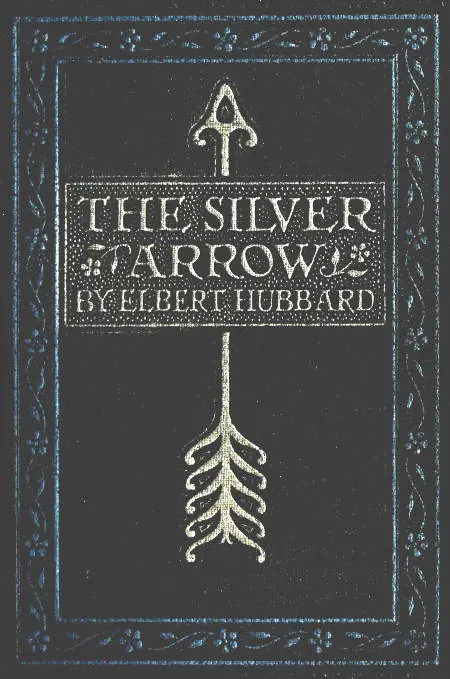
The Silver Arrow
Elbert Hubbard
THE CLASSIC COLLECTION · 1899
Time and chance by Elbert Hubbard. Explore this classic work in a free online edition. Subjects include Biographical fiction; Brown, John, 1800-1859 -- Fiction; Abolitionists -- Fiction. Read the locally hosted text below, adjust the reading display, and continue where you left off.
Introduction adapted from the source catalogue; source summaries may be automatically generated.
Free to read · English · 124,003 words · No account needed
MAKE TIME FOR A GOOD BOOK
On by default. Untick to stop anonymous reading totals. Each page counts after 10 seconds in view. How this works.
Anonymous counting is on unless you have switched it off.
“Good-evening, sir—where is he—where is Captain Brown, Mother?”
Richard had come into the room, cast his eye around, and was out again in
the hall.
“Here he is, here! this is Captain Brown; why, there must be some mistake—you said that you knew him.”
“I am John Brown. Colonel Brydges does not know me on account of my
wearing no beard.”
“Can it be possible?” exclaimed the Colonel. He turned the visitor around twice and gave him a most cordial, yea, even affectionate greeting.
Then Ruth Crosby appeared—white-haired, but with the vigor that comes with earnest purpose and systematic employment. The Colonel’s greeting had thawed Captain Brown. Tears came to his eyes as he kissed Ruth’s check—sentiment, after all, was not dead. And now the ice was all thawed—they shook hands again all ’round.
“Can’t we have supper in here, Mother, say yes, please—just we four?”
And so the mother smiled on her big boy, and said: “Why, for this once, of course—we don’t have Captain Brown with us often.”
A white spread was put over the center table, and a colored girl brought in the tea and toast and the poached eggs and the hot biscuit, and they drew up their chairs.
“I resigned my commission, Captain—resigned to come home and take care of my fanatical mother!”
“Rather he resigned and came here so that the mother could take care of her fanatical son,” laughingly said Mrs. Brydges.
“I hardly understand,” said Brown.
“Why, you converted him.”
“I—to what?”
“Abolitionism.”
“But we did not argue the question.”
“It was well you did not, or it would have only set Richard deeper in his heresy—it was your life that did it!”
“You mystify me.”
“Why, Richard wrote me that he came near saying to you, ‘Almost thou persuadest me to be a Christian,’ and now he is so over-zealous on the subject of Emancipation that I have to restrain him.”
“Don’t worry, it won’t hurt him.”
“We could not convert him—he thought us only silly women, but when he saw you, your heroism won him,” said Ruth.
Brown did not hear what she said. He glanced at her and then at Margaret. These two women looked much alike; beautiful faces they were; they shone with the beauty that comes with years devoted to high thinking, that subtle, feminine beauty that only is revealed where spiritual aspiration keeps pace with intellect. Ruth’s contact with Margaret had worked a wondrous change for good in both. Engaged in the same work, thinking the same thoughts, living the same life, they had grown alike.
Your reading position is saved on this browser. Take it to another device with a library code. Reading pages adapt to text, rather than matching a printed edition.
Elbert Hubbard
Elbert Hubbard
Elbert Hubbard
Elbert Hubbard
BEHIND THE BOOK
This eBook is for the use of anyone anywhere in the United States and most other parts of the world at no cost and with almost no restrictions whatsoever. You may copy it, give it away or re-use it under the terms of the Project Gutenberg License included with this eBook or online at www.gutenberg.org. If you are not located in the United States, you will have to check the laws of the country where you are located before using this eBook. Read the source licence.
The original source file, including credits and licence, is retained by this library. Request an original-format copy at no charge. Please include the book title and Project Gutenberg identifier #79783.
KEEP YOUR CURIOSITY GOING
Coulson Kernahan

Maurice Baring
Frances Wright
Cécile Tormay

Frederic Jesup Stimson

W. H. P. (William Henry Pope) Jarvis