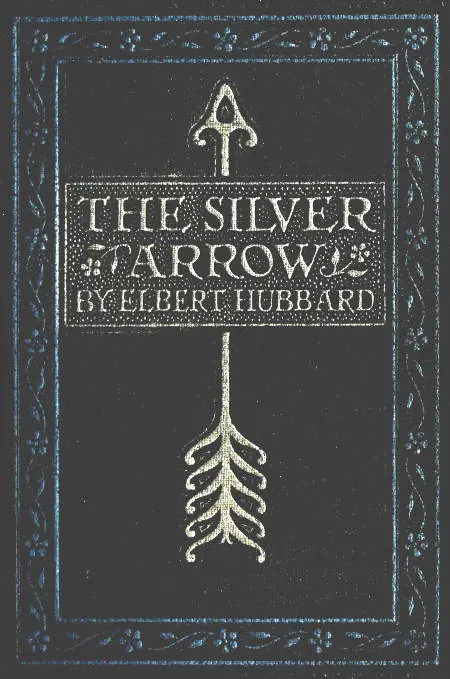
The Silver Arrow
Elbert Hubbard
THE CLASSIC COLLECTION · 1899
Time and chance by Elbert Hubbard. Explore this classic work in a free online edition. Subjects include Biographical fiction; Brown, John, 1800-1859 -- Fiction; Abolitionists -- Fiction. Read the locally hosted text below, adjust the reading display, and continue where you left off.
Introduction adapted from the source catalogue; source summaries may be automatically generated.
Free to read · English · 124,003 words · No account needed
MAKE TIME FOR A GOOD BOOK
On by default. Untick to stop anonymous reading totals. Each page counts after 10 seconds in view. How this works.
Anonymous counting is on unless you have switched it off.
Whenever two men meet for the first time there is usually a swift, unspoken understanding, and one acknowledges the other master.
Captain Carver was large, stout, good-natured, glib of tongue, sociable, and ready. But now his wit did not seem to fit, his jokes fell flat, and his loud, easy ways were out of keeping. He sat on the porch and tilted nervously on one leg of the chair: “So you are from York State, be you?”
“Yes,” said the visitor.
“What part o’ York State?”
“The northern.”
“Been here long? ’Scuse my askin’.”
“I have just arrived. I came purposely to see you.”
Then there was a pause. Captain Carver coughed, spat, removed a big chew of tobacco and replaced it with a larger one. He handed the pouch of tobacco towards the visitor, who refused it with a half smile.
“Hem—ah—a’ purpose to see me?”
“Yes.”
“And where hev I saw you before—your face is familiar!”
“You never saw me before.”
“And you said, I b’lieve, that you did not care to—talk about your errand till after dinner.”
“That is what I said.”
“Wall, the horn has blowed, less go in.”
The visitor was a smooth-shaven, elderly man. He wore a seedy suit of black and a black stock. He carried a cotton umbrella, and about his neck was a black tape, fastened to a silver watch.
Captain Carver felt strangely uneasy in the presence of this self-contained stranger; he would have liked to throttle him on the spot; he half believed the visitor was a preacher, so he dared not swear; his language had to be curtailed, and was awkward in the extreme. After dinner the guest and host again moved out on the veranda.
“Stranger, you are a perfect gent, but your manner is dam queer—leastways peculiar, that is, see? no ’fense. Now tell me what you want!”
“Have you a room where we can talk together by ourselves?”
“’Taint necessary, is it?”
“Yes.”
Carver now evidently thought he had a lunatic to deal with and deemed it best to humor him. He led the way into a little musty parlor and threw open the window. The visitor followed and closed the door.
“My name is Brown. Five of my sons live across the line in Kansas, and as you drove away their cattle, I have come to see about getting them back.”
“Who drove away their cattle?”
“You.”
“It’s a lie.”
“Sit down, please, we had better be calm about this matter.”
“Did you say I stole those cattle?”
“Yes.”
“If you wasn’t an old man, I’d kill you.”
Your reading position is saved on this browser. Take it to another device with a library code. Reading pages adapt to text, rather than matching a printed edition.
Elbert Hubbard
Elbert Hubbard
Elbert Hubbard
Elbert Hubbard
BEHIND THE BOOK
This eBook is for the use of anyone anywhere in the United States and most other parts of the world at no cost and with almost no restrictions whatsoever. You may copy it, give it away or re-use it under the terms of the Project Gutenberg License included with this eBook or online at www.gutenberg.org. If you are not located in the United States, you will have to check the laws of the country where you are located before using this eBook. Read the source licence.
The original source file, including credits and licence, is retained by this library. Request an original-format copy at no charge. Please include the book title and Project Gutenberg identifier #79783.
KEEP YOUR CURIOSITY GOING
Coulson Kernahan

Maurice Baring
Frances Wright
Cécile Tormay

Frederic Jesup Stimson

W. H. P. (William Henry Pope) Jarvis