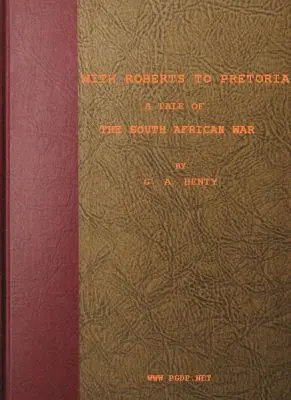
With Roberts to Pretoria: A Tale of The South African War
G. A. (George Alfred) Henty
THE CLASSIC COLLECTION · 1895
"Through Russian Snows: A Story of Napoleon's Retreat from Moscow" by G. A. Henty is a historical novel written in the late 19th century. This work vividly recounts the harrowing retreat of Napoleon's army from Moscow, depicted through the eyes of a central character, Sergeant Julian Wyatt, who embodies the spirit and challenges faced during this tumultuous time. Henty is known for his engaging storytelling that combines adventure with historical detail, making this novel likely to appeal to readers interested in both historical narratives and character-driven plots. At the start of the narrative, we are introduced to the Wyatt brothers, Julian and Frank, following the death of their father, Colonel Wyatt. The opening chapter sets up their contrasting personalities and roles within their family dynamic, particularly highlighting Julian's carefree spirit and Frank's more serious demeanor. The preface mentions the complexity and scale of the campaign against Russia, suggesting a historical backdrop of significant events. As Julian's character unfolds, we see tensions between responsibility and youthful exuberance, setting the stage for his eventual involvement in the historical events that will link back to the retreat from Moscow. The narrative promises a journey filled with wild adventures and moral quandaries against the larger canvas of history.
Introduction adapted from the source catalogue; source summaries may be automatically generated.
Free to read · English · 116,513 words · No account needed
MAKE TIME FOR A GOOD BOOK
On by default. Untick to stop anonymous reading totals. Each page counts after 10 seconds in view. How this works.
Anonymous counting is on unless you have switched it off.
One morning when Frank was dressing, the servant came up and told him that a fisherman, who said his name was Bill Bostock, wanted to speak to him. As he had often been out with Julian in the man's boat, he put on his jacket and ran to the door.
"Good morning, Bill!" he said; "what is it?"
"I will talk with you outside, sir, if you don't mind."
A good deal surprised Frank put on his cap and went out with him.
"There has been a bad business, Master Frank, a mighty bad job."
"What sort of a job, Bill?"
"A smuggling affair, Master Frank. There was a fight. I hears one of the revenue men was killed. I don't know as that is so, but some of them have been knocked about, and have got some pistol wounds, no doubt. But that ain't the worst part of the business. Mr. Julian is among those as has been caught."
"Julian!" Frank exclaimed in astonishment. "Why, what in the world had Julian got to do with it?"
"Well, sir," the sailor said apologetically, "you see it was like this. Mr. Julian is a young gentleman as loves a bit of a spree, and he has been out many a night with some of us to see a cargo run."
Frank uttered an exclamation of surprise and consternation.
"I thought perhaps as you knowed it, sir."
"I never dreamt of such a thing, Bill. How could Julian have been so mad as to mix himself up in such a business? I suppose this is your doing; you must have led him into this mischief."
"No, sir," the sailor said in an aggrieved voice. "How was I to lead a young gentleman like your brother into a thing as he didn't choose to do? I don't say as I didn't mention to him, promiscuous like, that I lent a hand some times in running a cargo; but how was I to know as he would up and say, 'I will go with you some night, Bill.' Well, I argues with him, and I points out to him as he might get into a scrape; but, says he, 'I am not going to take no share in it, but just want to look on and see the fun,' as he calls it. I points out to him as it was not always fun, but he puts that aside, and, says he, it would not be fun unless there was a little excitement about it. He promised me faithful that he would always cut and run as soon as he heard there was any talk of the revenue men a-coming, and what was I to do? I don't say, sir, as how if it had been you I would have taken you with me, 'cause you are young, you see, and I should have felt as I was 'sponsible for you. But Mr. Julian is a man now, and when he says, 'I mean to go with you anyhow, Bill,' it was not for me to say, you sha'n't go. Mr. Julian, he is a sort of gent that gets over one somehow, and there ain't no saying 'no' to him."
Your reading position is saved on this browser. Take it to another device with a library code. Reading pages adapt to text, rather than matching a printed edition.
G. A. (George Alfred) Henty
G. A. (George Alfred) Henty
G. A. (George Alfred) Henty
G. A. (George Alfred) Henty
BEHIND THE BOOK
This eBook is for the use of anyone anywhere in the United States and most other parts of the world at no cost and with almost no restrictions whatsoever. You may copy it, give it away or re-use it under the terms of the Project Gutenberg License included with this eBook or online at www.gutenberg.org. If you are not located in the United States, you will have to check the laws of the country where you are located before using this eBook. Read the source licence.
The original source file, including credits and licence, is retained by this library. Request an original-format copy at no charge. Please include the book title and Project Gutenberg identifier #30457.
KEEP YOUR CURIOSITY GOING
Cécile Tormay

Moritz Busch
Coulson Kernahan
John L. Ransom

Maurice Baring
Frances Wright