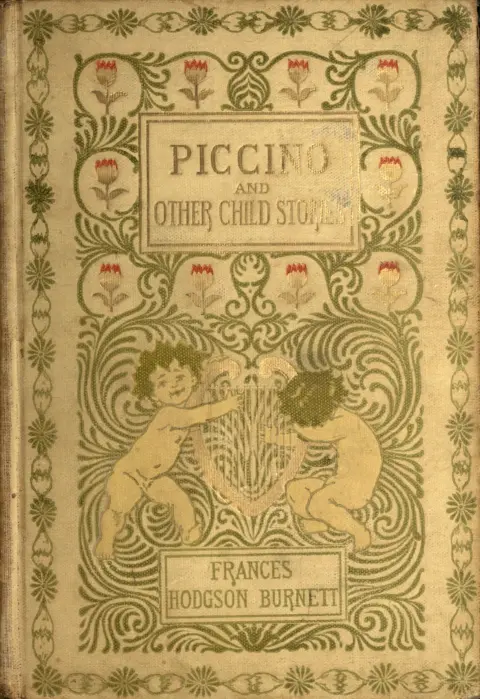
Piccino, and other child stories
Frances Hodgson Burnett
THE CLASSIC COLLECTION · 1881
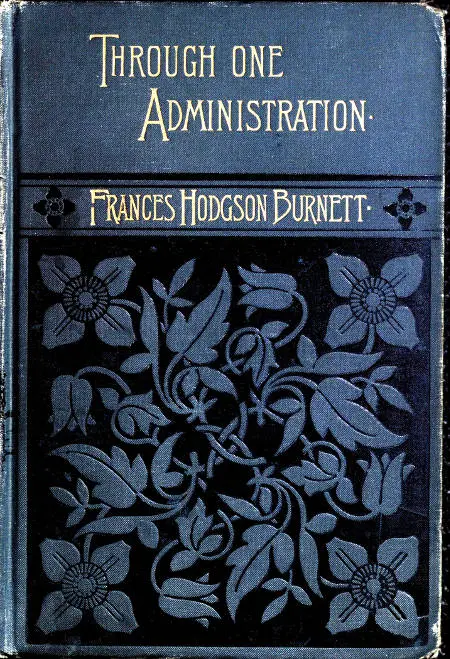
"Through One Administration" by Frances Hodgson Burnett is a novel written in the late 19th century. The story centers around the young officer Philip Tredennis, who visits Washington before heading to a military post in the West. During his visit, he interacts with his relative, Professor Herrick, and learns of the professor's daughter, Bertha, who is about to 'come out' into society, a pivotal moment for young women of that era. At the start of the novel, we are introduced to the setting of Washington, D.C., eight years before the significant events unfold. Tredennis meets Professor Herrick, a quiet entomologist, and learns about his daughter Bertha, who is arriving home from school. The professor is both absent-minded and somewhat detached when discussing his daughter, revealing the dynamic between them. Bertha's arrival is marked by excitement and anticipation for her first social season, with her character depicted as lively and charming. As Tredennis interacts with Bertha, hints of deeper feelings and complexities begin to emerge, foreshadowing the emotional entanglements that will develop as the story progresses.
Introduction adapted from the source catalogue; source summaries may be automatically generated.
Free to read · English · 183,113 words · No account needed
MAKE TIME FOR A GOOD BOOK
On by default. Untick to stop anonymous reading totals. Each page counts after 10 seconds in view. How this works.
Anonymous counting is on unless you have switched it off.
"We were very much pleased to see him, though we do not think he looks very well," she said. "I think you will find him talking to Professor Borrowdale, who has just returned from Central America."
She gave Bertha a kind glance of scrutiny.
"Are you looking very well?" she said. "I am afraid you are not. That is not a good way to begin a season."
"I am afraid," said Bertha, laughing, "that I have not chosen my dress well. Colonel Tredennis told me, a few moments ago, that I ought to be at home."
They passed on shortly afterward, and, on the way to the other room, Bertha was unusually silent. Tredennis wondered what she was thinking of, until she suddenly looked up at him and spoke.
"Am I so very haggard?" she said.
"I should not call it haggard," he answered. "You don't look very well."
She gave her cheek a little rub with her gloved hand.
"No; you should not call it haggard," she said, "that is true. It is bad enough not to look well. One should always have a little rouge in one's pocket. But you will see that the excitement will do me good."
"Will it, Bertha?" said the colonel.
But, whether the effect it produced upon her was a good or bad one, it was certainly strong enough. The room was full of people she knew or wished to know. She was stopped at every step by those who spoke to her, exchanging gay speeches with her, paying her compliments, giving her greeting. Dazzling young dandies forgot their indifference to the adulation of the multitude, in their eagerness to make their bows and their bon mots before her; their elders and superiors were as little backward as themselves, and in a short time she had gathered quite a little court about her, in which there was laughter and badinage, and an exhilarating exchange of gayeties. The celebrated scientist joined the circle, the newspaper man made his way into it, and a stately, gray-haired member of the Supreme Bench relaxed his grave face in it, and made more clever and gallant speeches than all his younger rivals put together; it was even remarked that the Oriental visage of the Chinese ambassador himself exhibited an expression of more than slight curiosity and interest. He addressed a few words to his interpreter as he passed. But somehow Colonel Tredennis found himself on the outer edge of the enchanted ground. It was his own fault, perhaps. Yes, it was his own fault, without a doubt. Such changes were too rapid for him, as he himself had said before. He did not understand them; they bewildered and wounded him, and gave him a sense of insecurity, seeming to leave him nothing to rely on. Was it possible that sadness or fatigue which could be so soon set aside and lost sight of could be very real? And if these things which had so touched his heart were unreal and caprices of the moment, what was there left which might not be unreal too? Could she look pale, and make her voice and her little hand tremulous at will when she chose to produce an effect, and why should it please her to produce effects upon him? She had never cared for him, or shown kindness or friendly feeling for him, but in those few brief days in Virginia. Was she so flippant, such a coquette and trifler that, when there was no one else to play her pretty tricks upon, she must try them on him and work upon his sympathies in default of being able to teach him the flatteries and follies of men who loved her less? He had heard of women who were so insatiable in their desire for sensation that they would stoop to such things, but he did not believe he had ever met one. Perhaps he had met several, and had been too ingenuous and generous to understand their wiles and arts. At any rate, they had always been myths to him, and it seemed to him that he himself, as well as all existence, must have changed when he could even wonder if such a thing might be true of Bertha. But nothing could be more certain than that there were no longer any traces of her weariness about her. A brilliant color glowed in her cheeks, her eyes were as bright as diamonds, there was something,--some vividness about her before which every other woman in the room paled a little, though there were two or three great beauties present, and she had never taken the attitude of a beauty at all. The colonel began to see, at last, that there was a shade of something else, too, in her manner, from which it had always before been free. In the midst of all her frivolities she had never been reckless, and there had never been any possibility that the looker-on could bear away with him any memory which had not the charm of fineness about it. But to-night, as one man hung over her chair, and others stood around and about it, one holding her fan, another wearing in his coat a rose which had fallen from her bouquet, all sharing her smiles and vying in their efforts to win them, Tredennis turned away more than once with a heavy heart.
Your reading position is saved on this browser. Take it to another device with a library code. Reading pages adapt to text, rather than matching a printed edition.
Frances Hodgson Burnett
Frances Hodgson Burnett
Frances Hodgson Burnett

Frances Hodgson Burnett
BEHIND THE BOOK
This eBook is for the use of anyone anywhere in the United States and most other parts of the world at no cost and with almost no restrictions whatsoever. You may copy it, give it away or re-use it under the terms of the Project Gutenberg License included with this eBook or online at www.gutenberg.org. If you are not located in the United States, you will have to check the laws of the country where you are located before using this eBook. Read the source licence.
The original source file, including credits and licence, is retained by this library. Request an original-format copy at no charge. Please include the book title and Project Gutenberg identifier #58325.
KEEP YOUR CURIOSITY GOING
Coulson Kernahan

Maurice Baring
Frances Wright
Cécile Tormay

Frederic Jesup Stimson

W. H. P. (William Henry Pope) Jarvis